Why Fourth-Grade History Disappears So Quickly
Many homeschooling parents eventually ask some version of this question: “Are we doing too much memorization of dates and names instead of actual understanding?”
The question often comes after a frustrating experience. A child studies a chapter on ancient civilizations, remembers the required names long enough to pass a quiz, and then two weeks later seems to have forgotten nearly everything. The dates are gone. The rulers are gone. The vocabulary words are fuzzy. The parent wonders whether the child was careless, whether the curriculum moved too quickly, or whether history simply “doesn’t stick” for this student.
This article looks at one specific part of that larger question: why history learned as disconnected information disappears so quickly. The problem is not always that the child failed to study. Often, the problem is that the information was learned in a form the mind is not very good at keeping.
The Fourth-Grade Mystery
A familiar homeschool pattern goes like this:
A child studies the explorers, the colonies, ancient Egypt, Rome, or the Middle Ages. The child can answer the questions at the end of the lesson. The quiz goes well enough. For a few days, the information seems secure.
Then, not long afterward, the child cannot explain what happened, why it mattered, or how the pieces fit together.
This can feel especially discouraging because the child really did appear to know it. The parent saw the correct answers. The child may have repeated the facts several times. So why did the learning vanish?
One answer is that temporary recall and durable understanding are not the same thing. A child can hold information long enough to reproduce it without having built the deeper structure needed to remember it later.
That distinction matters. Memorizing a date for Friday’s quiz is different from understanding what changed before and after that event. Naming a king is different from understanding the pressures, choices, conflicts, and consequences surrounding his reign. Reciting “476 AD” is different from understanding the long decline of Roman political power in the West.
When children forget quickly, that forgetting may be telling us something important. It may not be saying, “This child cannot learn history.” It may be saying, “This material was never connected strongly enough to become lasting knowledge.”
What Cognitive Science Suggests About Forgetting
Human memory does not store all information equally well. Isolated facts are fragile. Connected knowledge is stronger.
When a child learns a new fact, the mind needs some way to organize it. Cognitive scientists often use the idea of a “schema” to describe this kind of mental structure. A schema is a framework that helps information make sense. It gives new facts somewhere to go.
For example, the isolated statement “Julius Caesar was assassinated in 44 BC” may be remembered briefly. But it becomes more durable when connected to a larger structure:
Caesar gained unusual power.
Some Roman senators feared monarchy.
The Roman Republic was already under strain.
His assassination did not restore stability.
Civil war followed.
The Roman political system changed.
Now the date is not floating alone. It sits inside a network of meaning. The child has more than one way to retrieve it. They may remember the story, the political tension, the betrayal, the consequences, or the shift from republic toward empire. Any of those connections can help recover the fact.
This is why understanding supports memory. It does not replace facts. It gives facts a place to live.
Working memory also matters. Children can only hold a limited amount of new information in mind at once. When a lesson presents many names, dates, locations, and terms without enough structure, the child may be overloaded. They may manage short-term performance, especially with review, but the material remains weakly organized.
That kind of learning is vulnerable. It can look successful on Monday and disappear by the following month.
Why Dates Are Especially Vulnerable
Dates are often the first things to vanish because, by themselves, they can feel arbitrary.
To an adult with historical background, a date may carry meaning. “1776” is not just a number; it evokes revolution, independence, Enlightenment ideas, colonial grievances, war, and nation-building. “1066” may bring to mind the Norman Conquest, English monarchy, language change, feudalism, and medieval political restructuring.
But to a child who has not built those connections, a date may be little more than a number attached to a name.
That does not mean dates are unimportant. Chronology matters in history. Sequence matters. It matters whether one event happened before or after another. It matters that the American Revolution preceded the French Revolution. It matters that the fall of the Western Roman Empire came after centuries of political, military, economic, and social change.
The issue is not whether children should know dates. The issue is whether dates are being taught as anchors of meaning or as isolated labels.
A date connected to a story, a cause, a conflict, or a turning point has a better chance of lasting. A date memorized only as an answer to “When did this happen?” is much easier to lose.
What Understanding Does Differently
Understanding changes the way facts are stored.
When a child understands an event, they can explain relationships:
Why did this happen?
What changed because of it?
Who benefited?
Who lost power?
What problem were people trying to solve?
What choices were available?
What were the unintended consequences?
These questions create connections. They turn history from a list into a structure.
Consider two ways of learning about the fall of Rome.
In a memorization-heavy version, the child may learn:
Rome fell in 476 AD.
The last western emperor was Romulus Augustulus.
Germanic groups invaded.
The empire split into eastern and western halves.
Those facts are not useless. But if they remain disconnected, they may not last.
In a more meaning-centered version, the child still encounters those facts, but they are organized around explanation:
Why did the western half of the empire become harder to govern?
How did military pressure affect Roman stability?
Why did economic strain matter?
How did political instability weaken imperial authority?
Why did the eastern empire continue after the western empire fell?
Now the child is not merely holding a list. The child is building a model of decline, pressure, adaptation, and consequence.
That model gives the facts more staying power.
Why Historians Remember More Than Students
Historians do not remember more because they have memorized every fact in isolation. They remember more because their knowledge is organized.
A historian studying Rome already has categories in mind: republic, empire, citizenship, military expansion, patronage, slavery, urban life, provincial administration, religion, law, infrastructure, and political legitimacy. When a new fact appears, it fits somewhere. It connects to prior knowledge.
Students often lack that structure. To them, every name may feel equally new. Every date may feel equally arbitrary. Every event may feel like one more thing to remember.
This explains why a history lesson can overwhelm a child even when the amount of content looks reasonable to an adult. The adult sees patterns. The child sees pieces.
One of the parent’s jobs, then, is not merely to add more pieces. It is to help the child see how the pieces connect.
That may mean slowing down. It may mean asking fewer recall questions and more relationship questions. It may mean revisiting the same idea in different settings. It may mean treating “I forgot” not as the end of the lesson, but as a clue that the original learning needs more meaning.
Historical-Learning Application
Historical learning becomes more durable when students learn to connect facts into explanations.
Take a simple example: “Rome fell in 476 AD.”
A child can memorize that sentence. But what can the child do with it?
If the child only knows the date, the fact is easy to lose. If the child understands the surrounding historical problem, the fact becomes easier to recover.
A parent might ask:
What was Rome like before it fell?
Was the fall sudden or gradual?
What pressures had been building?
Why was the western empire more vulnerable than the eastern empire?
What did “fall” actually mean for ordinary people?
Did Roman culture disappear, or did parts of it continue?
These questions help the child think historically. They also support memory. Each question creates another pathway back to the event.
The same pattern works across history.
Instead of only asking, “When was the Declaration of Independence signed?” parents can also ask, “Why did the colonies believe independence had become necessary?”
Instead of only asking, “Who was Hammurabi?” parents can ask, “Why would a ruler want laws carved publicly in stone?”
Instead of only asking, “What year did the printing press spread through Europe?” parents can ask, “Why would cheaper books change religion, science, education, and politics?”
These questions do not eliminate factual knowledge. They make factual knowledge more meaningful.
Practical Takeaways
For homeschooling parents, the practical shift is not from “facts” to “no facts.” It is from isolated facts to connected facts.
A few principles can help.
First, ask “why” and “so what” more often than “when.” Dates and names matter, but they should usually be connected to causes, consequences, and significance.
Second, build timelines around questions. A timeline that simply lists events may become another memorization task. A timeline organized around a question – “How did Rome change from republic to empire?” – helps children see movement and relationship.
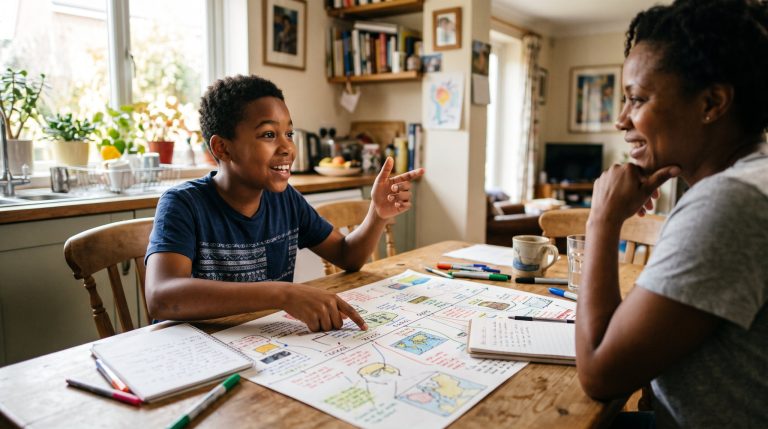
Third, use narration and explanation. When a child retells what happened in their own words, they are not just repeating information. They are organizing it. Narration reveals whether the child has a structure or only fragments.
Fourth, revisit ideas in different contexts. A child may first encounter empire while studying Rome, then revisit the idea when studying Britain, China, or Spain. Each return strengthens the concept.
Fifth, look for signs of connection, not only signs of recall. If a child says, “This reminds me of what happened in Rome,” or “That king had the same problem,” or “They were afraid of losing power,” that may be evidence of deeper learning even if a specific date is missing.
Finally, treat forgetting as feedback. When a child forgets quickly, the answer is not always more drilling. Sometimes the better response is to ask: What was this fact connected to? Did the child understand why it mattered? Did the lesson give the information a meaningful structure?
Conclusion
The fact that children forget history quickly does not prove that history is impossible for them to learn. It also does not prove that all memorization is bad.
It suggests something more useful: memory and understanding are deeply connected.
History learned as disconnected names and dates is often fragile. History learned through causes, consequences, stories, conflicts, decisions, and human experience has more structure. That structure helps children remember because the facts make sense.
This article does not answer the entire question of whether homeschool history includes too much memorization. Other parts of the larger discussion need to consider factual knowledge, historical thinking, source analysis, empathy, chronology, and curriculum design.
But this piece adds an important insight: when history disappears quickly, the problem may not be too little repetition. It may be too little meaning.
Help History Stick by Making Your Child Use It
If your child can remember a history fact on Friday but lose it two weeks later, the answer is not always more drilling. Often, the missing piece is connection. Spot the Anachronism gives your child a repeatable monthly way to practice making those connections: study a historical scene, notice what does not belong, explain why, and return to the details with fresh attention. Instead of treating history as loose names and dates, each activity turns facts into usable visual understanding — the kind your child can retrieve later because it has somewhere to live.
This Article Is Part Of A Larger Series
Question: Are we doing too much memorization of dates and names instead of actual understanding?
Series Position: Article 8 of 11
This article explores one evidence-supported aspect of the larger question. Future articles examine additional research-supported approaches to increasing engagement with history.
Related Facebook Discussions
- This related discussion shows how a historical scene becomes more memorable when its architecture, materials, crowd behavior, lighting, and space all belong to one coherent world.
- This discussion looks at how noticing fatigue and bodily effort can make historical scenes feel more human, concrete, and easier to remember.
- This marketplace discussion gives families a concrete way to revisit historical scenes by asking whether the space feels physically contested by everyday use.