Historical Fiction vs. Textbooks: Why One Often Sparks Interest When the Other Falls Flat
The Child Who Refuses the Textbook but Loves Historical Fiction
This question appears repeatedly across homeschooling communities because it touches a deeper concern:
How do I make history engaging when my child finds it completely boring?
This article explores one specific piece of that larger answer.
The issue may not be history itself.
The issue may be the difference between how textbooks and historical fiction present the past.
Why This Happens So Often
Many parents assume that textbooks represent “real history” while fiction represents entertainment.
From that perspective, a child who prefers novels simply prefers entertainment over learning.
Research and educational experience suggest the situation is more complicated.
When children reject a textbook but embrace historical fiction, they are often responding to differences in presentation rather than differences in subject matter.
Both may describe the same historical period.
Both may involve the same events.
Both may introduce the same historical figures.
Yet they create very different learning experiences.
One frequently presents information through summaries and explanations.
The other presents information through people, experiences, conflicts, and choices.
The child is not necessarily choosing fiction over history.
They may be choosing one way of encountering history over another.
Understanding that distinction is important because it shifts the conversation away from:
“How do I force my child to like history?”
and toward:
“What makes one form of history engaging while another feels flat?”
What Textbooks Often Remove
Textbooks face a difficult challenge.
They must cover large amounts of information efficiently.
To accomplish this, they often compress complex events into brief summaries.
A chapter may need to explain decades of political change, economic development, military conflict, and cultural transformation within a few pages.
The result is often informative.
It is not always engaging.
In the process of condensing information, many textbooks reduce or remove elements that naturally attract human attention:
- uncertainty
- conflict
- emotion
- personal perspective
- sensory experience
- individual decision-making
A textbook might explain that a city was under siege.
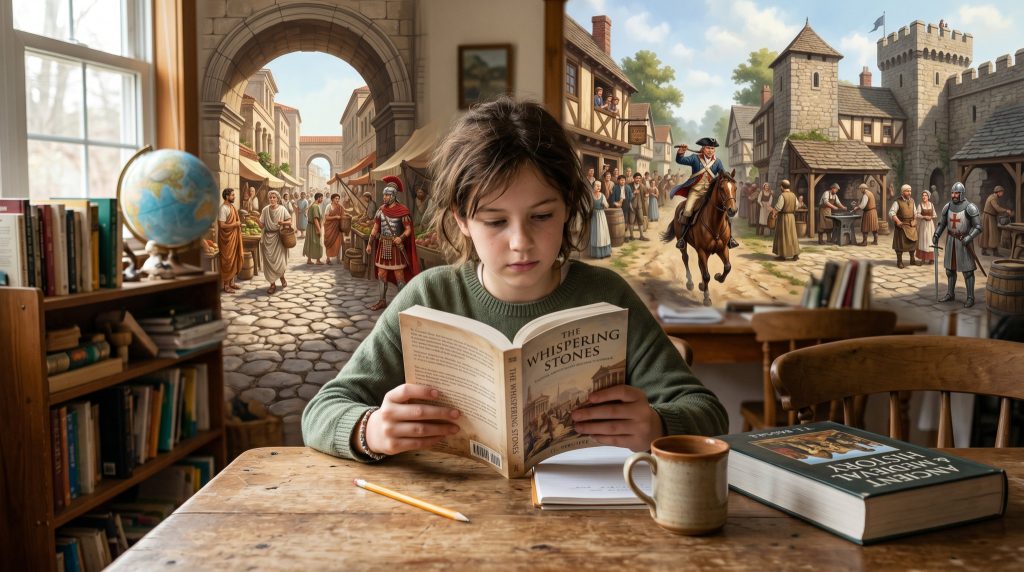
A historical novel may place the reader inside the city.
A textbook may describe a migration.
A historical novel may follow a family experiencing it.
A textbook may summarize a political crisis.
A historical novel may show how that crisis affected ordinary people.
The information may overlap substantially.
The experience does not.
This helps explain why children often describe textbooks as “boring” even when they are interested in the historical period being studied.
What Historical Fiction Adds
Historical fiction succeeds because it supplies many of the elements that compressed instructional materials often lack.
Character Perspective
Children experience events through identifiable individuals.
Rather than learning about “settlers,” they meet specific people.
Rather than studying “soldiers,” they follow particular characters.
Humans connect naturally with other humans.
Emotional Stakes
Historical fiction gives readers reasons to care about outcomes.
Will the family survive?
Will the character escape?
Will the plan succeed?
These questions create investment.
Motivation
Historical fiction frequently explores why people make decisions.
Readers gain insight into fears, hopes, ambitions, loyalties, and pressures.
Motivation transforms events from facts into human experiences.
Conflict and Uncertainty
Stories create momentum because the outcome is not immediately known.
The desire to discover what happens next sustains attention.
Sensory Detail
Historical fiction often helps readers imagine what life may have looked, sounded, smelled, or felt like.
These details make the past feel tangible rather than abstract.
Together, these elements help transform historical information into something meaningful and memorable.
Why Engagement Matters
Some parents worry that engagement is being prioritized over learning.
This concern deserves careful consideration.
However, there is an important reality about education:
Children rarely learn deeply from material they refuse to engage with.
Interest is not the entire goal of education.
But interest often creates the opportunity for education.
A child who voluntarily reads a three-hundred-page historical novel may absorb substantial background knowledge about a period, encounter unfamiliar vocabulary, develop curiosity about historical events, and begin asking questions about the past.
None of this guarantees historical understanding.
But it creates fertile ground for further learning.
Engagement does not replace learning.
It creates conditions that make learning more likely.
The Limits of Historical Fiction
Recognizing the strengths of historical fiction does not require ignoring its limitations.
Historical fiction is not identical to history.
Authors frequently make choices designed to improve narrative flow and reader engagement.
They may:
- invent dialogue
- combine multiple historical figures into one character
- simplify events
- compress timelines
- create fictional protagonists
- speculate about thoughts and motivations
These choices do not necessarily make historical fiction bad.
They simply mean that fiction blends historical evidence with author interpretation.
For homeschooling parents, this limitation can become an educational opportunity.
Instead of asking only:
Did my child enjoy the story?
You can also ask:
Which parts are historically documented?
Which parts might be imagined?
How do we know?
Questions like these encourage children to think critically about historical reconstruction and evidence.
Using Fiction as a Gateway Rather Than an Endpoint
The most productive question may not be whether historical fiction is better than textbooks.
A more useful question is:
How can historical fiction support historical learning?
Historical fiction works especially well as a gateway.
A child becomes interested in a character.
That interest leads to questions.
The questions lead to investigation.
Investigation leads to deeper understanding.
For example:
A novel set in ancient Rome may spark curiosity about gladiators.
That curiosity may lead to research on Roman society.
Research may lead to discussions about slavery, citizenship, politics, or entertainment.
The story becomes the doorway.
Historical inquiry becomes the destination.
This progression preserves both engagement and intellectual rigor.
Historical-Learning Application
Historical fiction can support several important aspects of historical learning.
Understanding
Stories help children understand the lived experiences of people in the past.
Historical events become human experiences rather than abstract summaries.
Memory
Narrative provides a framework that helps information become easier to remember.
Facts connected to people and events often remain accessible longer than isolated facts.
Historical Thinking
Fiction creates opportunities to distinguish between documented evidence and interpretation.
Children begin asking:
- What do we know?
- How do we know it?
- What might have been added by the author?
Inquiry
Stories naturally generate curiosity.
Curiosity leads to investigation.
Investigation leads to learning.
Discussion
Historical fiction frequently sparks conversations that textbook summaries do not.
Children want to discuss decisions, motivations, consequences, and perspectives.
These conversations often deepen understanding.
In this way, fiction can contribute to learning, remembering, discussing, evaluating, and thinking about history—even while remaining distinct from historical evidence itself.
Practical Takeaways for Homeschooling Parents
If your child loves historical fiction but dislikes history lessons, consider several possibilities.
View the Interest as Useful Information
Their attraction to historical fiction may reveal an effective pathway into historical learning.
Pair Fiction with Nonfiction
Use novels and biographies alongside more traditional historical resources.
The two can complement one another.
Follow Curiosity
When a story sparks questions, investigate those questions together.
Curiosity is often a stronger teacher than obligation.
Discuss Fact and Fiction
Help children distinguish between documented history and author invention.
This develops historical thinking skills.
Focus on People Before Abstractions
Children often connect more readily with individuals than with broad historical processes.
People can provide a useful entry point into larger historical topics.
Most importantly, resist the temptation to treat engagement and rigor as opposites.
In many cases, engagement creates the conditions under which rigorous learning becomes possible.
Conclusion
Many homeschooling parents worry when their child rejects history textbooks but eagerly embraces historical fiction.
At first glance, this can seem like evidence that the child prefers stories to learning.
A closer look suggests a different interpretation.
Historical fiction often succeeds because it provides many of the cognitive and emotional elements that textbook-centered instruction removes: people, motivations, conflict, uncertainty, and meaningful context.
That does not make fiction a replacement for history.
It does make fiction a valuable opportunity.
Rather than seeing historical fiction as a compromise, parents can view it as a gateway—a way of helping children care enough about the past to begin exploring it more deeply.
This article does not fully answer the question of how to make history engaging.
It does, however, illuminate one important part of the answer:
Sometimes the stories that children love are not pulling them away from history. They are leading them toward it.
Spot the Anachronism Is Part of the Answer
Many children don’t struggle with history because they dislike the past.
They struggle because the past feels abstract.
Stories work because they turn historical information into people, choices, and experiences.
Spot the Anachronism works in a different but complementary way.
Instead of memorizing facts, children learn to observe details, ask questions, and investigate evidence hidden inside historical scenes.
Curiosity often comes before understanding.
Sometimes learning starts by noticing something that doesn’t belong.
This Article Is Part Of A Larger Series
Question: How do I make history engaging when my child finds it completely boring?
Current article: Article 3 of 10 — Engagement Pathways
This article explores one evidence-supported aspect of the larger question. Future articles examine additional research-supported approaches to increasing engagement with history.