The 11-Year-Old Who Hated History: What Hundreds of Parents Can Teach Us About Engagement
The Post That Would Not Die

Several years ago, a homeschooling parent posted a simple question online.
The title was straightforward:
“11yo girl is bored with history.”
There was nothing unusual about the question itself.
What was unusual was the response.
Parent after parent joined the discussion.
Many described nearly identical experiences.
Some had children who groaned whenever history lessons began.
Others described expensive curricula that had failed completely.
Many expressed a familiar frustration:
“I’ve tried everything.”
The details varied, but the pattern remained remarkably consistent.
Children who enjoyed reading often disliked history.
Children who loved stories sometimes rejected textbooks.
Children who seemed naturally curious became disengaged during history lessons.
The discussion resonated because it touched a concern shared by countless homeschooling families.
When parents ask:
“How do I make history engaging when my child finds it completely boring?”
they are rarely asking an abstract educational question.
They are asking about a real child sitting at a real table, staring at a lesson that does not seem to matter.
This final article explores what happens when we step back and examine those experiences collectively.
The answer may be more encouraging than many parents realize.
The Myth That Your Family Is the Only One
One of the strongest themes that emerged throughout the research was frequency.
History boredom is not unusual.
It appears repeatedly across:
- homeschooling forums
- curriculum reviews
- parenting discussions
- educational blogs
- social media conversations
- question-and-answer websites
Parents often describe the problem as though it is unique to their family.
In reality, it is one of the most common challenges in history education.
This matters because isolation can distort perception.
When a child rejects math, parents usually recognize that many other families face similar struggles.
History often feels different.
Parents sometimes assume:
Maybe my child just isn’t interested in history.
Or:
Maybe I’m doing something wrong.
The evidence suggests a different interpretation.
History disengagement is widespread.
The question is not whether it happens.
The question is why.
What Parents Keep Reporting
Although the specific stories differ, the recurring themes are remarkably consistent.
Parents frequently describe children who:
- resist textbooks
- dislike memorization
- struggle to see relevance
- lose interest during repetitive activities
- remember stories but not summaries
- ask questions that lessons never address
- engage when topics connect to personal interests
The details change.
The patterns remain.
One child becomes fascinated by castles.
Another becomes absorbed in military history.
A third suddenly develops an interest in ancient Egypt.
A fourth loves historical fiction but dislikes formal lessons.
What stands out is that these children rarely reject all historical content.
More often, they reject particular ways of encountering historical content.
That distinction is important.
A child who rejects a method is not necessarily rejecting the subject.
What Research Keeps Finding
One reason the research behind this series is encouraging is that it aligns closely with parent experiences.
The same themes appear repeatedly across both.
Research consistently highlights factors such as:
- meaningful context
- narrative structure
- relevance
- curiosity
- inquiry
- perspective-taking
- learner ownership
At the same time, parents repeatedly describe disengagement emerging from:
- excessive memorization
- disconnected facts
- repetitive routines
- limited opportunities for questioning
- weak emotional connection
The overlap is striking.
The experiences families report are not random.
They correspond closely to what educational research already suggests about engagement and learning.
This does not mean every child responds the same way.
It does mean that many apparent failures have understandable causes.
The Nine Pathways to Engagement
Throughout this series, we explored nine different perspectives on the question of history boredom.
Each contributes part of the larger answer.
1. History Is More Than Information
Many children disengage when history becomes little more than facts to memorize.
Understanding matters more than accumulation.
2. Stories Create Meaning
Narratives provide structure, context, and human connection.
Stories help facts become memorable.
3. Historical Fiction Can Open Doors
Many learners connect with history through people, experiences, and narrative before they connect through formal instruction.
4. Not All Boredom Is the Same
Different forms of disengagement have different causes.
Understanding the type of boredom matters.
5. Ownership Matters
Choice and agency often increase investment and participation.
6. Historical Thinking Creates Purpose
Questions, investigation, and evidence make history active rather than passive.
7. Curiosity Often Comes First
Interest usually develops gradually.
Small sparks frequently precede long-term engagement.
8. Entry Points Matter
Some learners engage more readily through themes, questions, or topics than through strict chronology.
9. People Matter
Historical empathy helps learners connect with real human beings rather than abstract names.
Each pathway highlights a different aspect of engagement.
Together they reveal an important pattern:
History becomes more interesting when learners interact meaningfully with the past.
The Bigger Lesson
If there is one conclusion that appears repeatedly across parent experiences and educational research, it is this:
The problem is often not history.
The problem is how the learner is encountering history.
This distinction changes everything.
When a child says:
“History is boring.”
they may actually mean:
These activities are boring.
Or:
These facts feel disconnected.
Or:
I don’t understand why this matters.
Or:
I want to ask questions.
Or:
I cannot relate to these people.
Or:
I am overwhelmed.
The statement remains the same.
The underlying causes vary dramatically.
That is why searching for a single universal solution is often frustrating.
Different learners need different entry points.
Different learners become engaged through different pathways.
Historical-Learning Application
One of the most useful lessons from both research and parent experience is that engagement is not separate from historical learning.
Many of the practices that increase engagement also support deeper understanding.
For example:
- stories support memory and context
- inquiry supports historical thinking
- empathy supports interpretation
- curiosity supports investigation
- discussion supports analysis
- choice supports motivation
In other words, engagement is not merely about making history more enjoyable.
It is often about making history more understandable.
This distinction matters because parents sometimes feel forced to choose between rigor and interest.
The research suggests those goals frequently reinforce one another.
Practical Takeaways
If your child currently finds history boring, consider approaching the problem as an investigation rather than a verdict.
Observe Before Changing Everything
Pay attention to moments of interest and moments of disengagement.
Patterns often reveal useful clues.
Treat Boredom as Information
Boredom tells you something.
The goal is to understand what it is communicating.
Look for Engagement Pathways
Stories, questions, people, themes, projects, discussions, and investigations may affect learners differently.
Follow Curiosity
Even brief moments of interest can provide valuable direction.
Focus on Meaning Before Coverage
Coverage has value.
Meaning often creates the conditions that make coverage possible.
Experiment Systematically
Small changes are easier to evaluate than complete overhauls.
Observe what happens.
Adjust accordingly.
Conclusion
The question that launched this series was simple:
How do I make history engaging when my child finds it completely boring?
The answer turned out to be more complex than a single strategy or curriculum recommendation.
History boredom is common.
Parents are not alone.
The same concerns appear repeatedly across homeschooling communities, educational discussions, and curriculum reviews.
More importantly, those concerns often reflect identifiable causes rather than permanent limitations.
Children who seem uninterested in history may actually be responding to how history is being presented.
When parents begin exploring different pathways into engagement, many discover that the problem is not that their child hates history.
The problem is that they have not yet found the doorway that works for that particular learner.
That realization offers something valuable.
Not certainty.
Not a guaranteed solution.
But a reason for realistic optimism.
History boredom is common.
It is understandable.
And in many cases, it is far more reversible than it first appears.
History Engagement Begins With Curiosity
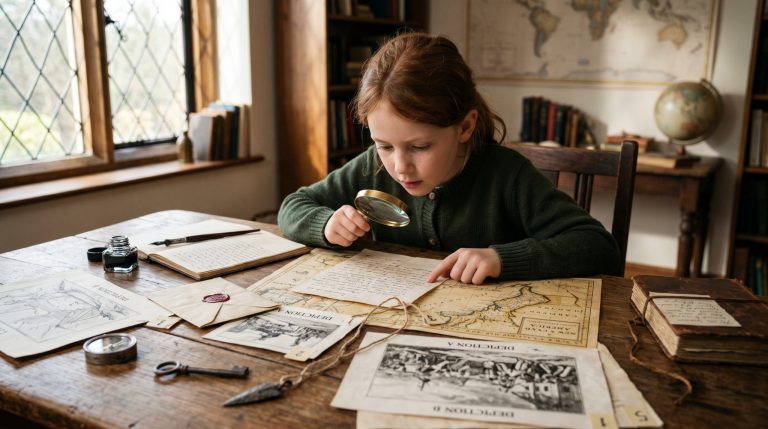
Many children discover a love of history when they stop passively receiving information and start actively looking for clues, patterns, and questions. Spot the Anachronism turns observation into investigation, helping learners practice the same curiosity, attention, and historical thinking that often spark deeper engagement with the past.
This Article Is Part Of A Larger Series
Question: How do I make history engaging when my child finds it completely boring?
Current article: Article 10 of 10 — Synthesis & Real-World Application
This article explores one evidence-supported aspect of the larger question. Future articles examine additional research-supported approaches to increasing engagement with history.
Related Facebook Discussions
- One way to see historical figures as real people is to notice the signs of effort, fatigue, and daily life visible in their bodies.
- Notice how everyday details can become far more interesting when you start examining how people actually used historical spaces.
- Historical curiosity often begins when we stop looking at what people built and start asking why they built it that way.