Sleep Is Part of the Lesson

What if some of the most important learning in your homeschool happens after you close the history book?
Not during the reading.
Not during the discussion.
Not during the narration.
Not even during the lesson itself.
What if part of the learning happens later, while your child is asleep?
For many parents, that idea sounds strange.
We naturally think of learning as something that occurs during instruction.
The lesson begins.
Information is presented.
The child understands it.
Learning happens.
The lesson ends.
Simple.
But memory does not work quite that way.
The truth is that learning is not a single event.
It is a process.
And one of the most important stages in that process occurs after instruction is over.
Understanding this can help explain one of the most common frustrations in homeschooling:
“My child knew it yesterday. Why can’t they remember it today?”
The Common Parent Experience
Imagine a history lesson that goes exceptionally well.
Your child listens attentively.
They answer questions correctly.
They narrate the story back to you.
Everything seems clear.
At the end of the lesson, you feel confident that real learning has occurred.
Then the next day arrives.
You revisit the topic.
Suddenly the answers are less certain.
Details have faded.
Names are missing.
Events are confused.
Parents often interpret this as evidence that the lesson failed.
Perhaps the child was not paying attention.
Perhaps the curriculum was ineffective.
Perhaps more review is needed.
Sometimes those explanations are correct.
But often another factor is involved.
The lesson may simply have been evaluated too soon.
What appeared to be learning was actually an early stage of memory formation.
The process was not finished yet.
Learning Is Not a Single Event
One reason memory can feel mysterious is that we often treat learning as though it happens all at once.
In reality, learning involves multiple stages.
First comes exposure.
The child encounters new information.
Next comes encoding.
The brain begins processing and organizing what was encountered.
Then comes consolidation.
This is the stage many parents rarely consider.
Consolidation is the process through which fragile new memories become more stable and durable.
Only after consolidation can information become reliably available for later retrieval.
Finally comes retrieval itself.
The ability to access information when needed.
Most parents focus on exposure and retrieval because those stages are visible.
We see the lesson.
We hear the answers.
Consolidation happens behind the scenes.
Yet it plays a critical role in determining whether information survives.
What Sleep Does for Memory
Imagine building a house.
At the end of a workday, construction materials may be sitting on the property.
Walls may be partially assembled.
The structure exists, but it is not finished.
Memory often looks similar immediately after a lesson.
The information has arrived.
Some understanding has formed.
But the memory is still fragile.
Sleep helps strengthen that structure.
During sleep, the brain continues processing information encountered during the day.
New memories become more organized.
Connections develop between new knowledge and existing knowledge.
Important information becomes easier to access.
Think of it as moving information from a temporary workspace into a more permanent system.
The lesson itself provides the raw materials.
Sleep helps transform those materials into something more durable.
This does not mean every memory survives.
Far from it.
The brain continues filtering information.
Some memories strengthen.
Others fade.
But sleep plays an important role in determining which memories become lasting knowledge.
Why This Matters for History
History presents unique challenges for memory.
Children encounter:
- unfamiliar names
- distant places
- new vocabulary
- complex relationships
- abstract chronology
- large amounts of information
Unlike everyday experiences, historical information often lacks immediate personal relevance.
As a result, many historical memories begin in a fragile state.
They require support if they are going to survive.
Consolidation helps provide that support.
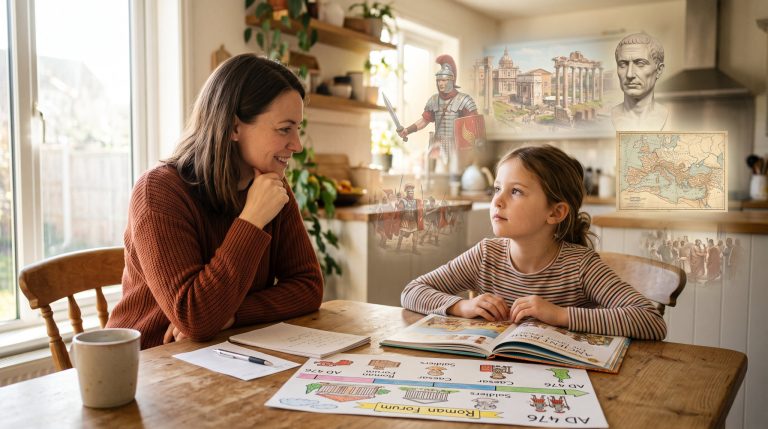
A child may hear a story about Julius Caesar, Ancient Egypt, or the American Revolution during a lesson.
At first, those memories may be incomplete and loosely connected.
Over time, the brain begins organizing them.
The story becomes clearer.
Relationships become easier to understand.
Previously confusing details find a place within a larger framework.
Parents sometimes notice this unexpectedly.
A child who struggled to discuss a topic immediately afterward may seem more comfortable discussing it the next day.
The information feels more organized.
More accessible.
More meaningful.
Part of that improvement may result from consolidation.
Why Stories Often Benefit More
This also helps explain why historical stories are frequently remembered better than isolated facts.
Stories provide structure.
Structure gives the brain something to work with during consolidation.
A list of disconnected facts can be difficult to organize.
A narrative already contains relationships.
People.
Goals.
Conflicts.
Consequences.
The brain naturally understands stories as meaningful sequences.
As a result, narrative information often survives more effectively than isolated details.
A child may forget the exact year of an event.
Yet vividly remember the story of the people involved.
That remembered story can later serve as a framework for additional learning.
The narrative survives.
Future knowledge attaches to it.
History gradually becomes easier to understand because earlier memories remain available.
Sleep Cannot Rescue Weak Learning
It is important to avoid a common misunderstanding.
Sleep supports learning.
Sleep does not replace learning.
A child who never paid attention to a lesson will not magically remember it after a good night’s sleep.
A poorly understood lesson does not become fully understood through consolidation alone.
Sleep helps strengthen what was encoded.
It cannot strengthen information that never entered memory effectively in the first place.
This is why all the other factors in this series still matter.
Attention matters.
Engagement matters.
Narration matters.
Retrieval matters.
Spacing matters.
Emotional connection matters.
Sleep works alongside these processes.
It is part of the learning system, not a substitute for it.
The strongest memories typically emerge when multiple factors work together.
Thinking Differently About Retention
Understanding consolidation can change the way parents interpret learning.
Instead of expecting permanent retention immediately, we begin recognizing that memory develops over time.
A child who understands a lesson today may remember it better tomorrow.
A memory that feels fragile now may become stronger after additional processing.
This perspective encourages patience.
It also encourages more accurate evaluation.
Instead of asking:
“Did my child master this immediately?”
we can ask:
“What remains after the memory has had time to develop?”
That question often provides a clearer picture of learning.
Practical Implications for Homeschooling
This understanding does not require dramatic changes to your homeschool.
It primarily changes expectations.
Parents can allow time between instruction and evaluation.
They can recognize that immediate performance is not the same thing as durable retention.
They can revisit topics after a delay rather than assuming the lesson is complete the moment the book closes.
Simple conversations can become valuable opportunities.
Ask questions such as:
- What do you remember from yesterday’s story?
- Which part stayed with you overnight?
- What seems clearer today?
These discussions reveal how memory is developing over time.
They also reinforce the learning that consolidation has begun.
The Hidden Hours of Learning
One reason parents become discouraged is that learning often appears invisible.
We see the lesson.
We see the assignment.
We see the narration.
We do not see what happens afterward.
Yet some of the most important work occurs during those hidden hours.
The brain continues processing.
Organizing.
Connecting.
Strengthening.
Building.
Learning is still happening even though instruction has stopped.
That reality changes how we think about retention.
The goal is no longer simply helping a child understand something today.
The goal is helping that understanding become part of what they know tomorrow, next week, and next month.
Sleep Is Part of the Lesson
When children forget historical information, it is tempting to assume the lesson failed.
Sometimes the lesson was simply incomplete.
Memory formation takes time.
Exposure begins the process.
Encoding continues it.
Consolidation strengthens it.
Retrieval reveals the result.
Sleep plays an important role in that chain.
It helps transform fragile learning into durable knowledge.
It helps organize new information.
It helps strengthen connections.
It helps determine what remains available in the future.
That is why learning should not be viewed as something that ends when the book closes.
The lesson continues afterward.
The brain is still working.
The memory is still developing.
And some of the most important learning may be happening while your child sleeps.
Because learning begins during the lesson.
But memory often finishes building long after the lesson is over.
Come Back to It Tomorrow
This article explains that memory keeps building after the lesson closes — the brain organizes and strengthens what it learned during sleep and the days that follow. Spot the Anachronism is well suited to that rhythm. Rather than treating one sitting as finished, return to a Roman scene with your child a day or two later and talk it through again. You will often notice that details they fumbled at first now come more easily, and that the reasoning feels clearer. Coming back to the same image after a delay lets consolidation do its quiet work and gives your child a natural chance to see what has stayed. A scene explored today and revisited tomorrow builds sturdier historical memory than either sitting alone.
This Article Is Part Of A Larger Series
Question: Why doesn’t the information stick? My child forgets everything right after a lesson.
Current article: Article 9 of 11 — Hidden Memory Factors Cluster
This article explores one evidence-supported aspect of the larger question. Future articles examine additional research-supported approaches to increasing engagement with history.
Related Facebook Discussions
- The brain strengthens connected structures over time, which is what this exercise builds when it asks whether an entire Roman scene belongs to one world.
- Details that slip past you at first, like how light actually filled a Roman room, often come into focus when you return to the same scene later.
- A scene caught as a real lived moment gives memory the narrative structure the brain holds onto long after the lesson ends.