A Complete Homeschool Parent’s Framework for Knowing Whether History Is Sticking
“How do I know if my child is actually retaining what they’ve learned in history?”
That question sounds simple, but it contains several different worries.
You may be wondering whether your child remembers enough facts.
You may be concerned that months of study will disappear.
You may want accountability without turning history into a constant series of tests.
You may see enthusiasm during lessons but feel uncertain about what remains afterward.
You may also be asking a more personal question:
“Am I teaching this effectively?”
The difficulty is that historical retention does not produce only one kind of evidence.
It can appear through recall, narration, conversation, explanation, comparison, curiosity, emotional connection, transfer, and increasingly sophisticated thought. Some evidence appears immediately. Some becomes visible only after weeks, months, or years.
That is why one failed recall question cannot provide a reliable answer.
To know whether history is sticking, parents need to look for several forms of evidence and interpret them together.
This article brings the major pieces of the retention question into one practical framework. Its purpose is to help parents move from uncertainty to informed observation without assuming that formal testing is the only legitimate way to evaluate learning.
The central question is no longer:
“Can my child remember everything?”
It becomes:
“What evidence do I see that history is becoming part of how my child remembers, explains, connects, questions, and understands?”
The Wrong Question: “What Facts Can My Child Remember?”
Facts matter.
Children need names, dates, places, chronology, vocabulary, and concrete examples. Historical thinking without factual knowledge quickly becomes vague opinion.
But factual recall is only one dimension of retention.
A child may forget that the Western Roman Empire ended in 476 while understanding that Rome weakened through interacting political, military, economic, and administrative pressures.
A child may confuse the dates of two revolutions while recognizing that material hardship, institutional weakness, political ideas, and failed reform can combine to produce upheaval.
A child may forget a ruler’s name while remembering why people supported, feared, or resisted that ruler.
These are not complete forms of knowledge. The missing facts may need review.
But neither are they evidence that nothing was learned.
Recall questions become misleading when parents use them as a complete diagnosis.
A question such as:
“What year did Rome fall?”
reveals whether the child can retrieve one date.
It does not reveal whether the child understands:
- why the empire became unstable
- how different pressures interacted
- what changed afterward
- how the decline affected different regions
- whether the child can compare Rome with another empire
The problem is not that parents ask factual questions.
The problem is that they often ask only factual questions and then draw broad conclusions from the answers.
A more reliable framework uses multiple evidence streams.
The Six Evidence Streams of Historical Retention
Historical learning becomes visible through six broad forms of evidence:
- Retrieval
- Conversation
- Transfer
- Historical reasoning
- Emotional connection
- Developmental growth
No single stream tells the entire story.
Together, they provide a far more accurate picture than a quiz score or one difficult review session.
Evidence Stream 1: Retrieval
Retrieval means bringing previously learned information back to mind.
It can occur through:
- oral narration
- written narration
- drawing from memory
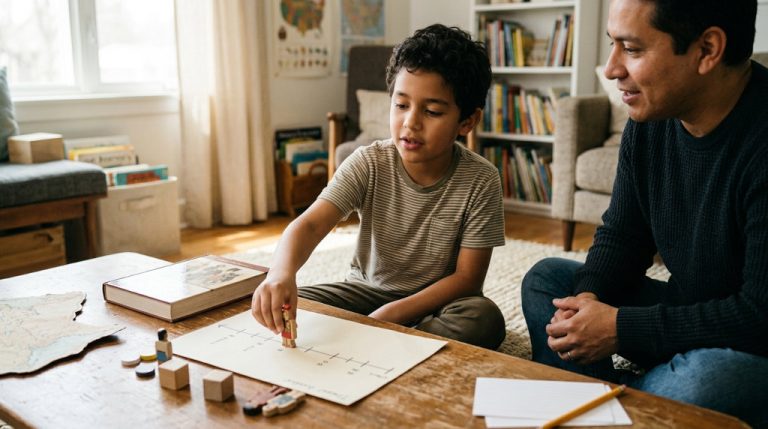
- timeline reconstruction
- map explanation
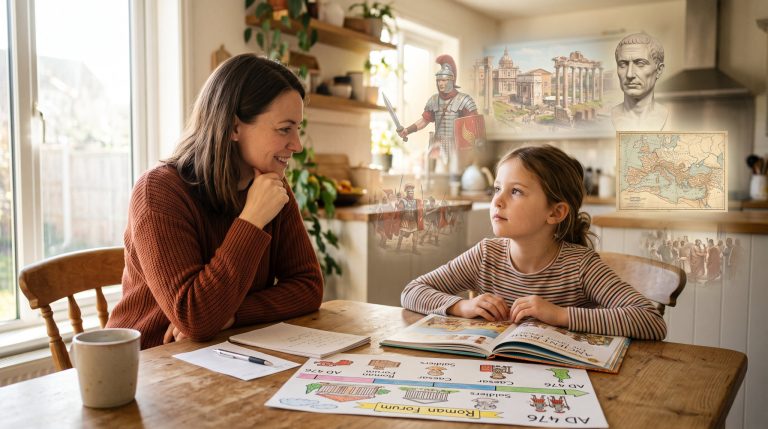
- teaching the material to someone else
- answering an open-ended question
- telling the historical story again
Retrieval matters for two reasons.
First, it reveals what is currently accessible.
Second, the act of retrieving strengthens future access.
That makes retrieval different from passive review.
When a child rereads a chapter, the information may feel familiar because it is visible. When the child closes the book and explains the chapter, the child must reconstruct the learning independently.
That effort provides stronger evidence.
What strong retrieval evidence looks like
A child can:
- retell the main sequence
- explain the central conflict
- remember important people or ideas
- identify causes and consequences
- organize information in their own words
- recover knowledge after a small cue
- retrieve more successfully over repeated attempts
The retelling does not need to be polished.
A child who says:
“Rome had trouble because it was huge, leaders kept fighting, and the army had too much influence”
is demonstrating a meaningful historical structure even if names and dates are missing.
What weaker retrieval evidence looks like
Be cautious about overvaluing:
- repeating language copied directly from a text
- recognizing the correct multiple-choice answer without being able to explain it
- memorizing a date with no understanding of its significance
- producing an answer only after the parent supplies most of it
- remembering immediately after a lesson but never again
These responses may still contribute evidence, but they are less convincing on their own.
A practical retrieval question
Ask:
“Tell me what you remember, and explain what seemed most important.”
Then listen before correcting.
Evidence Stream 2: Conversation
Conversation reveals learning that may not appear in a formal retelling.
A child may struggle to produce a complete narration but become highly thoughtful when discussing one part of the topic.
Open-ended conversation can reveal:
- partial memories
- causal reasoning
- misconceptions
- historical vocabulary
- curiosity
- moral questions
- connections
- uncertainty
- developing interpretations
Conversation also provides another retrieval opportunity, so it strengthens the learning it reveals.
What strong conversational evidence looks like
A child can participate in questions such as:
- Why do you think that happened?
- What did this person want?
- What changed because of that decision?
- How might another group have viewed the event?
- What evidence would help us answer that?
- Does this remind you of something else we studied?
The child does not need to provide a complete answer immediately.
Useful evidence may appear as:
“I’m not sure, but I think…”
“That sounds like…”
“Would people at the time have known…?”
“Maybe the problem was already happening before…”
These statements show the child working with historical knowledge.
What weak assessment conversation looks like
Conversation becomes less useful when it turns into interrogation:
“What was the date?”
“No.”
“Who was the king?”
“No.”
“You should know this.”
That exchange measures pressure as much as memory.
It may cause the child to withdraw, guess, or produce shorter answers than the child could offer in a safer discussion.
A practical conversation question
Ask:
“What part of this event is hardest to explain?”
The answer may reveal both what the child knows and where the child needs support.
Evidence Stream 3: Transfer
Transfer occurs when a child uses historical learning in a new context.
It is one of the strongest indicators that knowledge has become meaningful and usable.
A child demonstrates transfer by saying:
“This empire had the same problem Rome had with its borders.”
“That fictional ruler is using propaganda.”
“This argument sounds like the debates before the American Revolution.”
“The city grew there because the river helped trade.”
“That source was written by the winning side, so it might leave something out.”
Transfer matters because the child was not simply asked to reproduce the original lesson.
The child recognized that an older historical idea could help interpret something new.
What strong transfer evidence looks like
The child:
- compares historical periods
- connects history with current events
- applies historical concepts in literature
- recognizes recurring political patterns
- uses geography to explain settlement or conflict
- applies source-awareness outside the original unit
- notices similarities and differences without assuming situations are identical
Transfer often appears unexpectedly.
A casual comment during a movie may provide stronger evidence of durable learning than a formal worksheet.
What weak transfer evidence looks like
Not every comparison is accurate.
A child may say:
“This is exactly like Rome.”
That may reflect a useful beginning, but the comparison needs refinement.
Ask:
“What is similar?”
“What is different?”
“Where does the comparison stop working?”
The goal is not merely to notice patterns but to use them responsibly.
A practical transfer question
Ask:
“Have we seen another society face a problem like this?”
Evidence Stream 4: Historical Reasoning
Historical retention is not only about what happened.
It also involves how the child thinks about what happened.
Historical reasoning includes:
- causation
- chronology
- comparison
- context
- perspective
- evidence
- interpretation
- change and continuity
- significance
These abilities develop gradually.
A young child may identify one cause.
An older child may recognize several interacting causes.
A teenager may compare competing explanations and evaluate evidence.
What strong historical reasoning looks like
The child increasingly:
- explains why events happened
- distinguishes causes from consequences
- recognizes that one event can affect groups differently
- compares societies without flattening differences
- considers what historical people knew and believed
- asks where evidence came from
- notices that sources may disagree
- revises an explanation after learning something new
- understands that outcomes were not always inevitable
A child saying:
“The assassination of Caesar did not restore the Republic because the political system was already unstable”
shows more historical understanding than a child who remembers only the date of the assassination.
What weaker reasoning evidence looks like
Be cautious when the child:
- repeats a conclusion without explanation
- treats one cause as the entire story
- divides everyone into simple heroes and villains
- applies modern assumptions without considering context
- states an opinion but cannot identify supporting evidence
- compares two events only because both involved war or rebellion
These are not necessarily failures.
They are developmental starting points.
A practical historical-reasoning question
Ask:
“Was there one cause, or were several problems interacting?”
Evidence Stream 5: Emotional Connection
Children often remember what moved them.
A child may forget a date while vividly remembering:
- a person facing danger
- an act of courage
- an injustice
- a surprising discovery
- the fall of a city
- the experience of an enslaved person
- the ambition of a ruler
- the awe of an ancient structure
Parents sometimes dismiss this as remembering only the interesting part.
But emotional significance often supports deeper attention and stronger memory.
Emotion can act as an anchor.
The remembered story may carry:
- motivation
- conflict
- status
- power
- consequence
- human experience
- moral complexity
What strong emotional evidence looks like
The child:
- repeatedly returns to a historical story
- remembers what someone wanted or feared
- asks moral or human questions
- expresses curiosity months later
- identifies with or challenges a historical person
- connects an emotional story with broader historical ideas
- wants to investigate further
A child who remembers an enslaved gladiator’s restricted choices may also be retaining ideas about social status, public spectacle, labor, violence, and Roman power.
What weak emotional evidence looks like
Emotion alone is not complete historical understanding.
A child may remember one dramatic anecdote while losing:
- context
- chronology
- representative accuracy
- other perspectives
- evidence limitations
Parents should reconnect emotional anchors with the larger history.
Ask:
“What does that story help us understand about the society?”
A practical emotional-engagement question
Ask:
“Which person or event stayed with you most, and why?”
Evidence Stream 6: Developmental Growth
Historical retention must be evaluated according to developmental readiness.
A six-year-old, a ten-year-old, and a sixteen-year-old should not be expected to show learning in the same way.
Ages 5–7
Look primarily for:
- story recall
- memorable people
- emotional engagement
- simple sequence
- growing vocabulary
- curiosity
- broad awareness that the past differs from the present
Weak chronology at this age is not automatically concerning.
Ages 8–10
Look for growing ability in:
- sequencing
- simple cause and effect
- basic comparison
- timelines
- geographic connections
- recurring historical vocabulary
- connections between units
Ages 11–13
Look for:
- multiple causes
- cross-period comparison
- perspective
- unintended consequences
- stronger narrative organization
- questions about sources
- more precise use of concepts
Ages 14 and older
Look increasingly for:
- source evaluation
- contextualization
- historical argument
- competing interpretations
- complex causation
- change and continuity
- evidence-based conclusions
- revision of claims
What strong developmental evidence looks like
The child’s thinking becomes:
- more organized
- more independent
- more connected
- more nuanced
- more evidence-aware
- more precise
The clearest comparison is usually not between the child and an adult.
It is between the child now and the same child six or twelve months earlier.
A practical developmental question
Ask:
“How is my child’s explanation changing over time?”
What Strong Evidence Looks Like in Real Homeschool Life
Consider a child who studied the American Revolution.
Strong evidence may appear in several forms.
Retrieval
The child can narrate the growing conflict between Britain and the colonies.
Conversation
The child explains why colonists objected to taxation without representation.
Transfer
The child notices a similar argument about representation in another political conflict.
Historical reasoning
The child distinguishes the Boston Tea Party as a trigger within a much longer dispute.
Emotional connection
The child remains interested in the choices faced by Loyalist families.
Developmental growth
An earlier explanation focused only on unfair taxes. A later one includes political ideas, imperial policy, economic pressure, and divided colonial loyalties.
No single piece proves complete mastery.
Together, they provide strong evidence that meaningful historical learning is occurring.
What Weak or Misleading Evidence Looks Like
Parents also need to know what not to overinterpret.
Temporary recall
A child answers correctly immediately after a lesson but cannot retrieve or use the information later.
This shows initial access, not necessarily durable retention.
Parroting
A child repeats textbook language without being able to explain it in different words.
This may indicate memorization without strong understanding.
Isolated dates
A child recalls dates but cannot place them within a meaningful sequence or explain why the events matter.
The facts are real knowledge, but the structure remains weak.
Project polish
A beautiful project does not automatically demonstrate historical understanding.
Ask what choices the child made and what the child can explain.
Enthusiasm alone
Enjoyment supports learning but does not guarantee it.
Look for whether enthusiasm leads to questions, recall, connection, or explanation.
One bad day
A weak response during one review session should not outweigh months of thoughtful conversation, narration, and transfer.
One strong performance
Similarly, one excellent retelling should not be treated as proof that all knowledge is secure.
Retention is best evaluated across repeated observations.
The Role of Forgetting
Forgetting is normal.
Memory weakens when information is not revisited.
That does not mean learning never occurred.
A child may:
- recognize material without recalling it independently
- recover knowledge quickly after a cue
- relearn faster than before
- retain the broad framework while losing details
- use older ideas without remembering where they came from
Parents should treat forgetting as information.
It may signal that the material needs:
- retrieval
- reconnection
- spaced review
- clearer context
- stronger narrative structure
- comparison with later topics
The key distinction is between forgetting and absence of learning.
A child who recovers the topic quickly after a cue shows different evidence from a child who never understood the main idea at all.
Building a Simple Observation System
Parents do not need an elaborate assessment apparatus.
A practical system can be built from a few repeated habits.
Weekly: One Retrieval Opportunity
Ask for one narration, explanation, sketch, timeline reconstruction, or teach-it-back response.
Examples:
“Tell me the main story from this week.”
“Draw the trade route from memory and explain why it mattered.”
“Teach me how the Roman Republic worked.”
During Normal Life: Notice Connections
Write down brief examples of spontaneous transfer.
For example:
“Compared fictional succession dispute to Roman civil war.”
“Asked whether documentary source represented the winning side.”
“Connected river geography to settlement.”
A sentence is enough.
Monthly: One Reflection Conversation
Ask:
- What historical topic stayed with you this month?
- What connection did you notice?
- What question are you still thinking about?
- Which event became easier to understand?
- What do you remember from an earlier unit?
Periodically: Revisit a Timeline
Use the timeline to reactivate chronology and connection.
Ask:
- What came before this?
- What was happening elsewhere?
- How much time passed?
- Which later event was influenced by this one?
Quarterly: Review a Portfolio
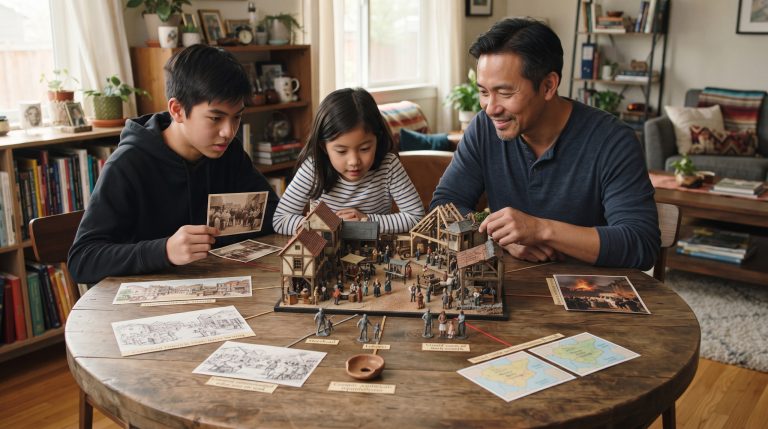
A simple portfolio may contain:
- narrations
- drawings
- maps
- essays
- discussion notes
- questions
- timeline photographs
- project explanations
- research samples
Look for growth in:
- explanation
- vocabulary
- causation
- comparison
- evidence-awareness
- transfer
- independence
The goal is not to assign a grade.
The goal is to observe a pattern.
A Practical Confidence Scale
Parents often want to know how much evidence is enough.
A simple qualitative scale can help.
Limited evidence
You mainly observe:
- immediate recognition
- copied answers
- isolated facts
- dependence on heavy prompting
- little connection or explanation
This does not necessarily mean failure.
It means more retrieval, discussion, context, or instructional adjustment may be needed.
Developing evidence
You observe:
- partial narration
- simple cause and effect
- growing vocabulary
- occasional connections
- strong interest in particular stories
- recovery after cues
This often indicates that a useful foundation is forming.
Strong evidence
You observe several streams together:
- independent retrieval
- meaningful discussion
- transfer
- causal reasoning
- emotional significance
- growth over time
This provides good reason for confidence that history is sticking.
Durable evidence
Over months or years, the child:
- reconnects with older topics quickly
- uses historical concepts in new settings
- asks informed questions
- compares periods with increasing precision
- explains complex relationships
- revises interpretations
- retains broad chronological and conceptual frameworks
This is evidence of long-term historical development.
Historical-Learning Application
Historians do not rely on one form of evidence when interpreting the past.
They compare:
- artifacts
- written sources
- archaeology
- chronology
- context
- testimony
- competing interpretations
Parents can adopt a similar principle when evaluating learning.
Do not rely on one memory check.
Use several forms of evidence.
A child’s date recall is one source.
A narration is another.
A spontaneous comparison is another.
A portfolio sample is another.
A question about evidence is another.
A discussion showing causal reasoning is another.
The more independent evidence streams point in the same direction, the more confident the conclusion becomes.
This approach is especially appropriate for history because historical learning itself is multidimensional.
A child is not merely storing information.
The child is gradually learning to:
- organize time
- understand people in context
- identify causes
- recognize consequences
- compare societies
- evaluate evidence
- form interpretations
- revise conclusions
- use the past to understand new situations
Assessment should reflect that complexity.
Practical Takeaways for Homeschooling Parents
Use factual recall, but do not use it alone.
Ask for explanations as well as answers.
Invite retrieval before reopening the book.
Use narration regularly.
Let the child reconstruct the material rather than repeating your explanation.
Have open-ended conversations.
Ask why, how, what changed, and what the topic resembles.
Watch for transfer.
Spontaneous connections are among the strongest signs of usable learning.
Listen for historical reasoning.
Notice causation, comparison, perspective, evidence, and context.
Take emotional memory seriously.
A remembered story may be carrying a larger historical framework.
Adjust expectations by age.
Do not demand teenage analysis from a young child.
Expect forgetting.
Plan spaced retrieval instead of interpreting every gap as failure.
Preserve selected evidence.
A simple portfolio can make growth visible.
Compare the child with the child’s earlier work.
Development matters more than one isolated performance.
Distinguish partial recall from no understanding.
A child may know the central structure while missing details.
Correct misconceptions without treating them as disasters.
Historical understanding develops through revision.
Use several evidence streams before drawing conclusions.
One weak answer is not enough to diagnose failure.
Most importantly, ask a better question.
Not:
“Can my child remember everything?”
But:
“What evidence do I see that history is becoming part of how my child thinks?”
Conclusion
History is sticking when it begins to influence what a child can retrieve, explain, connect, question, and understand.
It appears when a child reconstructs an event from memory.
It appears when conversation reveals motives, causes, and consequences.
It appears when an old historical idea becomes useful in a new context.
It appears when a child begins asking how historians know something.
It appears when a story remains emotionally significant months later.
It appears when explanations become more complex with age.
It appears when forgotten material returns more quickly during later learning.
No single form of evidence provides the entire answer.
But multiple forms of evidence can provide parents with a reliable and practical basis for confidence.
Formal tests may sometimes be useful. They are not the only alternative to uncertainty.
Parents can assess historical retention through retrieval, conversation, transfer, reasoning, emotional connection, and developmental growth. They can preserve evidence in portfolios and observe patterns across months and years.
The complete answer to the homeschool parent’s question is therefore not:
“Your child should remember everything.”
It is:
“Look for the many ways historical learning leaves evidence behind.”
History is sticking when the past becomes part of the child’s growing mental world—part of how the child recognizes patterns, evaluates choices, understands people, and makes sense of new knowledge.
The goal is not perfect recall.
The goal is an increasingly historically informed mind.
Turn “Is History Sticking?” Into Evidence You Can See
Stop relying on one recall question to tell you whether history is taking hold. Spot the Anachronism gives your child a fresh visual investigation every month – inviting them to retrieve knowledge, examine evidence, explain their reasoning, and connect details with historical context. It is active, repeatable practice that helps you see growing historical judgment without turning your homeschool into a cycle of tests.
This Article Is Part Of A Larger Series
Question: How do I know if my child is actually retaining what they’ve learned in history?
Series Position: Article 11 (Series Capstone)
This article explores one evidence-supported aspect of the larger question. Readers interested in the full answer should explore the complete series.
Related Facebook Discussions
- A brief visual investigation can reveal how much historical evidence a child notices, remembers, and can explain.
- See how asking what Roman architecture was designed to do turns visible details into evidence of historical reasoning.
- Recognizing when a modern cultural signal has entered an ancient scene is strong evidence that historical knowledge has become usable.