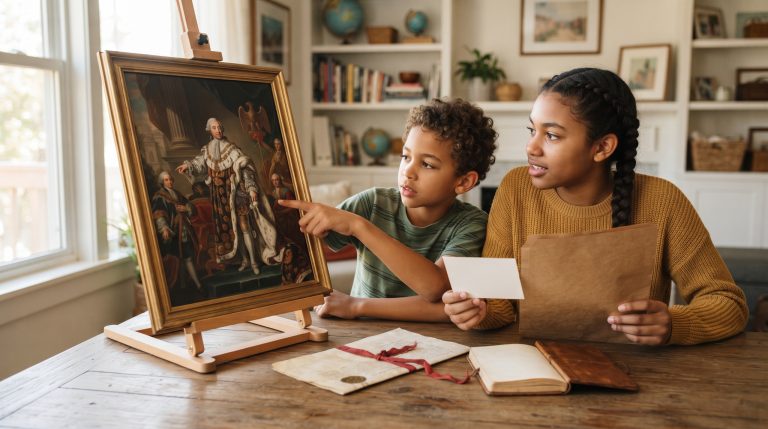
Forget the Grade: How to Build a History Portfolio That Actually Shows What Your Child Knows
“How do I know if my child is actually retaining what they’ve learned in history?”
For many homeschooling parents, that question creates an accountability problem.
You may not want history to revolve around quizzes, tests, and grades. You may believe that understanding the past requires more than memorizing dates and names.
But you still want evidence.
You want to know whether months of reading, discussion, narration, projects, and exploration have produced meaningful learning. You may also want a record you can review later, share with an evaluator, or use to reassure yourself that progress is occurring.
Without some form of documentation, history learning can seem to disappear as soon as a lesson ends.
A portfolio offers a practical middle path.
It does not require parents to reduce history to numerical scores. It also does not require them to rely only on impressions or memory.
A thoughtfully maintained history portfolio collects evidence of what a child has understood, created, explained, questioned, and connected over time.
This article examines one specific part of the larger retention question:
How can parents create a visible record of historical learning without constantly testing their children?
The goal is not to produce more schoolwork.
The goal is to preserve better evidence.
Why Grades Feel Reassuring
Grades provide a simple answer to a complicated question.
An A appears to mean that learning is strong. A low score appears to mean that more work is needed.
That clarity can feel reassuring, especially for homeschooling parents who do not have an outside teacher regularly evaluating their children.
Grades also create records.
A worksheet can be filed. A test can be dated. A score can be placed in a gradebook. When parents wonder whether progress is happening, they can point to something concrete.
The difficulty is that a grade compresses many different kinds of performance into one symbol or number.
A child may earn a high score because of strong factual recall while having a weak understanding of cause and consequence.
Another child may understand the central conflicts of a historical period but lose points for misspelled names, confused dates, or difficulty expressing ideas in writing.
The score records performance on the assessment.
It does not necessarily record the full extent of historical learning.
This does not make grades useless. It means they provide a limited kind of evidence.
Parents often continue using them not because they believe grades are perfect, but because the alternative seems to be having no evidence at all.
A portfolio removes that false choice.
What Traditional Tests Often Miss
History tests commonly measure information that is easy to score.
- Who was the ruler?
- When did the event occur?
- Which battle came first?
- What term matches this definition?
- Which civilization built this structure?
These facts matter. Historical understanding requires knowledge of people, events, chronology, and terminology.
But many important aspects of learning are difficult to capture through short-answer questions.
A test may not reveal whether a child can:
- explain why an event happened
- distinguish an immediate trigger from a long-term cause
- compare two societies
- recognize bias in a historical account
- understand why people made particular choices
- connect an earlier lesson with a later one
- ask a thoughtful question about missing evidence
- revise an interpretation after learning something new
- apply a historical idea in an unfamiliar context
These abilities are central to thinking historically.
They also develop gradually.
A child may show only the beginning of causal reasoning in September and produce a much more complex explanation by April. A single test score may not make that growth visible.
A portfolio can.
What Is a History Portfolio?
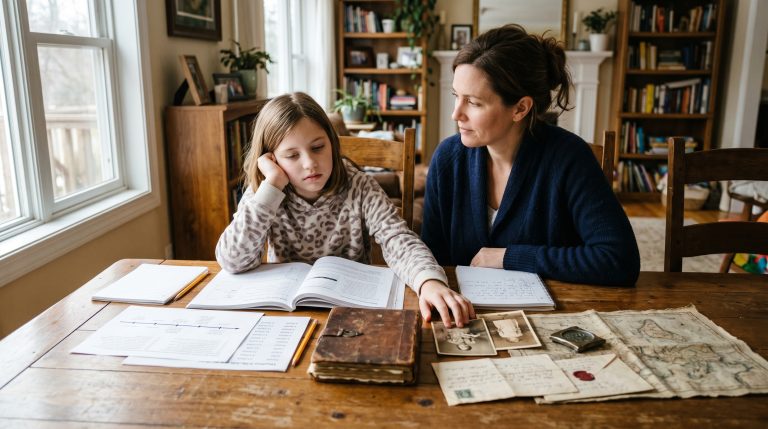
A history portfolio is a purposeful collection of evidence showing what a child has learned over time.
It is not simply a folder containing every worksheet, coloring page, and completed assignment.
A useful portfolio is selective.
It preserves examples that reveal understanding, reasoning, memory, interpretation, curiosity, or growth.
The portfolio may be physical, digital, or a combination of both.
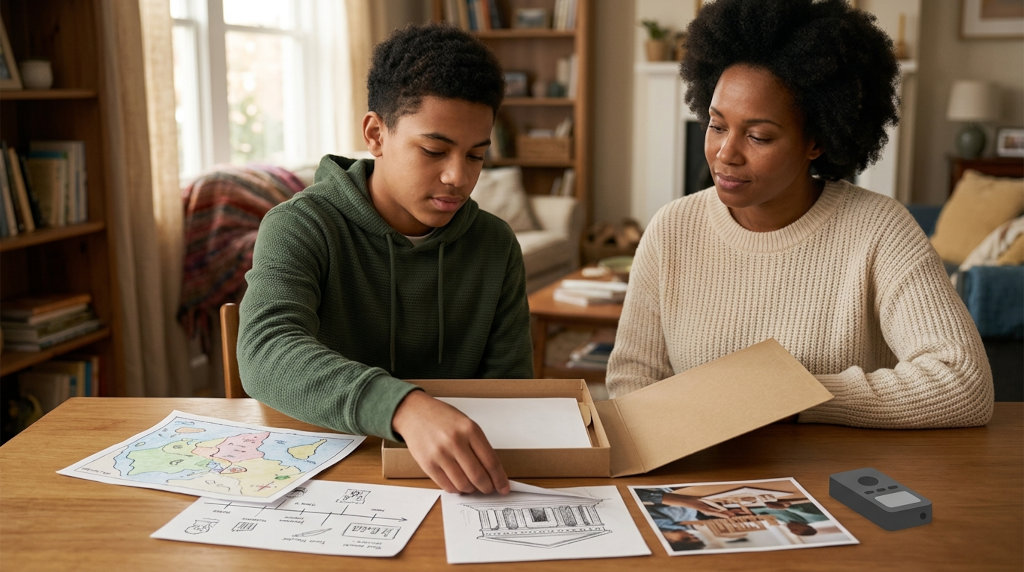
A physical binder can hold written work, drawings, maps, timelines, and photographs. A digital folder can include audio recordings, videos, scanned pages, presentation files, and notes about discussions.
The format matters less than the purpose.
A portfolio should help answer questions such as:
- What does my child understand?
- How does my child explain historical events?
- What kinds of connections are becoming visible?
- How has the child’s reasoning changed?
- What can the child do now that was difficult earlier?
- Which areas still need development?
The portfolio is not merely storage.
It is a record of learning.
What Belongs in a History Portfolio?
Historical understanding appears in many forms. A portfolio should reflect that variety.
Oral narrations
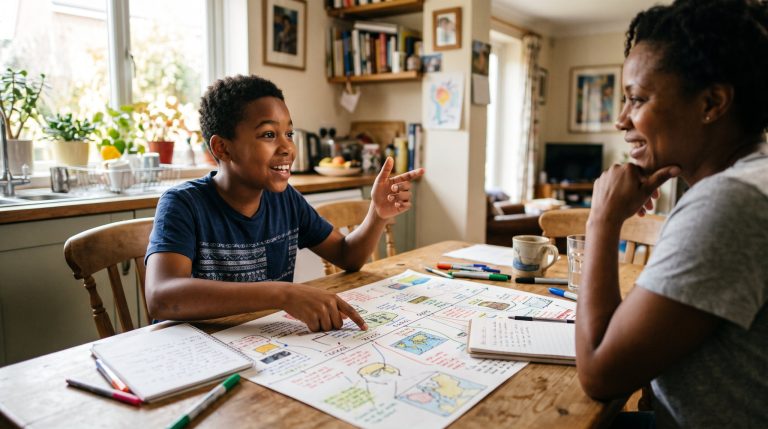
An audio recording of a child telling back a lesson can provide rich evidence of retention.
The narration may reveal sequence, causation, vocabulary, emphasis, and misunderstanding.
Recording every narration would be unnecessary. Saving one periodically can show how the child’s explanations develop over time.
A parent might preserve:
- one immediate narration after a lesson
- one delayed narration several days later
- one narration near the end of a unit
These samples can reveal both initial learning and what remained accessible later.
Written narrations
Written narrations allow children to reconstruct material in their own words.
They can show changes in organization, detail, interpretation, and historical vocabulary.
Parents should remember that writing ability can affect the result. A child may understand more than can be expressed easily on paper.
Written narrations are therefore useful evidence, but they should not be the only evidence.
Discussion notes
Some of the strongest historical thinking appears in conversation and then vanishes.
A child makes an insightful comparison during dinner. A question about a documentary reveals awareness of historical evidence. A discussion of a current event prompts a connection with an earlier civilization.
A parent can preserve this evidence with a brief dated note.
For example:
“Compared the political instability after Caesar’s death with a succession crisis in another empire.”
“Asked whether the surviving account was written by the winning side.”
“Explained that food shortages did not cause the revolution alone but increased existing anger.”
The note does not need to reproduce the entire conversation.
Its purpose is to preserve the evidence that otherwise would be forgotten.
Timelines
Timelines can reveal more than whether a child remembers dates.
They show whether the child understands sequence, duration, overlap, and the relationship between events.
Photographs taken at different points in the year can show how the timeline becomes more complex.
The child may also annotate the timeline with causes, consequences, turning points, or comparisons.
That transforms it from a display of dates into evidence of historical organization.
Maps
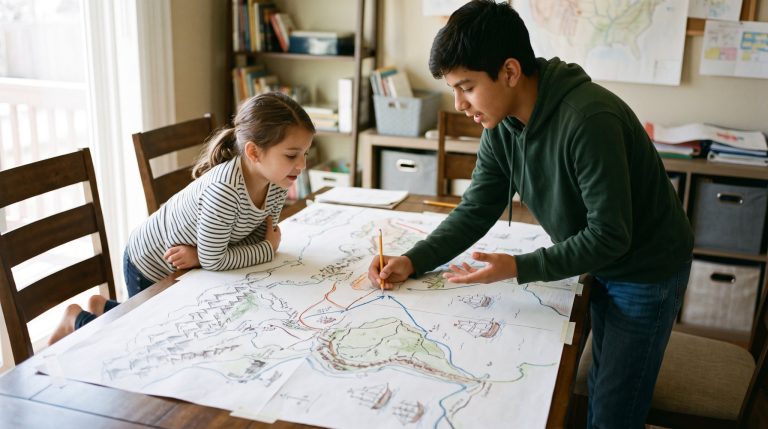
Maps can show understanding of geography, migration, conflict, trade, settlement, and political expansion.
A map becomes especially useful portfolio evidence when the child explains it.
A simple recording or written note might capture the child explaining:
- why a city developed in a particular location
- how geography affected an invasion
- why a trade route mattered
- why an empire had difficulty controlling its borders
The explanation reveals the learning. The map supports it.
Drawings and artifact sketches
A drawing can document careful observation and historical understanding, especially when accompanied by an explanation.
A child might draw:
- a Roman house
- an Egyptian temple
- a medieval town
- a soldier’s equipment
- a historical object
- the layout of a battlefield
The value does not lie primarily in artistic quality.
The drawing may reveal which features the child understood and considered important.
Ask the child to label or explain the work. That explanation turns the image into evidence of historical thought.
Essays and longer writing
Older students may produce analytical essays, research papers, source comparisons, or argumentative writing.
These can show:
- use of evidence
- development of a thesis
- understanding of context
- comparison of interpretations
- ability to support conclusions
Saving several pieces across a year allows parents and students to see growth in historical argumentation.
Historical questions
A child’s questions belong in a portfolio.
Questions reveal curiosity, prior knowledge, confusion, and emerging awareness of historical complexity.
Examples include:
- Why did ordinary people support this ruler?
- How do we know what happened if the sources disagree?
- Did everyone in the empire think of themselves the same way?
- Why did this system work for so long before it failed?
- What happened to the people who lost the war?
A list of questions across several months can reveal a developing historical mind.
Early questions may focus on what happened. Later questions may focus on evidence, motivation, perspective, and consequence.
That is growth.
Creative projects
Historical newspapers, character journals, mock interviews, models, presentations, and dramatic retellings can provide evidence when they require children to use what they have learned.
The key question is not whether the project looks impressive.
It is whether the project reveals historical understanding.
A beautiful model copied from instructions may show persistence and craftsmanship but little independent historical thought.
A simpler project that requires the child to make evidence-based choices may reveal much more.
Research work
Research notes, source lists, annotated pages, and short reports can show how a child gathers and evaluates information.
Parents might preserve evidence of:
- changing a conclusion after finding new evidence
- noticing disagreement among sources
- identifying a weak or unsupported claim
- asking for better evidence
- distinguishing primary and secondary sources
These actions show historical inquiry rather than mere information collection.
Evidence of transfer
Some of the most important portfolio entries may not come from a history lesson at all.
A child may apply historical understanding while discussing literature, politics, geography, religion, economics, art, or current events.
A parent can record moments when the child:
- compares a fictional government with a historical one
- recognizes propaganda in a new context
- connects geography with political development
- notices a recurring pattern of reform and resistance
- uses a previous civilization to understand a new one
Transfer shows that the knowledge has become usable.
It deserves a place in the record.
A Portfolio Should Be Selective
A portfolio is not more useful simply because it is larger.
If every paper, coloring page, and activity is preserved, important evidence may disappear inside a mass of material.
Selectivity makes the portfolio readable.
Parents might keep:
- one or two meaningful samples per month
- a few examples from each major unit
- evidence from different forms of learning
- work that shows improvement
- work that reveals a misconception later corrected
- spontaneous examples of connection or transfer
The portfolio should show a pattern, not document every minute.
A thin, intentional portfolio may provide more insight than several overflowing binders.
It can also reduce the administrative burden on the parent.
The purpose is to make learning visible, not to create a second full-time recordkeeping job.
How Portfolios Reveal Growth
A test usually captures performance at one moment.
A portfolio creates a sequence.
That sequence allows parents to compare earlier and later work.
Suppose a child narrates the fall of Rome in September:
“Rome got too big, and other groups attacked it.”
The explanation is simple, but it contains an initial causal idea.
Several months later, the child writes:
“The Western Roman Empire declined because several problems affected one another. Political instability weakened leadership, military pressure increased, and the empire struggled to govern and fund such a large territory.”
The second response shows greater complexity.
The child now recognizes multiple interacting causes rather than one simple explanation.
A grade could be assigned to each response, but the comparison itself provides more useful information.
It shows growth in historical reasoning.
The same development may appear in other areas.
An early timeline contains disconnected events. A later timeline includes turning points and causal links.
An early map labels locations. A later map explains how geography shaped trade and military strategy.
An early historical question asks, “Who won?” A later one asks, “Why do the two sources describe the outcome differently?”
A portfolio makes these changes visible.
Portfolios Preserve Partial and Developing Understanding
Traditional assessment often treats knowledge as correct or incorrect.
Portfolio evidence can capture learning in progress.
A child may produce an explanation that is partly right but oversimplified. The parent records it. Several months later, new learning leads the child to revise that explanation.
Both pieces belong in the portfolio.
The earlier work is not embarrassing evidence to remove. It establishes the starting point.
The later revision shows intellectual growth.
This is especially valuable in history because interpretation often becomes more nuanced over time.
A young child may describe a ruler simply as “bad.” Later, the child may recognize that the ruler faced conflicting pressures, made some effective decisions, and caused serious harm through others.
The later interpretation does not merely contain more facts.
It reflects greater historical maturity.
A portfolio can preserve that development in a way a numerical grade cannot.
How to Review a History Portfolio
Collecting evidence is only the first step.
Parents need to review it periodically.
A quarterly review is often sufficient. The goal is to identify patterns, not to grade every item.
Look for growth in several areas.
Stronger explanations
Are the child’s accounts becoming clearer and more complete?
Does the child increasingly explain why events occurred rather than merely listing what happened?
More complex causal reasoning
Does the child recognize that events can have multiple causes?
Can the child distinguish between long-term conditions and immediate triggers?
Better connections
Does the child connect events across units, civilizations, or time periods?
Are those comparisons becoming more precise?
Growing historical vocabulary
Does the child use terms more naturally and accurately?
Do concepts such as empire, revolution, alliance, succession, trade, reform, and evidence appear in meaningful contexts?
Greater attention to context
Does the child increasingly consider what people at the time knew, believed, feared, or valued?
Is the child becoming less likely to judge the past only through modern assumptions?
Stronger evidence awareness
Does the child ask where information came from?
Can the child notice that sources may disagree or represent different perspectives?
Improved transfer
Does the child apply historical ideas in new situations?
Can earlier learning help make sense of a later topic?
Increasing independence
Does the child require fewer prompts?
Can the child organize explanations, research questions, or projects with greater autonomy?
Persistent gaps
Are the same misunderstandings appearing repeatedly?
Does the child struggle consistently with chronology, geography, vocabulary, or explaining causation?
A portfolio should provide reassurance, but it should also help parents identify what needs support.
Evidence is useful because it can guide future teaching.
Historical-Learning Application
Imagine that a family studies the American Revolution over several months.
The portfolio includes:
- an early drawing of the Boston Tea Party with the child’s explanation
- an oral narration about why Britain taxed the colonies
- a timeline showing protests, legislation, and armed conflict
- a written comparison of Loyalist and Patriot perspectives
- a note from a dinner conversation about whether compromise was still possible
- a later essay explaining why the Revolution had more than one cause
No single item provides a complete measurement of learning.
Together, they create a rich picture.
The drawing reveals what captured the child’s attention.
The narration shows initial understanding of taxation and protest.
The timeline reveals chronology.
The comparison demonstrates perspective-taking.
The conversation note shows inquiry and interpretation.
The essay reveals developing causal reasoning.
The portfolio also allows the parent to identify gaps.
Perhaps the child understands colonial grievances but pays little attention to the experiences of enslaved people, Indigenous nations, or colonists who opposed independence.
That gap can shape the next stage of learning.
The portfolio is therefore not merely a display of completed work.
It is both evidence and guidance.
Documentation Without Turning Everything Into a Performance
A portfolio can reduce pressure, but only if it does not turn every activity into something that must be saved and displayed.
Children need room to experiment, misunderstand, revise, and create imperfect work.
Not every narration needs recording.
Not every discussion needs documentation.
Not every project needs presentation quality.
Parents can preserve occasional representative samples.
They may also allow children to help choose what belongs in the portfolio.
A child might select:
- a piece that shows improvement
- a project that created pride
- a question that led to further study
- an explanation that changed after new evidence appeared
- a difficult task that eventually became manageable
This participation encourages ownership.
The portfolio becomes a record of learning rather than a file assembled about the child without the child’s involvement.
A Simple Portfolio Structure
Parents do not need an elaborate system.
A basic history portfolio might contain five sections:
Narrations and explanations
Oral, written, drawn, or recorded examples of the child reconstructing historical material.
Timelines, maps, and visual work
Evidence of sequence, geography, observation, and material understanding.
Questions and conversations
Brief notes preserving thoughtful questions, comparisons, and spontaneous historical connections.
Projects and research
Selected examples of deeper investigation or creative application.
Parent and student reflections
Occasional notes answering questions such as:
- What became easier?
- What still feels confusing?
- Which topic produced the strongest interest?
- What new connection did we notice?
- How has the child’s historical reasoning changed?
This structure is broad enough to capture different forms of learning without becoming difficult to maintain.
Practical Takeaways for Homeschooling Parents
Choose a simple format.
A binder, digital folder, or combination of both is enough.
Collect representative evidence rather than everything.
One meaningful sample can be more useful than ten routine worksheets.
Include several forms of expression.
A portfolio should not depend entirely on writing, especially for children whose writing ability may conceal their historical understanding.
Date each entry.
Dates make growth easier to see.
Add short context notes.
A sentence explaining the activity or the child’s comment may make the evidence far more meaningful later.
Save questions as well as answers.
Curiosity and inquiry are part of historical learning.
Photograph large or temporary projects.
The portfolio does not need to store every physical object.
Record occasional conversations or narrations.
Audio can preserve evidence that would otherwise vanish.
Review the portfolio every few months.
Look for patterns in reasoning, vocabulary, comparison, context, evidence use, and transfer.
Invite the child to participate.
Ask which pieces show the most learning or growth.
Do not turn the portfolio into a showcase of perfection.
Misunderstandings, revisions, and developing explanations can provide some of the strongest evidence of growth.
Use the portfolio to guide instruction.
Notice both strengths and persistent gaps.
Most importantly, remember that the portfolio exists to answer a better question than:
“What grade did my child earn?”
It helps answer:
“What can my child understand, explain, connect, and do with historical knowledge?”
Conclusion
Homeschooling parents do not need to choose between constant testing and having no evidence of progress.
A history portfolio offers a more complete form of accountability.
It can preserve narrations, discussions, maps, timelines, drawings, research, questions, projects, and spontaneous moments of transfer.
Over time, those pieces show how a child’s historical understanding is developing.
They reveal stronger explanations, more thoughtful comparisons, richer vocabulary, greater attention to evidence, and increasingly independent reasoning.
A portfolio does not answer every question about retention. It cannot ensure that every fact will remain accessible, and it should not replace all conversation, review, observation, or factual assessment.
But it contributes something that a single quiz cannot.
It shows learning accumulating over time.
The goal is not to produce a grade.
The goal is to make historical learning visible.
See Historical Thinking Grow—Month by Month
A history portfolio is strongest when it captures what your child can notice, explain, and justify – not merely what they completed. Spot the Anachronism provides a fresh visual investigation each month: your child studies the scene, identifies what does not belong, and explains the evidence behind the answer. Save an occasional narration, annotated image, or written explanation, and you gain a low-pressure record of historical reasoning that grows over time – without adding another test or stack of worksheets.
This Article Is Part Of A Larger Series
Question: How do I know if my child is actually retaining what they’ve learned in history?
Series Position: Article 5 of 11
This article explores one evidence-supported aspect of the larger question. Readers interested in the full answer should explore the complete series.should explore the complete series.
Related Facebook Discussions
- See how distinguishing displayed surfaces from worked surfaces can teach children to treat historical objects as evidence rather than decoration.
- Explore how fasteners, textile edges, and other small details can become evidence for deeper historical conclusions.
- See how asking what a surface reveals can turn architecture from a backdrop into evidence of use, change, and time.