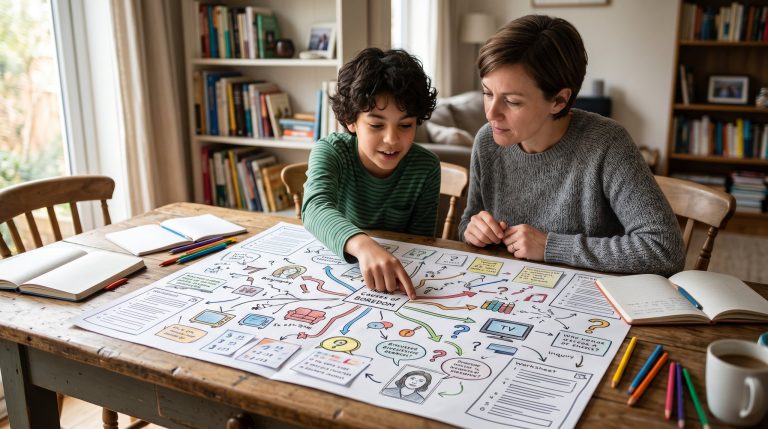
If History Isn’t About Memorizing Dates, Then What Is It For?
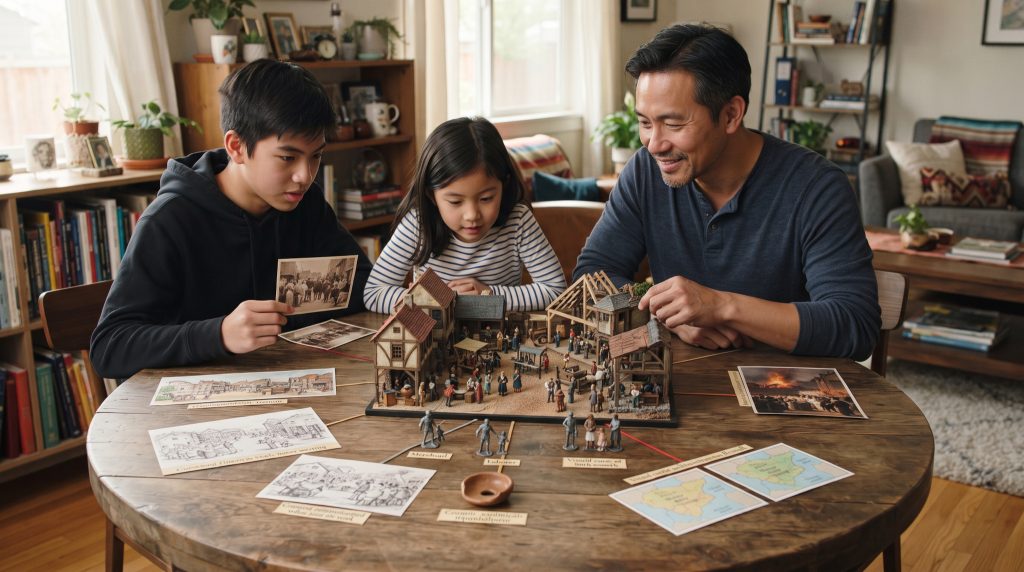
Many homeschooling parents eventually ask some version of this question:
Are we doing too much memorization of dates and names instead of actual understanding?
It is a reasonable question. A parent may watch a child memorize a list of rulers, battles, inventions, or dates, pass a quiz, and then forget most of it a few weeks later. The parent may remember having the same experience in school: history as a long march through names, dates, wars, and chapters, with very little sense of why any of it mattered.
But there is often a deeper question underneath the concern about memorization:
If history is not mainly about remembering dates and names, what is it actually for?
This article is the capstone of a larger series exploring that question. Earlier articles have looked at memory, causation, historical empathy, source analysis, curriculum debates, and the difference between recall and understanding. This article brings those threads together around one central idea: history education is not primarily about storing information from the past. It is about learning to understand people, evidence, change, causation, and human experience across time.
History Is Not Less Serious When It Moves Beyond Memorization
One reason parents hesitate to move away from memorization-heavy history is that they worry they are lowering the standard.
That concern is understandable. If a child does not know any dates, names, places, or events, then history becomes vague. Facts matter. A child cannot reason well about the American Revolution, ancient Egypt, the Roman Empire, the Civil War, the Protestant Reformation, or World War II without learning concrete information.
But the purpose of those facts is not simply to sit in memory as isolated data.
Dates help children place events in sequence. Names help them recognize real people and institutions. Places help them understand geography, culture, trade, empire, migration, and conflict. Events give them the raw material for asking better questions.
Facts are the foundation. They are not the whole house.
A memorization-only approach often treats factual recall as the final goal. A richer approach treats facts as tools for understanding. The difference is not whether children learn information. The difference is what they are expected to do with it.
What Historians Actually Do
Professional historians do not spend most of their time reciting timelines from memory. They ask questions about the past and then investigate evidence.
They ask:
- What happened?
- How do we know?
- Why did it happen?
- What changed?
- What stayed the same?
- Who benefited?
- Who suffered?
- What choices did people believe they had?
- What evidence supports one interpretation over another?
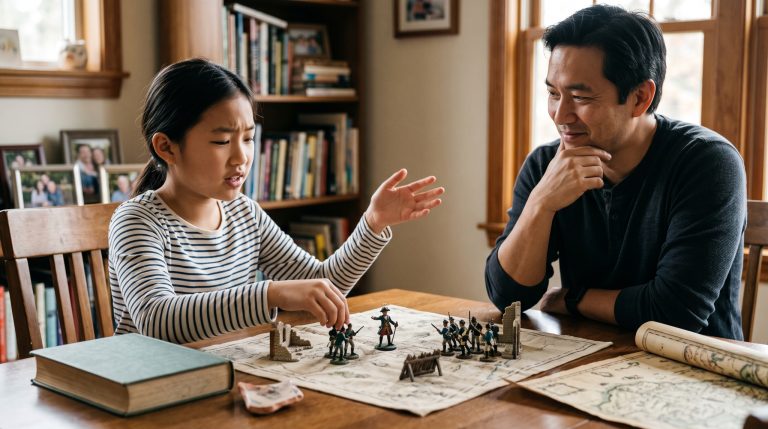
This matters for homeschooling because it changes the goal of history instruction. Instead of asking only, “Can my child remember this?” we can also ask, “Can my child think historically about this?”
Historical thinking includes several habits of mind. Children learn to notice significance, evaluate evidence, understand continuity and change, reason about cause and consequence, consider historical perspectives, and think carefully about ethical dimensions. Those are not soft substitutes for knowledge. They are disciplined ways of using knowledge.
A child who knows that the Declaration of Independence was signed in 1776 has learned a useful fact. A child who can also explain why the colonies moved from protest to independence, what arguments were made, what risks the signers faced, and how different groups experienced those events has begun to think historically.
That is a deeper form of learning.
Understanding Change Over Time
One major purpose of history is to help children understand change.
Children often encounter the world as though it has always been the way it is now. History disrupts that assumption. It shows them that governments, technologies, family structures, economies, religions, cities, borders, rights, customs, and daily routines have changed over time.
This helps children see the present more clearly.
For example, studying ancient cities can show that urban life did not begin with modern skyscrapers and cars. Cities have long depended on food supply, labor systems, trade, water, sanitation, architecture, crowd movement, and social hierarchy. Studying medieval Europe can show how land, power, religion, and obligation shaped ordinary life. Studying industrialization can show how technology changed work, family rhythms, migration, wealth, pollution, and politics.
History teaches children that human societies are not static. They are built, changed, damaged, repaired, contested, and inherited.
That insight is much larger than memorizing a date. Dates help organize the story, but the deeper learning is about how people and societies change over time.
Understanding Cause and Consequence
History also teaches children that events do not usually happen for one simple reason.
A memorization-heavy approach may present history as a sequence:
This happened. Then this happened. Then this happened.
But historical understanding asks why events happened and what followed from them.
Most major historical events have multiple causes. Some are immediate. Some are long-term. Some are political, economic, religious, technological, environmental, or personal. Some causes are visible at the time. Others become clearer only later.
Consider a war, a migration, a revolution, or the collapse of an empire. A child can memorize the date. But understanding begins when the child asks:
- What pressures had been building?
- What choices did leaders make?
- What role did ordinary people play?
- What conditions made conflict more likely?
- What consequences were intended?
- What consequences were unexpected?
This kind of reasoning helps children move beyond “history as a list” into “history as explanation.”
For homeschool parents, this is one of the easiest shifts to make. After reading about an event, ask not only, “When did it happen?” but also, “Why did it happen?” and “What changed because of it?”
The answers do not need to be perfect. The habit matters. Children are learning that the past is intelligible. Events have causes. Choices have consequences. Human beings act within circumstances they did not fully control.
Understanding Human Beings
History is also for understanding people.
Not just famous people. Not just kings, presidents, generals, inventors, or explorers. History helps children understand how real human beings lived within worlds different from their own.
This is where historical empathy matters.
Historical empathy does not mean approving of everything people did in the past. It means trying to understand people within their own context before judging them from ours. It asks children to consider what people knew, believed, feared, valued, and expected at the time.
That is difficult work. It is also deeply humanizing.
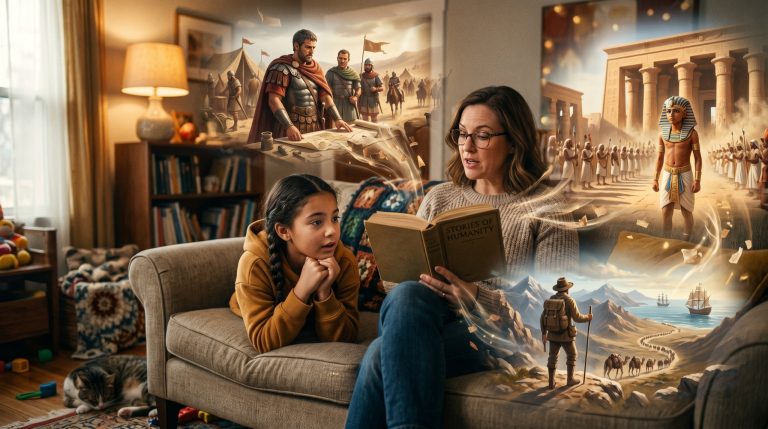
A child studying a Roman slave, an Egyptian scribe, a medieval peasant, a colonial printer, an enslaved mother, an immigrant child, a soldier in a trench, or a factory worker in the nineteenth century is not merely collecting facts. The child is learning to imagine lives shaped by different constraints.
This helps children resist two common errors.
The first error is treating people in the past as stupid because they did not know what we know now.
The second error is treating people in the past as cardboard characters who exist only to prove a moral lesson.
Good history is more demanding. It asks children to see people as real: limited, intelligent, flawed, courageous, fearful, selfish, loyal, cruel, generous, confused, and complicated.
That kind of understanding is one of the great gifts of historical study.
Understanding Evidence
History is also for learning how we know what we think we know.
This may be one of the most important parts of history education, especially for children growing up in a world full of claims, images, posts, videos, arguments, and half-truths.
Historical claims depend on evidence. That evidence may include letters, laws, diaries, artifacts, architecture, tools, clothing, maps, paintings, inscriptions, newspapers, census records, oral histories, photographs, and archaeological remains.
Children do not need to become professional historians to benefit from source work. Even simple questions can change the nature of a lesson:
- Who made this?
- When was it made?
- Why might it have been made?
- What does it show?
- What does it leave out?
- Who is speaking?
- Who is missing?
- Can we trust it completely?
- What other evidence would help?
This turns history from passive reception into investigation.
A textbook may tell a child what happened. A source invites the child to ask how anyone knows. That shift builds judgment. It also teaches humility. The past does not simply hand us answers. We interpret evidence, compare accounts, and revise our understanding when new information appears.
In a homeschool setting, this can be as simple as reading a short primary-source excerpt alongside a textbook paragraph and asking, “What do we learn from each one?”
Understanding the Present
History is not valuable only because it teaches children about the past. It also helps them understand the present.
Modern arguments often have historical roots. National borders, religious conflicts, racial categories, economic systems, educational debates, voting rights, family patterns, technological anxieties, and cultural assumptions all have histories.
Without historical understanding, the present can seem natural or inevitable. With historical understanding, children begin to see that the world they live in has been shaped by decisions, conflicts, accidents, inventions, movements, laws, migrations, and inherited institutions.
This does not mean every history lesson has to end with a modern application. Sometimes children should simply dwell in the past and understand it on its own terms.
But over time, history gives children a longer view. They learn that people before them faced uncertainty. They made choices without knowing the outcome. They inherited problems from earlier generations and passed consequences to later ones.
That longer view can make children wiser. It can make them slower to accept simple explanations. It can help them recognize patterns without pretending that history repeats mechanically.
So What Should Success Look Like?
If success in history is not measured only by memorized dates and names, what should homeschooling parents look for?
A child who is growing in historical understanding may begin to:
- ask better questions about why events happened
- connect one event to another
- notice that people in the past had different assumptions
- use evidence to support an answer
- explain cause and consequence
- compare perspectives
- recognize change over time
- remember facts because they are attached to meaningful stories
- challenge overly simple explanations
- discuss historical dilemmas with increasing nuance
These signs may appear gradually. They may not show up neatly on a quiz. A child may forget a date but remember the conflict that made the date important. A child may not recall every king in order but may understand how monarchy, religion, land, and power interacted in a given period.
That does not mean dates and names should disappear. It means they should serve understanding.
A useful homeschool question is not, “Did my child memorize everything?” It is, “Is my child becoming more capable of making sense of the past?”
Practical Takeaways for Homeschooling Parents
The shift from memorization to understanding does not require abandoning structure. It requires changing the role of structure.
A timeline is still useful. But after placing events on it, ask what changed between them.
A list of important people is still useful. But after learning their names, ask what choices they faced.
A chapter summary is still useful. But after reading it, ask what evidence supports the account.
A quiz can still be useful. But do not let the quiz define the whole purpose of the lesson.
Here are practical principles parents can use:
Use facts as anchors. Children need names, dates, places, and events. Teach them as anchors for thought, not as disconnected trivia.
Ask more “why” and “how” questions. These questions move children toward causation, consequence, and interpretation.
Let children explain their reasoning. A short explanation often reveals more understanding than a correct one-word answer.
Compare perspectives. Ask how different people in the same event may have understood what was happening.
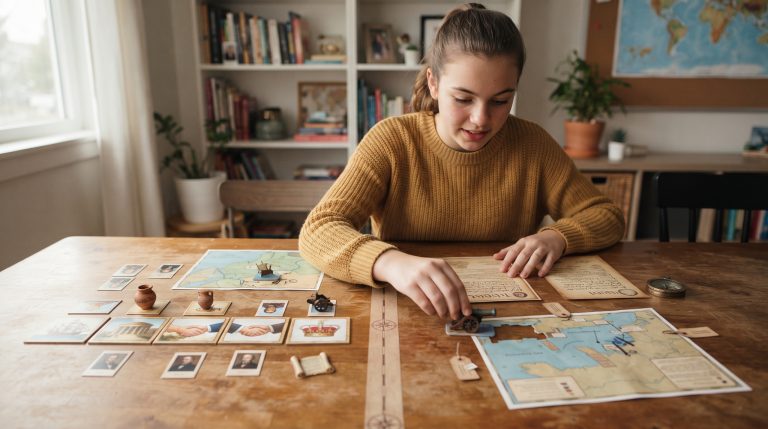
Use evidence when possible. Even one image, artifact, map, diary excerpt, or quote can turn a lesson into an investigation.
Treat memory and meaning as partners. Children remember more when information is connected to stories, questions, conflicts, and human stakes.
Redefine progress. Progress is not only “more facts remembered.” It is also better questions, better explanations, and better judgment.
Conclusion
The concern behind the question is real. Many children have experienced history as little more than memorizing dates and names. Many parents have seen that approach produce boredom, short-term recall, and shallow understanding.
But the answer is not to remove knowledge from history education. The answer is to restore knowledge to its proper purpose.
History is not primarily about remembering the past. It is about understanding people, evidence, change, causation, and human experience across time.
Dates and names matter because they help children locate real events and real people. But the larger goal is to help children make sense of how human beings have lived, struggled, built, believed, governed, fought, adapted, failed, and changed.
That is a much richer vision of history education than memorization alone can offer.
This article does not answer every part of the larger question. Other parts of the series explore memory, retention, curriculum design, source analysis, causation, empathy, and the role of factual knowledge in more detail. But this capstone offers the larger frame: if history is not mainly about memorizing dates, then it is about learning how to understand the human story.
Turn Historical Understanding Into a Monthly Habit
If this article describes the kind of history learning you want—less disconnected memorization, more evidence, explanation, observation, and human meaning – Spot the Anachronism gives you a practical way to build that habit at home. Each monthly visual challenge asks your child to study a historical scene, notice what does not belong, explain why, and return to the past as an active investigator rather than a passive memorizer. It turns facts into usable judgment: looking closely, comparing evidence, reasoning about context, and making sense of how a historical world works.
This Article Is Part Of A Larger Series
Question: Are we doing too much memorization of dates and names instead of actual understanding?
Series Position: Article 11 (Capstone)
This article explores one evidence-supported aspect of the larger question. Future articles examine additional research-supported approaches to increasing engagement with history.
Related Facebook Discussions
- A related discussion looks at why a Roman scene becomes more believable when architecture, materials, crowd behavior, lighting, and movement all belong to the same operational world.
- Another discussion explores how fatigue, posture, effort, and bodily wear can make historical characters feel more human.
- A marketplace-focused discussion shows how repeated questions about space, use, and human activity can deepen historical understanding beyond surface-level facts.