Your Child Isn’t Bored with History – They’re Bored with How History Is Being Taught
The Moment Every Homeschool Parent Dreads
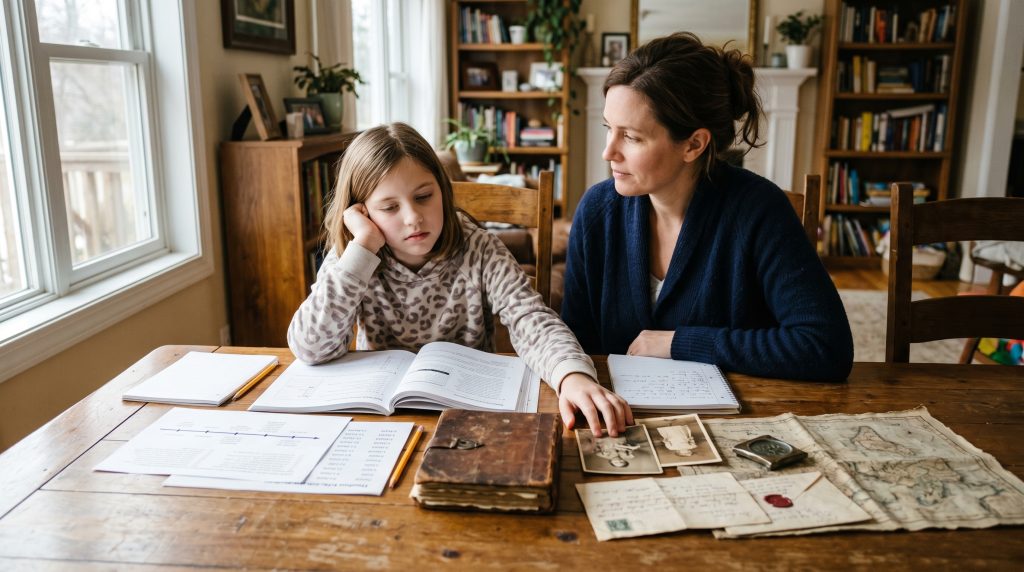
“History is boring.”
For many homeschooling parents, those words land with surprising force.
Maybe you’ve invested in a respected curriculum. Maybe you’ve carefully chosen books, activities, and lesson plans. Maybe history is one of your favorite subjects, and you were excited to share it with your child.
Then comes the rejection.
“I hate all these dates.”
“Why do I have to memorize this?”
“Can we do something else?”
Parents across homeschooling communities ask the same question again and again:
How do I make history engaging when my child finds it completely boring?
It’s a painful question because it often feels personal. If your child rejects history, it can feel as though you’ve failed to make the subject come alive.
But before you replace your curriculum, abandon your plans, or conclude that your child simply isn’t interested in history, there is an important possibility worth considering.
What if your child isn’t rejecting history at all?
What if they’re rejecting the way they’re encountering it?
This article explores that possibility. It is the first article in a larger series examining why children disengage from history and what research suggests can help. This particular article focuses on one foundational idea:
Children who say history is boring are often reacting to an instructional format, not the subject itself.
The Hidden Assumption Behind “History Is Boring”
When a child says they dislike history, most adults naturally interpret that statement at face value.
The assumption sounds reasonable:
If a child says history is boring, they must not be interested in history.
But consider how we would respond in other subjects.
If a child disliked math because every lesson consisted of copying formulas from a board for an hour, we probably wouldn’t conclude that they hated mathematics itself.
If a child disliked reading because every book was presented as vocabulary drills and comprehension quizzes, we wouldn’t necessarily conclude that they hated stories.
Yet history often receives this treatment.
A child encounters history through textbook summaries, worksheets, timelines, memorization exercises, and lists of names and dates. When they become disengaged, we sometimes assume the subject is the problem rather than the format.
Research and classroom experience suggest a different interpretation.
Many children have never actually encountered history as historians encounter it.
They have encountered a particular instructional version of history.
Those are not the same thing.
What Research Says About History Boredom
The good news for frustrated parents is that history boredom is not unusual.
In fact, complaints about history being dry, irrelevant, or overly focused on memorization appear repeatedly in educational research and in parent discussions across homeschooling communities.
This matters because it changes the nature of the problem.
If one child finds history boring, we might suspect a personal preference.
If large numbers of children consistently describe history in similar ways, we should ask whether something about the instructional approach is producing that reaction.
Researchers in history education have repeatedly identified textbook-centered instruction as a major contributor to disengagement. When students primarily encounter history as information to absorb rather than questions to explore, interest often declines.
That does not mean textbooks are inherently bad.
It means that textbooks alone may not provide the elements that naturally attract human attention and curiosity.
The important takeaway is this:
Your child’s boredom is not evidence that you failed as a parent. It may be evidence that they are responding predictably to a common educational pattern.
Why Textbook History Often Feels Dead
Imagine meeting a person through nothing but a list of facts:
- Date of birth
- Occupation
- Major accomplishments
- Date of death
You would know information about them.
You would not know them.
History instruction sometimes creates a similar problem.
Students receive facts disconnected from the human experiences that produced them.
They learn:
- what happened
- when it happened
- who was involved
But they may never explore:
- why people made those choices
- what pressures they faced
- what alternatives existed
- what was at stake
Educational psychology provides one explanation for why this matters.
Human memory works best when information connects to meaningful structures. Stories, causes, conflicts, goals, and consequences create relationships between facts. Isolated facts, by contrast, are harder to organize and retrieve.
James Loewen famously criticized many history textbooks for removing the uncertainty, conflict, and drama that make history compelling. In an effort to simplify, textbooks often present history as a settled sequence of conclusions rather than a series of human decisions and contested interpretations.
The result can feel less like exploration and more like data entry.
And children notice.
What Historians Actually Do
One of the most surprising discoveries for many students is that historians do not spend most of their time memorizing facts.
Historians investigate.
Research by historian and education scholar Sam Wineburg emphasizes that historians approach the past through questions, evidence, context, and interpretation rather than simple fact collection.
Historians ask questions such as:
- Who created this account?
- Why did they create it?
- What evidence supports this claim?
- What perspectives might be missing?
- What alternatives existed at the time?
In other words, history is not merely a collection of answers.
It is an ongoing process of investigation.
Imagine the difference between these two lessons:
Lesson A:
Memorize the dates and outcomes of an event.
Lesson B:
Examine two conflicting accounts of the event and determine which seems more reliable.
The second activity feels fundamentally different.
One asks for storage.
The other asks for thinking.
That distinction is important because curiosity often emerges when learners are invited to solve problems rather than merely receive conclusions.
A Different Way to Think About History
Perhaps the most useful reframe is this:
History is not primarily about facts.
History is about people.
More specifically, it is about people making choices under circumstances that mattered.
Every historical event is ultimately a story about human beings facing constraints, opportunities, fears, ambitions, mistakes, and consequences.
When children encounter history primarily as dates and definitions, they may struggle to find a reason to care.
When they encounter history as human drama, the experience changes.
A king is no longer just a name.
A general is no longer just a date.
A political crisis is no longer just a paragraph.
They become people attempting to solve problems, often without knowing how things will turn out.
That is inherently more interesting because it mirrors how humans experience life.
Historical-Learning Application
What does this look like in practice?
Consider three simple substitutions.
Story Instead of Summary
Instead of beginning with a chapter overview, begin with a person.
What challenge were they facing?
What decision did they need to make?
What happened next?
Artifact Instead of Worksheet
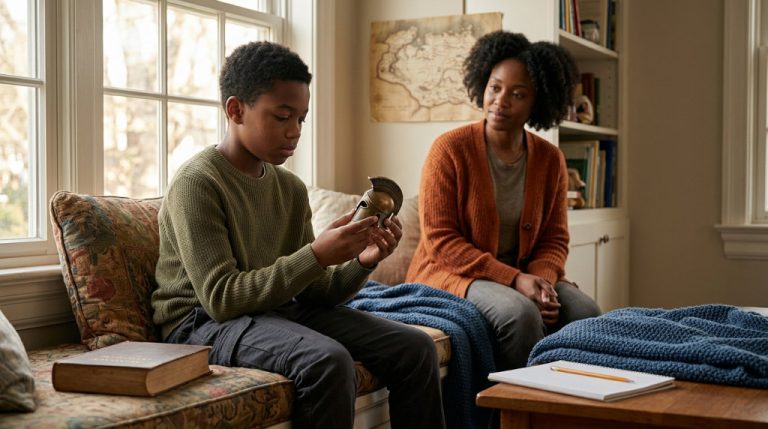
Rather than starting with review questions, start with an object.
A photograph.
A letter.
A coin.
A tool.
Ask:
What can we learn from this?
Question Instead of Answer
Instead of presenting a conclusion first, present a mystery.
Why did this happen?
What evidence supports that explanation?
What other explanations might exist?
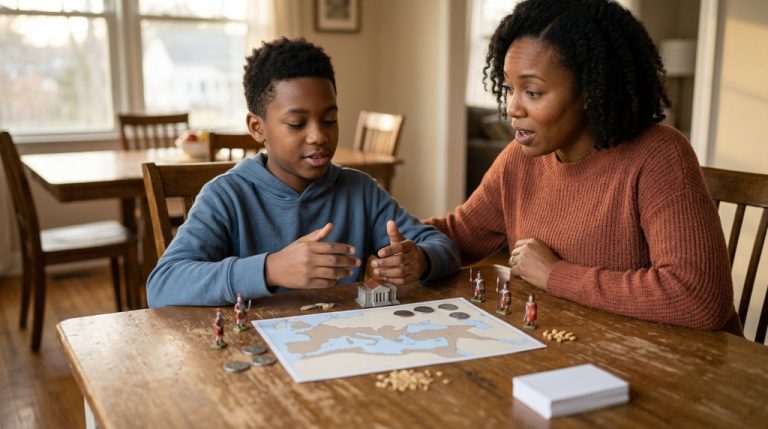
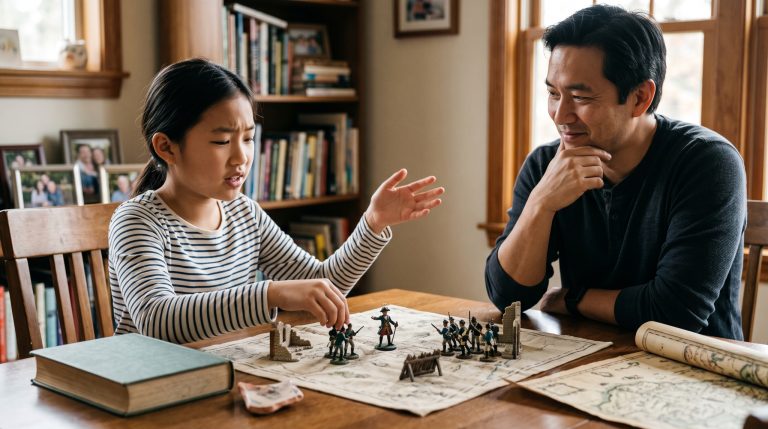
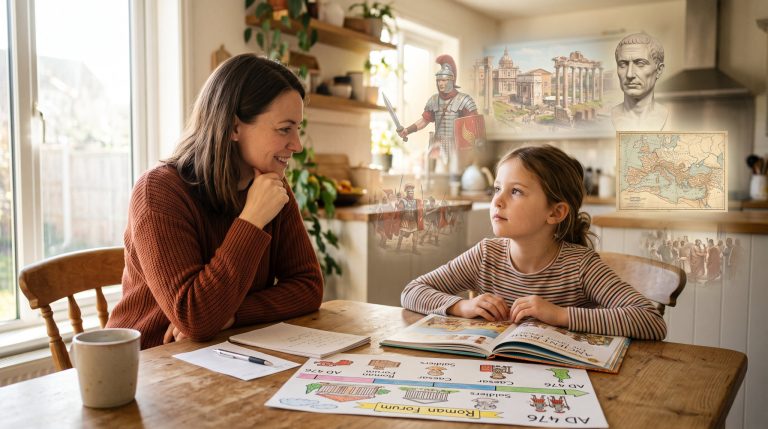
These changes shift the learner from passive recipient to active participant.
And that shift aligns more closely with how historical understanding actually develops.
Practical Takeaways for Homeschooling Parents
You do not need to throw away your curriculum tomorrow.
You do not need to redesign your entire homeschool.
Instead, start by observing.
Ask:
- Which parts of history trigger the strongest resistance?
- Which parts generate even brief moments of interest?
- Does disengagement begin during memorization, reading, writing, or discussion?
Then experiment with small changes.
Consider:
- Replacing one textbook lesson each week with a narrative account.
- Introducing one primary source during each unit.
- Starting with a person before introducing a timeline.
- Using discussion before written assignments.
- Asking “Why?” more often than “When?”
Most importantly, separate the subject from the format.
A child who dislikes worksheets may still love history.
A child who resists memorization may still enjoy investigation.
A child who complains about dates may still be fascinated by people, conflicts, and mysteries.
Conclusion
When a child says history is boring, it is tempting to view that statement as a verdict on the subject.
Research and educational experience suggest a different interpretation.
Often, children are not rejecting history itself.
They are rejecting a particular way of encountering history.
That distinction matters because it transforms the problem from a fixed limitation into a solvable instructional challenge.
The goal of this article is not to claim that every history-engagement problem has a simple solution.
Rather, it offers a foundational reframe:
The child’s boredom may be information, not a verdict.
Understanding that possibility opens the door to the rest of the conversation-and to the remaining articles in this series, which explore additional evidence-supported ways of helping children connect with the past.
Spot the Anachronism
One way to make history more engaging is to turn learning into investigation.
Each Spot the Anachronism activity presents two historical images. One contains a subtle historical mistake. The other has been corrected.
Children learn to slow down, observe carefully, gather clues, and think critically about what they are seeing.
These activities are designed to encourage the same habits historians use when examining evidence from the past.
This Article Is Part Of A Larger Series
Question: How do I make history engaging when my child finds it completely boring?
Current article: Article 1 of 10 – Foundational Reframe
This article explores one evidence-supported aspect of the larger question. Future articles examine additional research-supported approaches to increasing engagement with history.