Countries That Stopped Teaching History as Dates – What Happened Next
Many homeschooling parents eventually ask some version of this question: Are we doing too much memorization of dates and names instead of actual understanding?
It is a fair concern. History lessons can easily become lists: kings, wars, capitals, explorers, treaties, timelines, and test answers. Parents may notice that a child can repeat a date on Friday but cannot explain, a month later, why the event mattered. That raises a deeper worry: if history is mostly memorization, are children really learning history at all?
But there is another worry on the other side. If a parent moves away from memorization-heavy instruction, is that risky? Will the child miss important knowledge? Is teaching history through discussion, questions, evidence, and interpretation just a modern educational trend?
This article looks at that specific concern. It does not try to answer the entire memorization-versus-understanding question. Instead, it asks: What happened when entire countries and educational systems began moving away from teaching history mainly as dates and facts?
The answer is useful for homeschool parents because this debate is not happening only around kitchen tables. It has also been happening in ministries of education, curriculum boards, teacher-training programs, and history-education research around the world.
Main Discussion
The central lesson from international history-education reform is this: many education systems have not abandoned historical facts, but they have changed what those facts are for.
In older fact-centered models, the main goal was often recall. Students were expected to know the names, dates, rulers, battles, and events that appeared in the curriculum. That knowledge mattered, but it could easily become disconnected from explanation. A child might know that an event happened in 1066, 1492, or 1776 without being able to explain what changed because of it, why people acted as they did, or how historians know what happened.
Across many countries, reformers began identifying similar problems. Students could often describe events but struggled to reason historically. They could repeat information but had difficulty explaining causation. They could memorize textbook summaries but had little practice evaluating sources or understanding why accounts of the same event might differ.
That is why history education in many places began shifting toward what is often called historical thinking. The phrase may sound academic, but the idea is straightforward. Students still learn about real people, places, events, and dates. But they also learn to ask historical questions:
Why did this happen?
How do we know?
What changed afterward?
Why did different people see this differently?
What made this event significant?
What evidence supports this interpretation?
In this approach, facts are not discarded. They become the raw material for understanding.
This distinction matters for homeschool parents. A child cannot reason well about the American Revolution, ancient Rome, medieval trade, or the Civil Rights Movement without factual knowledge. But factual knowledge alone does not guarantee understanding. A child also needs practice connecting facts, weighing evidence, explaining causes, and recognizing significance.
International reforms have often aimed at this balance. The goal has not been “less knowledge.” The goal has been knowledge used more intelligently.
Why Countries Began Rethinking History Education
Different countries reached this point for different reasons, but several concerns appear again and again.
First, memorization-heavy history often produces shallow retention. Students may remember information long enough for a quiz but fail to build a durable mental framework. Facts that are not connected to causes, consequences, people, places, and problems tend to fade quickly.
Second, fact-centered instruction can make history feel finished and closed. If history is presented as a list of settled answers, students may not realize that historians work with evidence, uncertainty, interpretation, and argument. They may think history is simply “what the textbook says.”
Third, students often need explicit instruction in historical reasoning. Many children do not naturally move from “what happened” to “why it happened” or “how we know.” Without guidance, they may remain at the level of description: this king ruled, this war occurred, this empire fell. Description is useful, but it is not the whole discipline.
Fourth, many education systems wanted students to transfer historical learning beyond the classroom. They wanted students to understand public debates, evaluate claims about the past, recognize misuse of history, and think critically about evidence. Memorized facts alone are not enough for that.
These concerns are familiar to homeschool parents. A parent may see the same problem in miniature: a child can recite the names of explorers but cannot explain why exploration changed trade, empire, disease, slavery, mapping, or cultural contact. The child has learned information, but not yet built historical understanding.
What Changed in Reformed History Curricula
When countries and curriculum systems moved away from history-as-recall, they tended to emphasize several recurring goals.
One was evidence. Students were asked to look at sources, not just summaries. They might compare two accounts of the same event, examine a political speech, study an artifact, interpret a photograph, or ask what a document can and cannot tell us.
Another was causation. Instead of only asking when something happened, students were asked why it happened. They learned that major events usually have multiple causes: economic pressures, political decisions, beliefs, geography, technology, personality, and chance.
Another was historical significance. Not every event matters in the same way. Students were encouraged to ask why certain events are remembered, why others are ignored, and how significance can change depending on the question being asked.
Another was continuity and change. Students learned to ask what changed, what stayed the same, who experienced change most, and whether change was gradual or sudden.
Another was perspective. This did not mean pretending every viewpoint was equally accurate. It meant trying to understand how people in the past understood their world, including their assumptions, limitations, fears, loyalties, and beliefs.
These are not replacements for content. They are ways of making content meaningful.
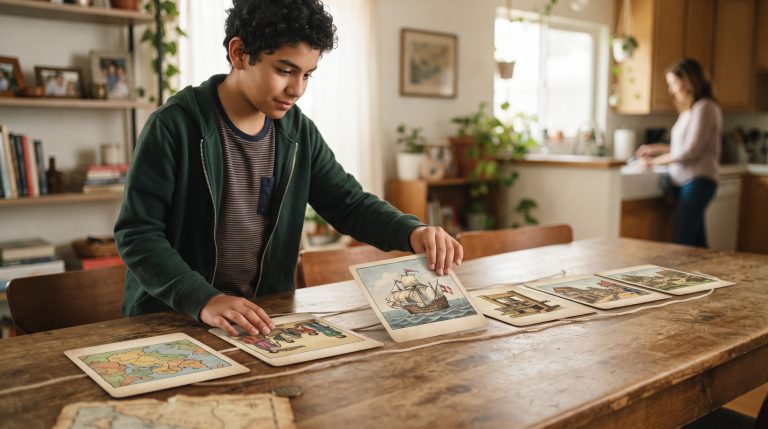
A timeline still matters. A child needs some sense of sequence. But in a historical-thinking approach, a timeline is not the final achievement. It is a tool that helps students see relationships: what came before, what followed, what overlapped, and what changed over time.
A date still matters. But the question becomes: what does this date help us understand?
A name still matters. But the question becomes: what role did this person play, and why did that role matter?
Historical-Learning Application
For historical learning, the international shift points toward a practical principle: children need both memory and meaning, but meaning should govern memory.
In a homeschool setting, that means parents do not need to choose between “facts” and “thinking.” The better question is how facts are being used.
Consider a lesson on the fall of the Western Roman Empire. A memorization-heavy version might ask a child to remember 476 AD, Romulus Augustulus, and the name Odoacer. Those facts are useful. But if the lesson stops there, the child may walk away with a thin understanding.
A more historically rich lesson would still include those names and dates, but it would add questions:
Was Rome already changing before 476?
What pressures weakened imperial authority?
How did military, economic, political, and geographic factors interact?
Did everyone at the time experience this as “the fall of Rome”?
Why do historians debate the meaning of the event?
Now the child is not merely storing information. The child is learning how historical explanation works.
The same approach applies to younger students. A parent studying ancient Egypt might ask, “Why did the Nile matter so much?” rather than only asking the child to remember the names of pharaohs. A parent studying the American Revolution might ask, “Why did different colonists disagree about independence?” rather than only asking for a list of battles. A parent studying westward expansion might ask, “Who gained land, who lost land, and how do we know?” rather than only memorizing a sequence of territorial acquisitions.
These questions do not lower expectations. They raise them. They ask the child to use knowledge.
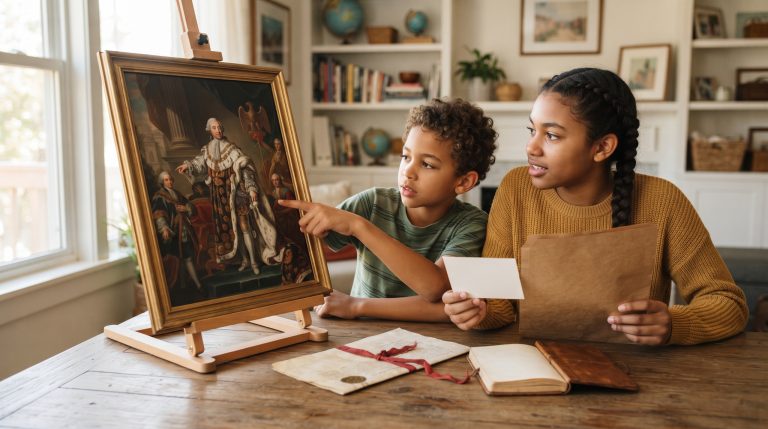
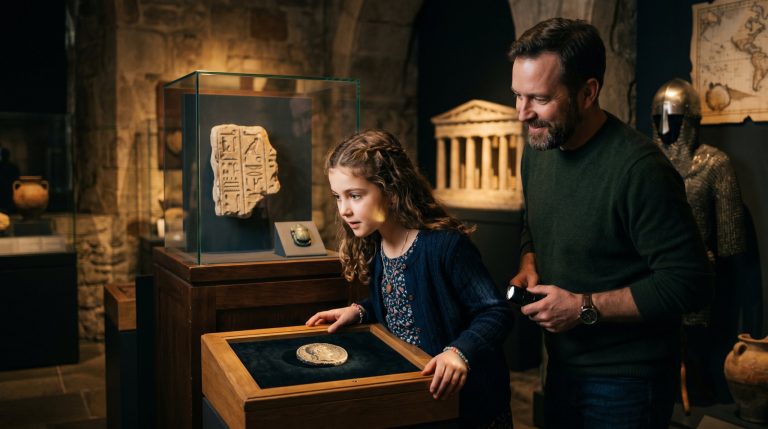
This is also where observation becomes important. In history, children are not only learning words on a page. They are learning to notice evidence: clothing, tools, maps, buildings, laws, speeches, images, letters, and artifacts. A historically thoughtful child begins to ask, “What can I tell from this source? What can I not tell? What might be missing?”
That kind of thinking is more durable than isolated recall. It gives memory a structure.
Practical Takeaways
Homeschool parents can draw several practical lessons from international history-education reform.
First, do not treat facts as the enemy. Dates, names, places, and events are part of historical knowledge. The problem is not that children learn facts. The problem is when facts are treated as the whole purpose of history.
Second, use timelines as supports, not trophies. A timeline helps children organize sequence and change over time. But a completed timeline is not the same as understanding. After placing events on a timeline, ask what changed between them and why the order matters.
Third, replace some recall questions with reasoning questions. Instead of asking only, “When did this happen?” also ask, “Why did it happen?” “What happened because of it?” “Who saw it differently?” and “What evidence do we have?”
Fourth, let children compare accounts. Even young students can notice that two books, maps, images, or eyewitnesses do not present the past in exactly the same way. That opens the door to historical thinking without requiring advanced academic language.
Fifth, watch for explanations, not just correct answers. A child who says, “The empire weakened because of many pressures at once,” is showing a different kind of understanding than a child who only remembers the final date. Look for connections, causes, comparisons, and questions.
Sixth, allow discussion to be part of history learning. Recitation can check memory, but discussion reveals understanding. A child’s explanation, even if incomplete, gives the parent a better view of what the child is actually thinking.
Finally, be confident that teaching for understanding is not a fringe experiment. The same concerns homeschool parents raise have been raised internationally. Many education systems have concluded that students need more than memorized summaries. They need the tools to reason about the past.
Conclusion
The international shift away from memorization-heavy history instruction offers an important perspective for homeschool parents. It shows that the concern behind the HPQ is not unusual, anti-traditional, or careless. Around the world, educators and researchers have wrestled with the same issue: how can students learn real historical knowledge without reducing history to disconnected recall?
The answer emerging from many reforms is not to remove facts. It is to reposition facts inside historical understanding. Dates help establish sequence. Names identify human actors. Events provide the substance of study. But the larger goal is for students to explain, interpret, compare, evaluate, and remember history in a connected way.
This article contributes one piece to the larger answer. It shows that teaching history for understanding has broad support beyond any one homeschool method or curriculum preference. It does not settle every practical question. Parents still need to decide what content to teach, how much memory work to require, and how to match instruction to a child’s age.
But it does offer reassurance: if you are asking whether history should be more than memorizing dates and names, you are asking a serious question that many educational systems have also had to face.
Turn Facts Into Historical Thinking
If this article makes sense to you, Spot the Anachronism is the practical next step: it gives your child a repeatable way to use historical knowledge instead of only recalling it. Each month, your child studies a detailed historical scene, looks for what does not belong, and explains why the evidence matters. That turns dates, objects, clothing, buildings, tools, and daily-life details into active reasoning practice — the kind of history learning that builds understanding rather than short-term memorization.
This Article Is Part Of A Larger Series
Question: Are we doing too much memorization of dates and names instead of actual understanding?
Series Position: Article 10 of 11
This article explores one evidence-supported aspect of the larger question. Future articles examine additional research-supported approaches to increasing engagement with history.
Related Facebook Discussions
- For a visual example of why facts need to operate as a connected system, see this discussion of Roman scenes as working environments.
- This discussion shows how small visual details can become evidence students must interpret, not just background facts to notice.
- For a concrete way to move from “Does it look Roman?” to “What is this object doing?”, this post offers a useful classroom-style question.