Why Children Remember What Moved Them
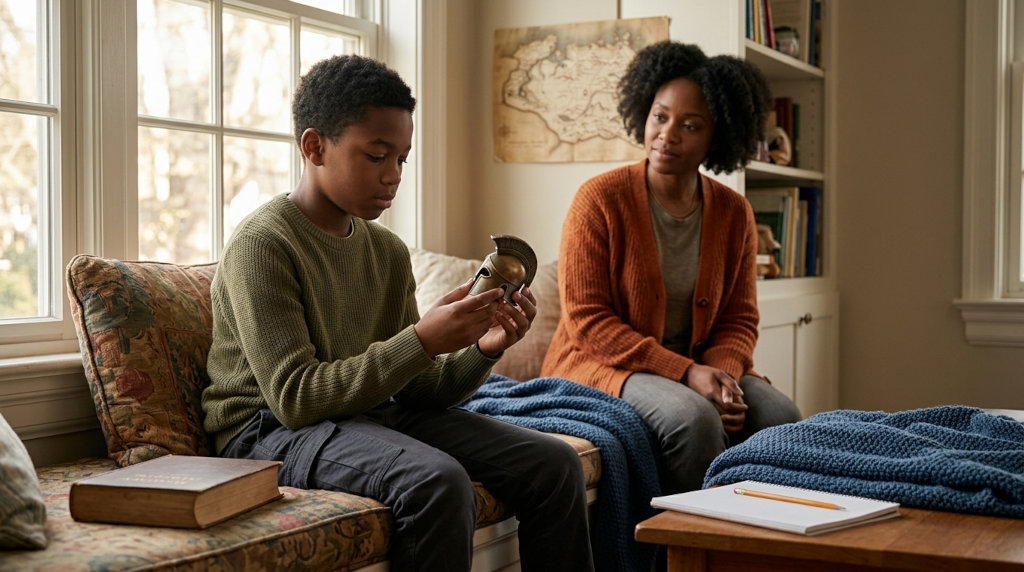
“How do I know if my child is actually retaining what they’ve learned in history?”
Sometimes the answer seems contradictory.
Your child cannot remember the date of a battle.
The name of a ruler is gone.
A timeline that once seemed clear has become blurry.
But months later, the child vividly recalls the story of a gladiator facing the arena, a family separated by slavery, a ruler making a disastrous choice, or a civilization collapsing after years of pressure.
Parents often interpret this pattern as selective attention.
“My child only remembers the dramatic parts.”
“They remember the stories, but not the real history.”
“They enjoyed it, but I’m not sure they learned anything.”
Research on memory and narrative suggests a different interpretation.
The story may be what made the history memorable.
Emotionally meaningful experiences often create stronger memory traces than disconnected information. Curiosity, admiration, fear, wonder, empathy, outrage, and surprise can all influence what receives deeper attention and remains accessible later.
This does not mean that emotion replaces evidence, chronology, or factual knowledge.
It means that emotion can help organize and anchor them.
This article examines one specific part of the larger retention question:
Why do children remember some parts of history for years while forgetting others within weeks?
Often, they remember what moved them because emotional significance helped the learning take hold.
The Mystery of Selective Memory
Selective memory can be frustrating.
A child studies ancient Rome and forgets the dates of the Punic Wars, but remembers the story of Hannibal crossing the Alps.
A child cannot name every stage of the abolitionist movement but remembers Frederick Douglass learning to read.
A child confuses Egyptian dynasties but remembers the fear and uncertainty surrounding the death of a pharaoh.
A child forgets several details of the Industrial Revolution but vividly recalls children working in dangerous factories.
From a fact-centered perspective, this pattern looks uneven.
The child seems to have retained whatever was exciting, sad, strange, or dramatic while losing the academically important content.
But emotion does not merely decorate memory.
It helps direct attention.
It influences what the mind treats as significant.
When information creates a meaningful response, the learner is more likely to process it deeply, connect it with existing knowledge, discuss it, revisit it mentally, and remember it later.
This is one reason memories of stories often survive when lists do not.
A story provides people, goals, danger, choices, conflict, consequence, and change.
A list provides information.
Both may be accurate, but they do not ask the mind to do the same work.
Why Emotion Matters to Memory
Memory is selective by necessity.
Children encounter far more information than they can preserve in equal detail. The mind must decide—often without conscious intention—which experiences deserve greater attention.
Emotion helps mark significance.
An event associated with surprise, curiosity, fear, admiration, or moral concern is less likely to be treated as ordinary background information.
The emotional response signals:
“This matters.”
That signal can deepen processing.
A child who reads that thousands of people were displaced by a war may register the fact.
A child who follows the experience of one family forced to leave home may begin to understand what displacement meant.
The family’s story provides a human structure for the larger event.
The child may later forget the exact number of displaced people. But the concept of displacement, the choices families faced, and the consequences of war may remain vivid.
That emotional memory can become a route back to the broader history.
The same is true of positive emotions.
Awe can make architecture memorable.
Admiration can anchor a story of courage.
Curiosity can make an unusual object or practice difficult to forget.
Humor can preserve a surprising historical detail.
Wonder can motivate a child to keep asking questions after the lesson ends.
Emotion is not one single feeling. It is the experience of significance.
Emotional Memory Is Not Perfect Memory
Emotion can strengthen memory, but it does not preserve every detail accurately.
Children may remember the dramatic center of a story while losing chronology, context, or qualification.
They may remember one person so strongly that the individual appears more representative than the evidence allows.
They may remember an injustice but oversimplify the institutions and pressures surrounding it.
They may remember the emotional tone of an event while confusing names or sequence.
This means emotional memory should be treated as an anchor, not as a complete historical account.
The anchor gives the parent somewhere to begin.
A child remembers the suffering of enslaved workers.
The parent can reconnect that memory with the economic system, laws, social hierarchy, geography, resistance, and historical change surrounding it.
A child remembers Caesar’s assassination.
The parent can return to the decline of republican institutions, military loyalty, civil war, and the political consequences that followed.
A child remembers the terror of a city under siege.
The parent can reconnect that response with strategy, resources, geography, leadership, and civilian experience.
Emotion makes the doorway memorable.
Historical study still needs to explore what lies beyond it.
History Is Naturally Emotional
History is the study of people making choices under real conditions.
Those conditions include:
- fear
- ambition
- loyalty
- hunger
- faith
- hope
- grief
- injustice
- courage
- humiliation
- sacrifice
- survival
- curiosity
- conflict
Removing those elements does not make history more rigorous.
It makes history less complete.
A revolution is not only a sequence of dates. It involves people deciding that an existing political order can no longer continue.
A migration is not only movement across a map. It involves departure, uncertainty, opportunity, loss, adaptation, and conflict.
An empire is not only territory. It involves conquest, administration, taxation, cultural exchange, resistance, privilege, and coercion.
A reform movement is not only legislation. It involves people recognizing a problem, arguing about causes, opposing change, and accepting risk.
When children respond emotionally, they may be reacting to the human reality of the subject.
That response can motivate deeper historical questions:
- Why did people accept this?
- Why did no one stop it?
- What choices did they have?
- Who benefited?
- Who suffered?
- What did they believe?
- What would have happened if they resisted?
- How do we know what they experienced?
Emotion can therefore become the beginning of historical inquiry.
Why Stories Work Better Than Lists
Stories organize information.
They provide sequence:
Something happened before something else.
They provide causation:
A decision created a consequence.
They provide motivation:
A person wanted, feared, believed, or misunderstood something.
They provide conflict:
Different goals or pressures collided.
They provide change:
The situation ended differently from how it began.
These features make narrative a natural structure for historical learning.
Consider two ways of presenting the decline of the Roman Republic.
The first is a list:
- military reforms
- political rivalry
- economic inequality
- civil war
- Julius Caesar
- assassination
- Octavian
- end of the Republic
The second is a narrative:
Roman generals increasingly depended on the loyalty of their soldiers. Political rivals used military power against one another. Caesar crossed into Italy with his army, defeated his opponents, and accumulated extraordinary authority. Senators who feared the loss of the Republic assassinated him. Instead of restoring stability, the assassination produced further civil war, and Octavian eventually became Rome’s first emperor.
The list contains useful components.
The narrative shows their relationship.
A child may not retain every detail, but the story provides a causal framework.
Military loyalty weakened political institutions.
Fear of one-man rule led to assassination.
The assassination produced the opposite of what the conspirators intended.
That framework is easier to remember because it has movement and consequence.
Narrative does not eliminate facts.
It gives facts structure.
The Difference Between Drama and Meaning
Emotionally engaging history does not require exaggeration, spectacle, or constant entertainment.
There is a difference between meaningful engagement and manufactured drama.
Meaningful engagement emerges from the historical subject itself.
A child may be moved by:
- an ordinary person facing an impossible choice
- the discovery of a letter
- a family adapting to war
- a leader misunderstanding a crisis
- the design of an ancient building
- the persistence of an archaeological object
- the gradual collapse of a political system
- a debate over justice
- the daily life of someone unlike the child
These do not all require battles, disasters, or heroic figures.
Quiet historical experiences can be emotionally powerful.
The goal is not to make every lesson thrilling.
The goal is to help children perceive why the subject mattered to the people who lived it and why it still matters enough to study.
Curiosity Is an Emotional Response
Emotion in learning is often discussed in terms of empathy or sadness, but curiosity is equally important.
A child may become fascinated by:
- how ancient builders moved stone
- why a civilization settled near a river
- what ordinary people ate
- how messages traveled
- why soldiers obeyed
- how archaeologists know what happened
- what a strange object was used for
- why two sources disagree
Curiosity creates a gap between what the child knows and wants to know.
That gap encourages attention.
A curious child is more likely to ask questions, seek explanations, make connections, and return to the subject.
These repeated mental encounters strengthen memory.
A fact discovered in response to a genuine question often becomes more memorable than the same fact supplied without context.
This is another reason parent observation matters.
A child’s repeated question or fascination may be evidence that a durable learning pathway is forming.
Awe and Wonder Help Children See Scale
History contains experiences of scale that can be difficult to grasp through description alone.
- the size of an empire
- the age of a monument
- the distance of a migration
- the number of people affected by a war
- the labor required to build a city
- the continuity of a tradition
- the survival of an artifact across centuries
Awe helps children register that scale.
Standing before an ancient structure, examining a detailed reconstruction, or imagining generations living in the same place can make time and human achievement feel real.
The emotional response becomes connected with historical perspective.
A child may later forget measurements or dates but retain the understanding that this achievement required enormous organization, labor, knowledge, and authority.
That is not trivial retention.
It is a conceptual foundation.
Outrage Can Become Historical Inquiry
Children often respond strongly to injustice.
They may be disturbed by slavery, conquest, religious persecution, political repression, child labor, displacement, or unequal treatment.
Parents sometimes worry that these reactions are emotional rather than analytical.
But outrage can create important historical questions.
- How did this system become normal?
- Who defended it?
- Who resisted?
- What laws supported it?
- Who profited?
- Why did change take so long?
- Did people at the time recognize the injustice?
- What evidence survives from those who suffered?
These questions move the child beyond simply declaring something wrong.
They encourage investigation of institutions, beliefs, interests, power, and historical change.
The emotional response becomes educationally valuable when it leads to context and evidence.
Parents can help by acknowledging the reaction without allowing it to end the inquiry.
“That was unjust” may be true.
History asks the next questions:
“How did it work?”
“Why did it continue?”
“What changed it?”
Historical Empathy Is Not the Same as Approval
Historical empathy means trying to understand how people in the past perceived their circumstances.
It does not mean excusing harmful behavior.
It does not require children to agree with historical people.
It requires an effort to reconstruct context.
A child studying a political leader might ask:
- What information did the leader have?
- What pressures existed?
- What options seemed possible?
- What beliefs shaped the decision?
- What consequences were foreseeable?
- What could the person not have known?
This form of empathy strengthens historical understanding because it resists the assumption that people in the past thought exactly as we do.
It also prevents history from becoming a flat contest between heroes and villains.
A child can recognize that a person faced real pressures while still judging the person’s choices critically.
A child can understand why a society accepted an institution without concluding that the institution was justified.
Empathy adds context.
Evidence and moral reasoning remain necessary.
Identification Creates Memory—but Requires Care
Children often remember historical figures they admire, relate to, or imagine themselves beside.
A child may identify with:
- a young person living through war
- an inventor solving a problem
- a ruler under pressure
- a rebel challenging authority
- an explorer entering an unfamiliar place
- a writer preserving forbidden ideas
- an ordinary worker enduring difficult conditions
Identification can make the past feel immediate.
It can also distort understanding if one person’s experience is treated as universal.
A diary may provide powerful insight, but it represents one perspective.
A heroic story may inspire, but it may hide the contributions of others.
A child’s favorite historical figure can become a strong memory anchor, but parents should continue widening the frame:
- Who else experienced this event?
- Would everyone have seen this person the same way?
- Whose voice is missing?
- What larger system shaped this individual’s choices?
Identification draws the child into history.
Context prevents that identification from narrowing it.
Emotion and Rigor Are Not Competitors
Some parents worry that emotionally engaging history is less academically serious.
They may assume that rigorous learning should be difficult, restrained, and somewhat detached.
But rigor does not mean emotional absence.
Rigor means:
- accurate information
- careful use of evidence
- appropriate context
- clear distinctions between fact and inference
- willingness to consider multiple perspectives
- precise causal reasoning
- revision when evidence changes
None of these requires boredom.
In fact, emotional engagement can motivate children to pursue these tasks more seriously.
A child who cares about a historical person may want to know whether a popular story is accurate.
A child disturbed by an injustice may examine how the system functioned.
A child fascinated by an ancient city may pay close attention to architecture, trade, labor, and social hierarchy.
The emotional connection creates a reason to investigate.
Rigor governs the investigation.
Historical-Learning Application
Imagine that your child studies gladiatorial combat in ancient Rome.
Several months later, the child cannot remember the dates associated with a particular amphitheater or name every gladiator type.
But the child remembers a story about an enslaved fighter entering the arena.
The child recalls that gladiators trained professionally, that the crowd influenced the atmosphere, that survival involved both skill and social forces, and that the fighter’s status limited the choices available.
The emotional center of the story created several historical pegs:
- slavery and status
- public spectacle
- professional training
- political entertainment
- violence as social institution
- crowd behavior
- restricted personal agency
Those ideas can support future learning about Roman society.
The parent can make the learning more visible by asking:
“What do you remember about why Romans attended the games?”
“Was the gladiator simply a soldier?”
“What choices did the fighter have?”
“Who benefited from the spectacle?”
“What did the arena reveal about Roman society?”
The child’s remembered story becomes an entry point into social hierarchy, politics, labor, entertainment, and violence.
The emotional memory is not separate from the history.
It is carrying the history.
Signs That Emotional Learning Is Lasting
Parents can watch for several forms of evidence.
Repeated stories
The child returns to the same historical event or person months later.
Repetition suggests that the material remains mentally active.
Strong reactions
The child still expresses admiration, concern, anger, sadness, or fascination.
The reaction indicates that the subject retained significance.
Remembered motives
The child may forget a name but remember what a person wanted or feared.
Motivation is part of historical understanding.
Remembered consequences
The child recalls that a decision harmed a group, triggered conflict, or changed a political system.
This shows causal retention.
Moral questions
The child continues asking whether a decision was fair, avoidable, justified, or effective.
These questions indicate that the event remains available for thought.
Spontaneous connections
A new topic reminds the child of the earlier story.
This shows transfer.
Continued inquiry
The child asks to learn more, seeks another book, or raises a new question later.
Curiosity has survived the lesson.
These signs do not replace all factual assessment.
They show that the historical material achieved durable significance.
When Emotional Engagement Becomes a Problem
Emotion helps memory, but it can also overwhelm or simplify learning.
Parents should be cautious when:
- dramatic details overshadow the larger context
- suffering is presented primarily for shock
- children are exposed to material beyond their emotional readiness
- heroic narratives erase complexity
- one vivid anecdote is treated as representative of everyone
- moral judgment replaces investigation
- fictionalized details become confused with evidence
- emotional manipulation is used to force a conclusion
The goal is not maximum emotional intensity.
The goal is meaningful connection within accurate historical context.
Children should have room to respond without being pressured to feel a particular way.
They may react differently from the parent.
One child may be moved by an individual story.
Another may be fascinated by technology, landscape, or political structure.
A third may respond most strongly to a historical mystery.
Emotional engagement is not one prescribed response.
It is the experience of finding the subject meaningful.
Practical Takeaways for Homeschooling Parents
Notice what your child remembers voluntarily.
Repeated stories, favorite figures, strong questions, and spontaneous connections are evidence worth taking seriously.
Do not dismiss story memory as “only” remembering the interesting parts.
The interesting part may be carrying the larger framework.
Use people as entry points.
Historical individuals can help children understand institutions, conflicts, and consequences.
Connect emotion back to context.
Ask what conditions produced the experience and who else was affected.
Let children respond honestly.
Do not require admiration, sadness, or outrage. Invite reflection.
Ask questions such as:
- What surprised you?
- Who did you understand best?
- Whose situation was hardest to imagine?
- Why do you think that decision mattered?
- Was there another choice?
- Who was affected most?
- What would you want to know before judging this person?
- What does this story help us understand about the society?
Use stories to organize facts.
Names, dates, places, and terminology become easier to retain when attached to a meaningful sequence.
Return to emotional anchors during review.
A remembered person or event can reactivate a larger unit.
Preserve complexity.
Ask whose perspective is missing and whether the story represents everyone.
Distinguish empathy from approval.
Understanding why someone acted does not require accepting the action.
Allow curiosity to guide extension.
A child’s fascination can lead naturally into deeper research.
Avoid artificial drama.
Ordinary life, work, family, architecture, belief, and survival can be as memorable as war or disaster.
Balance emotional meaning with evidence.
A powerful story should lead toward historical investigation, not replace it.
Most importantly, recognize emotional memory as a legitimate form of retained learning.
It may be the most visible sign that the subject became meaningful.
Conclusion
Children do not remember every part of history equally.
Dates, names, and isolated facts may fade while a story, person, conflict, or moral question remains vivid for years.
That pattern is not necessarily evidence of shallow learning.
Emotion often helps determine what receives deeper attention, stronger encoding, and repeated mental use.
Narrative provides structure.
Empathy provides human context.
Curiosity motivates inquiry.
Awe communicates scale.
Outrage can lead to investigation of power and injustice.
Identification can make the past immediate.
These responses do not compete with rigor.
When guided by evidence and context, they can support it.
Emotional retention does not answer every question about historical learning. Children still need factual knowledge, chronological structure, retrieval, review, and opportunities to explain what they understand.
But when a child remembers what moved them, parents should not assume that only the entertaining portion survived.
The remembered story may be holding together an entire network of historical meaning.
Your child may forget the date.
Your child may still remember why the event mattered.
Turn What Moves Them Into History That Sticks
If your child remembers what surprised, intrigued, or moved them, build on that strength. Each monthly Spot the Anachronism challenge gives them a historical scene worth investigating: notice what feels wrong, explain why, and use evidence to reconstruct how the world should work. That repeatable cycle turns curiosity into durable understanding while giving you a ready-to-use way to revisit context, causation, and daily life – without reducing history to another list to memorize.
This Article Is Part Of A Larger Series
Question: How do I know if my child is actually retaining what they’ve learned in history?
Series Position: Article 8 of 11
This article explores one evidence-supported aspect of the larger question. Readers interested in the full answer should explore the complete series.
Related Facebook Discussions
- See how fatigue, posture, and physical effort can turn a historical figure into someone a child can understand and remember.
- Explore how crowd pressure, movement, hierarchy, and scale can transform Roman architecture from an empty backdrop into a memorable human environment.
- See how a worn, functional object can lead a child from an immediate visual reaction into questions about labor, maintenance, status, and daily life.