Who Wrote This, and Why? Teaching Kids to Read History Like Historians
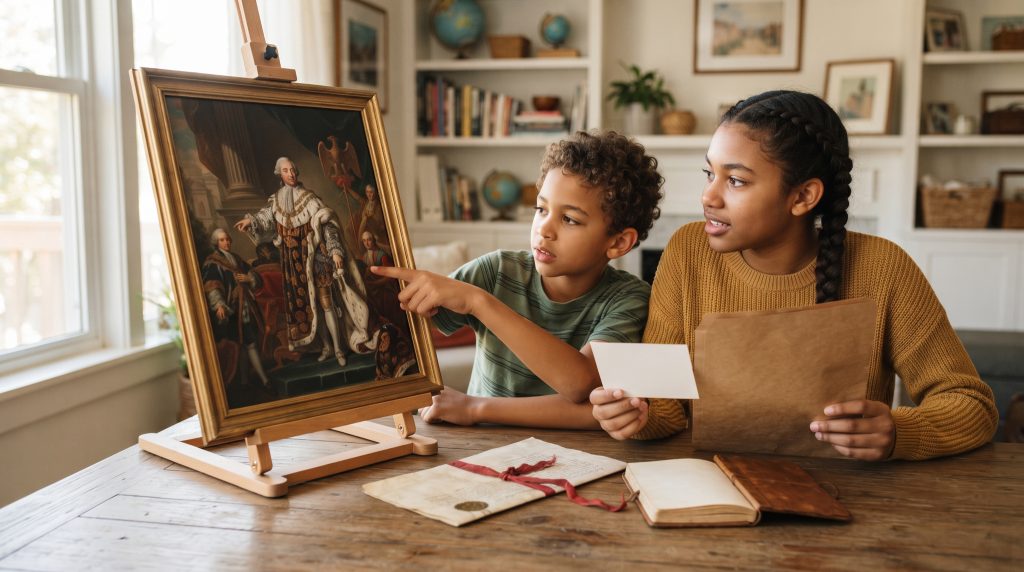
Many homeschooling parents eventually ask some version of the same question: Are we doing too much memorization of dates and names instead of actual understanding?
It is an understandable concern. A child may be able to recite that a battle happened in a certain year, name a king or president, or list the major events in a chapter — and yet still seem unsure what any of it means. The parent senses that “knowing history” should involve more than storing information. But then the practical question follows: What should replace memorization?
This article explores one of the clearest answers: children can learn to evaluate historical sources.
Instead of treating history as a finished list of facts, students can begin asking where historical claims come from, who made them, why they made them, and how much trust we should place in them. That shift changes history from information transfer into investigation.
The Central Shift: From “What Happened?” to “Who Is Telling Us?”
In many history lessons, the first question is factual:
What happened?
That is not a bad question. Children do need to learn events, people, places, and sequences. Dates and names are not useless. They help anchor memory and give students a basic timeline.
But historians do not stop there. In fact, trained historians often begin somewhere else entirely. When they encounter a document, speech, letter, diary entry, painting, newspaper account, or inscription, they do not simply ask, “What facts can I pull out of this?”
They ask:
- Who created this?
- When was it created?
- Why was it created?
- Who was supposed to read or see it?
- What did the author want people to believe?
- What might be missing?
- How does this compare with other evidence?
That habit is called sourcing. It is one of the foundational practices of historical thinking.
Educational researcher Sam Wineburg famously studied the difference between how historians and students read historical documents. Students often tried to extract facts directly from the page. Historians, by contrast, immediately questioned the document itself. They looked at authorship, purpose, context, audience, and reliability before deciding what the document could tell them.
That difference matters for homeschooling because it gives parents a practical way to move beyond memorization without abandoning structure. The alternative to rote recall is not vague discussion. It is guided inquiry.
Historians Read Like Detectives
A detective does not treat every witness statement as equally reliable. A witness may be honest but mistaken. Another may be biased. Another may have seen only part of the event. Another may be trying to protect someone. Another may be repeating a rumor.
Historians face the same problem.
A soldier’s letter, a royal decree, a newspaper article, a political speech, a diary entry, and a textbook paragraph may all contain useful information. But none of them should be read as if they dropped from the sky as pure truth. They were created by people, and people have perspectives, motives, limitations, and blind spots.
That does not mean children should become cynical. The goal is not to teach, “Everyone lies, so nothing can be trusted.” The goal is to teach careful judgment.
A child can learn to say:
“This person was there, so their account matters. But they were also trying to persuade people, so we should pay attention to what they emphasize.”
Or:
“This textbook gives a summary, but I wonder what evidence the author used.”
Or:
“These two people describe the same event differently. Maybe they saw it from different positions, or maybe they cared about different things.”
That is historical thinking. It is not memorization, but it is also not free-form opinion. It is disciplined questioning.
Why Textbooks Can Hide the Most Important Part
Textbooks are useful. They organize information, provide sequence, and help children see the broad shape of a period. A well-written textbook can be an excellent homeschool tool.
But textbooks often hide the process by which historical knowledge is built.
A textbook may say, “The colonists were angry about taxation,” or “The emperor’s reforms weakened the old political order,” or “Industrialization changed family life.” Those statements may be accurate, but they usually arrive as conclusions. The child does not always see the evidence behind them.
That can make history feel strangely flat. The student receives the answer without seeing the investigation.
Primary sources help reopen that process. A letter, law code, diary, speech, advertisement, painting, map, artifact, or newspaper clipping lets the child see that history is not merely “what the book says.” It is built from evidence.
For example, instead of only reading that people disagreed about a revolution, students might compare two short excerpts: one from a supporter and one from a critic. Suddenly, the event is no longer just a heading in a chapter. It becomes a contested human situation. People had reasons. They feared consequences. They justified themselves. They misunderstood one another. They used language to persuade.
That is where understanding begins to deepen.
Children Can Start Earlier Than Many Parents Think
Some parents assume source analysis is too advanced for younger children. They imagine it belongs in high school or college, after students have already memorized the basics.
But the basic habit can begin much earlier.
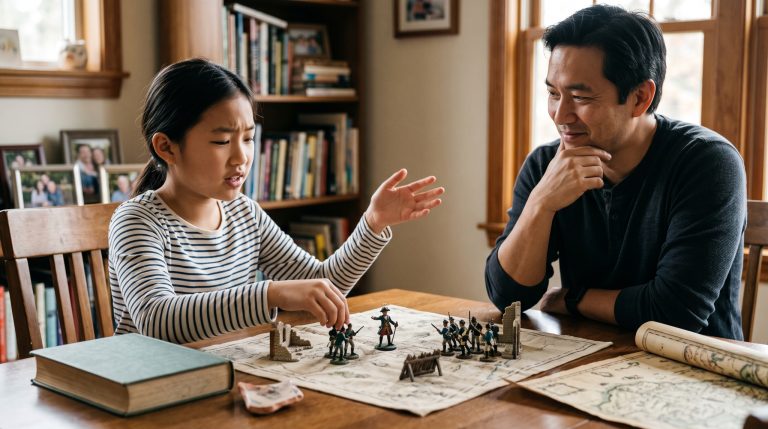
A young child does not need to write a sophisticated document analysis. The parent can simply ask age-appropriate questions:
“Who made this picture?”
“Was this person there?”
“Do you think this person liked the king or disliked him?”
“Why might someone write this down?”
“What do you notice?”
“What do you wonder?”
Even elementary-age children can understand that people see things differently. They know siblings may tell different versions of the same event. They know a person trying to avoid blame may leave something out. They know a person trying to win an argument may exaggerate.
Those everyday experiences are a bridge into historical source evaluation.
With older students, the questions can become more precise:
“What was the author’s social position?”
“What audience was this intended for?”
“What would this source help us understand?”
“What can this source not tell us?”
“What other evidence would we need before making a strong claim?”
The skill grows over time. It does not need to arrive all at once.
Four Questions Every Child Can Learn
A simple sourcing framework can fit into almost any homeschool history lesson. Parents do not need a specialized curriculum to begin. They can add four questions to ordinary reading:
1. Who wrote or created this?
This question reminds children that historical information comes from somewhere. A diary entry, government proclamation, textbook paragraph, painting, and newspaper article are not the same kind of evidence. Each has a creator.
2. Why did they create it?
Was the source meant to record private thoughts? Persuade voters? Praise a ruler? Sell a product? Report an event? Defend an action? Entertain an audience?
Purpose shapes reliability.
3. What did they want people to believe?
This question helps children notice persuasion. A political speech, for example, is not merely a list of facts. It is trying to move an audience toward a conclusion.
4. What might they not be telling us?
This is often the most powerful question. It teaches children to look for omissions, not just statements. A source may be valuable and incomplete at the same time.
These questions can be asked quickly. They do not need to turn every lesson into a long seminar. Even two minutes of sourcing can change how a child reads history.
Historical-Learning Application: Reading a Letter as Evidence
Imagine a homeschool lesson about a war. The textbook gives the basic outline: causes, major battles, leaders, and outcome. That provides useful structure.
Now add a short letter from a soldier.
A memorization-centered lesson might ask:
“What battle does the soldier mention?”
“When was the letter written?”
“What army was he in?”
Those questions are not wrong. But they mostly ask the child to retrieve information.
A source-evaluation lesson goes further:
“Who wrote this letter?”
“Was he writing for the public or for his family?”
“What does he seem worried about?”
“What does he describe in detail?”
“What does he avoid mentioning?”
“Does this letter tell us what the whole war was like, or only what one person experienced?”
“Would a general, a civilian, or an enemy soldier describe the same event differently?”
Now the child is doing something more historically meaningful. The letter becomes evidence, not just reading material. The student begins to understand that history is constructed from partial human records.
This also improves discussion. Instead of asking only, “Do you remember what happened?” the parent can ask, “How much can we learn from this source?” That question invites observation, judgment, and humility.
It also helps memory. Children are more likely to remember a historical situation when they have investigated a person’s perspective, noticed contradictions, and discussed motives. Facts become connected to a meaningful problem.
Practical Takeaways for Homeschooling Parents
The most important change is simple: ask more sourcing questions.
You do not need to remove dates, names, maps, timelines, or memory work. The goal is not to discard factual knowledge. The goal is to connect facts to evidence and interpretation.
Here are several practical principles.
First, treat textbooks as starting points, not the whole lesson. After reading a summary, ask, “What kinds of sources would help historians know this?”
Second, use short primary-source excerpts. A paragraph from a letter, a few lines from a speech, a diary entry, a law, a newspaper clipping, or an image can be enough.
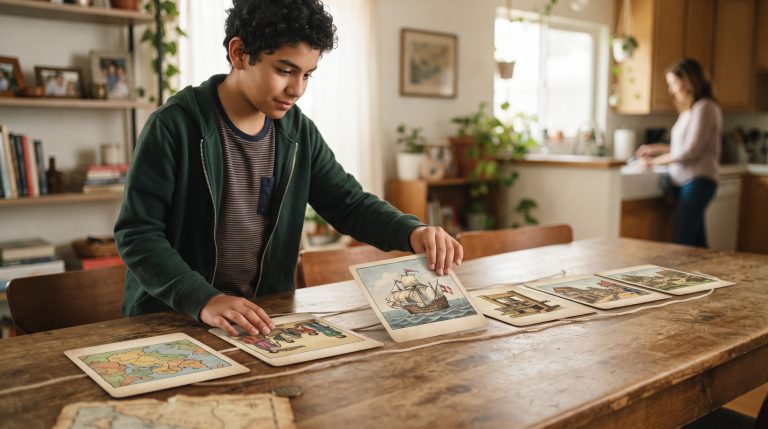
Third, compare two accounts of the same event. Children quickly notice that people emphasize different details. That comparison makes historical interpretation visible.
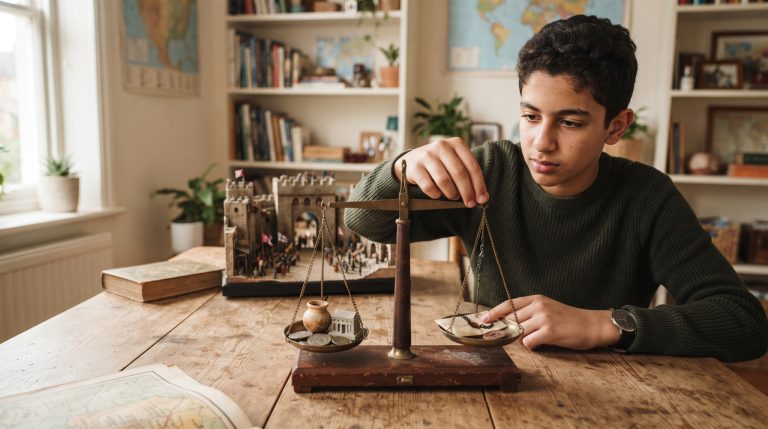
Fourth, use images as sources. A painting, photograph, coin, monument, or artifact can be discussed historically. Ask who made it, what it shows, what it leaves out, and what message it may have been meant to send.
Fifth, replace some factual questions with investigative ones.
Instead of only asking:
“When did this happen?”
Also ask:
“Who is telling us this happened?”
Instead of only asking:
“What did this leader do?”
Also ask:
“How do we know?”
Instead of only asking:
“What was life like then?”
Also ask:
“Whose life are we hearing about, and whose life is missing?”
These questions help children move from passive reception to active evaluation.
Conclusion
The concern behind the question “Are we doing too much memorization of dates and names instead of actual understanding?” is legitimate. If history becomes only recall, children may learn to repeat information without learning how historical knowledge works.
Source evaluation offers one concrete alternative.
When children learn to ask, “Who wrote this, and why?” they begin reading history more like historians. They learn that historical accounts are built from evidence, that sources have perspectives, and that understanding requires judgment. This does not eliminate the need for factual knowledge. Instead, it gives facts a richer purpose.
This article does not answer the entire question of memorization versus understanding. Other parts of the larger discussion need to address causation, empathy, retention, curriculum structure, and the role of dates themselves. But source evaluation contributes one essential piece of the answer: meaningful history education teaches children not only to remember what they read, but to question how we know.
Turn “How Do We Know?” Into a Monthly History Habit
Your child does not learn to question historical evidence by hearing one explanation—they learn by practicing the questions themselves. Spot the Anachronism turns richly detailed historical scenes into recurring investigations: What belongs here? What does not? What evidence supports that judgment? Each monthly activity gives your family a ready-made way to move beyond passive recall and practice observation, sourcing, comparison, and evidence-based reasoning together. Instead of adding another lesson to prepare, you get an active visual challenge that helps your child build the habits historians actually
This Article Is Part Of A Larger Series
Question: Are we doing too much memorization of dates and names instead of actual understanding?
Series Position: Article 5 of 11
This article explores one evidence-supported aspect of the larger question. Future articles examine additional research-supported approaches to increasing engagement with history.
Related Facebook Discussions
- See how examining belts, fasteners, textiles, and other small details can teach children to evaluate the evidence inside a historical image.
- Explore how asking what an object is doing can turn a Roman image from something to recognize into evidence to investigate.
- Consider how comparing every part of a scene can help children decide whether its historical claims form one coherent world.