The Boredom Map: Why Different Children Get Bored with History for Different Reasons
“My Child Hates History” Is Not a Diagnosis
Few homeschooling frustrations are as common—or as discouraging—as hearing a child say:
“History is boring.”
Parents often respond exactly as you would expect.
They look for a better curriculum.
They add hands-on activities.
They try videos, projects, books, games, and discussions.
Sometimes these changes work.
Sometimes they don’t.
When they fail, the experience can feel deeply confusing. If one child becomes fascinated by a new approach while another remains disengaged, how are parents supposed to know what to try next?
Part of the problem is that “history is boring” is not actually a diagnosis.
It is a symptom.
Just as a headache can have many causes, boredom can have many causes.
This article explores a specific aspect of the larger question:
How do I make history engaging when my child finds it completely boring?
Before asking how to make history engaging, it may be more useful to ask:
Why is my child disengaging in the first place?
Research and parent experiences suggest that history boredom is not one problem. It is a collection of different problems that often look similar on the surface.
Understanding the difference can make it much easier to identify productive next steps.
Why Boredom Is More Complicated Than It Looks
Imagine two children sitting at the same history lesson.
Both appear uninterested.
Both avoid the assignment.
Both describe the lesson as boring.
Yet their reasons may be completely different.
One child may feel overwhelmed by too many unfamiliar facts.
Another may understand the facts perfectly but see no reason to care about them.
One may crave stories.
Another may crave discussion.
One may be exhausted by repetitive activities.
Another may want more opportunities to ask questions.
From the outside, all of these situations look similar.
The child is disengaged.
From an instructional perspective, however, they are very different problems.
Different causes often require different responses.
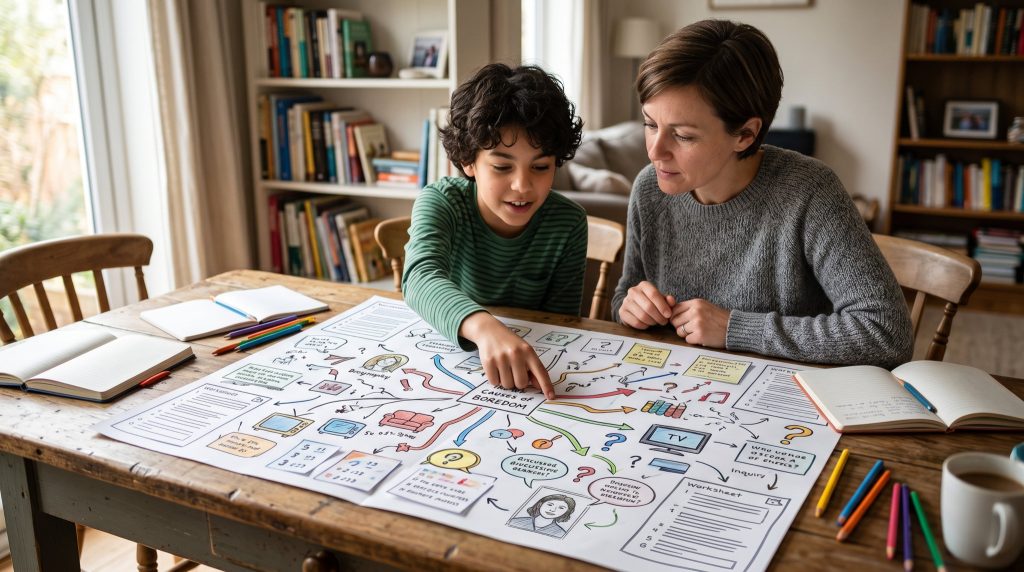
That is why it can be helpful to think of history boredom not as a single condition but as a map of possible pathways.
The goal is not to place every child into a neat category.
The goal is to identify patterns that may explain what is happening.
Type 1: Story Starvation
Some children do not dislike history.
They dislike history without people.
These learners often encounter lessons filled with facts, dates, and summaries but very little narrative.
History feels disconnected from human experience.
Common signs include:
- They remember stories better than summaries.
- They ask questions about historical figures.
- They enjoy biographies or documentaries.
- They seem more interested in people than timelines.
A child experiencing story starvation may not be rejecting history.
They may be looking for the human dimension that makes history meaningful.
For these learners, the past becomes interesting when it revolves around choices, conflicts, personalities, and consequences rather than information alone.
Type 2: Fact Overload
Other children experience a different problem.
They are overwhelmed.
History often introduces:
- unfamiliar names
- unfamiliar places
- unfamiliar cultures
- unfamiliar vocabulary
- complex sequences of events
For some learners, this volume of information becomes difficult to organize.
Instead of building understanding, the lesson feels like an endless stream of disconnected facts.
Common signs include:
- Frequent confusion between historical figures.
- Difficulty remembering details.
- Frustration during memorization activities.
- Shutting down when too much information is presented at once.
These children are not necessarily unwilling to learn.
They may simply need more structure, context, and time to connect information together.
Type 3: Relevance Failure
Some learners constantly ask:
“Why do I need to know this?”
This question is sometimes interpreted as laziness or resistance.
Often it is neither.
The learner genuinely cannot see why the material matters.
History feels disconnected from their life, interests, questions, or concerns.
Common signs include:
- Rapid disengagement.
- Frequent questioning of the lesson’s purpose.
- Minimal curiosity about historical events.
- Difficulty seeing connections between past and present.
These children often become more engaged when historical topics connect to questions they already care about:
- leadership
- technology
- inventions
- exploration
- conflict
- justice
- family life
- survival
The issue is not always the content itself.
It is often the absence of visible meaning.
Type 4: Repetition Fatigue
Some children begin a history program enthusiastically and then gradually lose interest.
Parents sometimes assume the subject stopped appealing to them.
In reality, they may be reacting to instructional monotony.
Many history programs rely heavily on recurring activity patterns:
- reading
- worksheets
- timelines
- maps
- narration
- review exercises
None of these activities are inherently problematic.
The challenge arises when the experience rarely changes.
Common signs include:
- Initial enthusiasm followed by declining interest.
- Resistance to familiar assignments.
- Increased engagement when the format changes.
- Complaints that lessons feel repetitive.
The HPQ evidence itself includes examples of this phenomenon, with parents describing children who became disengaged after repeating similar mapping activities year after year.
The child may not be tired of history.
They may be tired of doing history in exactly the same way.
Type 5: Inquiry Deprivation
Some learners want participation rather than reception.
These children often enjoy:
- asking questions
- debating ideas
- exploring possibilities
- solving problems
Yet many history lessons ask them primarily to receive information.
Common signs include:
- Frequent questioning during lessons.
- Strong opinions about historical events.
- Enjoyment of discussion.
- Resistance to lecture-style instruction.
For these learners, boredom often emerges when history becomes something they passively consume rather than actively investigate.
They want opportunities to ask:
- Why did this happen?
- Could things have happened differently?
- Was that decision justified?
- How do we know this is true?
These are not distractions from historical learning.
They are historical thinking in action.
Historical-Learning Application
One of the most useful shifts a homeschooling parent can make is treating boredom as information rather than failure.
Instead of asking:
Why won’t my child engage?
Try asking:
What kind of disengagement am I seeing?
Observe patterns.
Notice when attention increases and decreases.
Pay attention to the questions your child asks.
Look for moments of spontaneous curiosity.
Some useful reflection questions include:
- Does my child become more interested when people are involved?
- Do they seem overwhelmed by information?
- Do they struggle to see why the material matters?
- Does engagement decline when activities become repetitive?
- Do they want more opportunities to ask questions and discuss ideas?
These observations can reveal important clues about how your child learns history best.
In this sense, boredom becomes something to investigate rather than simply eliminate.
Practical Takeaways
Before making major curriculum changes, consider gathering information.
Observe Patterns
Look for recurring conditions under which engagement rises or falls.
Patterns are often more informative than isolated incidents.
Ask Specific Questions
Instead of asking:
Did you like today’s lesson?
Try asking:
What part felt interesting?
What part felt boring?
What made the difference?
Change One Variable at a Time
When experimenting, make small adjustments.
Changing everything at once makes it difficult to identify what actually helped.
Follow Curiosity
Pay close attention to moments when your child voluntarily engages.
Those moments often reveal useful pathways forward.
Treat Boredom as Data
Disengagement is frustrating, but it is also informative.
The goal is not to force enthusiasm.
The goal is to understand what the boredom may be communicating.
Conclusion
Many parents approach history boredom as though it has a single cause and therefore requires a single solution.
Research and experience suggest otherwise.
Some children are disengaged because they need more narrative.
Others are overwhelmed by facts.
Some struggle to see relevance.
Others are exhausted by repetition or deprived of opportunities for inquiry.
Understanding the source of the boredom is often more important than changing the curriculum.
This article does not provide a complete answer to how history becomes engaging.
Instead, it offers a framework for understanding why engagement may be missing in the first place.
The goal is not simply to remove boredom.
The goal is to learn what the boredom is trying to tell you.
Spot the Anachronism Is Part of the Answer
One reason some children disengage from history is that they never develop the habit of careful observation.
Spot the Anachronism trains students to look closely, notice details, identify patterns, and ask questions about what they see.
Those same observation skills often become the foundation for deeper curiosity and engagement with history.
This Article Is Part Of A Larger Series
Question: How do I make history engaging when my child finds it completely boring?
Current article: Article 4 of 10 — Diagnostic Framework
This article explores one evidence-supported aspect of the larger question. Future articles examine additional research-supported approaches to increasing engagement with history.