I Hated History Too
Many homeschooling parents ask some version of this question: “Are we doing too much memorization of dates and names instead of actual understanding?”
It is a practical question, but it is rarely only practical.
Yes, parents may be wondering whether a curriculum is too worksheet-heavy, whether their child should be remembering more, or whether quizzes are measuring the right thing. But underneath those concerns is often something more personal:
“I hated history in school. Is my child starting to hate it too?”
That question carries weight because many parents are not just evaluating their child’s history lessons. They are revisiting their own experience as students. They remember history as a blur of dates, names, wars, kings, presidents, battles, and chapter tests. They remember trying to remember things just long enough to pass a quiz. They remember forgetting most of it soon afterward. And they remember wondering why any of it mattered.
This article explores that hidden layer of the larger question: what happens when parents who disliked history are now responsible for teaching it?
The answer is not that those parents are unqualified. It is that many of them were given a narrow model of history education, and without meaning to, they may be reproducing the very model that failed them.
The History Many Parents Remember
For many adults, school history was not presented as a way of understanding human choices, societies, conflicts, ideas, inventions, beliefs, or consequences. It was presented as information to retain.
Who was the ruler?
What year did the war begin?
What treaty ended it?
What was the capital?
Who discovered what?
Who conquered whom?
These questions are not useless. Facts matter. Dates matter. Names matter. A child cannot understand the American Revolution, the Roman Republic, the Reformation, or ancient Egypt without knowing something concrete about people, places, and chronology.
But when facts are presented without meaning, they often feel like debris.
A date without a story is easy to forget. A name without a motive is hard to care about. A battle without causes and consequences becomes just another item on a list. A civilization without daily life, conflict, beliefs, architecture, food, family, work, and social structure becomes a paragraph to summarize rather than a world to understand.
This is why so many parents can say, with complete honesty, “I learned history, but I don’t remember any of it.”
They may have completed assignments. They may have passed tests. They may even have earned good grades. But they did not build a lasting relationship with the subject. They did not experience history as inquiry. They experienced it as recall.
So when they begin teaching their own children, they naturally reach for the model they know.
Read the chapter.
Memorize the names.
Answer the questions.
Take the quiz.
Move on.
That structure feels like “real school” because it resembles what many parents experienced. But if that structure produced boredom, confusion, and forgetting the first time, it should not surprise us when it produces similar results the second time.
The Cycle Repeats Because It Feels Familiar
One of the most important insights for homeschooling parents is this: educational habits often pass from one generation to the next, even when no one consciously wants them to.
Parents may dislike how they were taught and still default to those same methods because those methods feel legitimate. They feel recognizable. They feel safe. They look like school.
This is especially true with history because many adults were never shown an alternative.
If a parent’s own history education was built around memorization, then “teaching history” may automatically mean “making sure the child knows the facts.” If the child forgets, the solution seems obvious: more review, more repetition, more quizzes, more timeline drills.
Sometimes more review is useful. But if the basic problem is that the facts have no meaningful structure, adding more recall practice may not solve it. It may simply intensify the same frustration.
A child who does not understand why the Roman Republic collapsed is not helped much by memorizing the date of Julius Caesar’s assassination in isolation. A child who does not understand why colonists objected to British policy is not helped much by reciting “1776” as a disconnected answer. A child who does not understand why ancient civilizations settled near rivers is not helped much by memorizing the names of the rivers alone.
The issue is not that facts are bad.
The issue is that facts need somewhere to live.
They need a story, a question, a problem, a pattern, or a relationship. They need to connect to something the child is trying to understand.
When history is taught only as information, children often experience it as arbitrary. When history is taught as investigation, facts become clues.
That shift changes the entire emotional experience of the subject.
What Historians Actually Do
One reason parents feel trapped by memorization is that they may assume memorization is what history is.
But historians do not approach the past as a list of facts to collect.
Historians ask questions.
They examine sources. They consider who created a source, when it was created, what it was trying to communicate, what it leaves out, and how reliable it may be. They compare accounts. They look for context. They investigate causes. They debate significance. They ask how ordinary people experienced events, not only what leaders decided. They think about change over time. They interpret evidence.
This does not mean historians ignore facts. Quite the opposite. Historical thinking depends on factual knowledge. But facts are used in the service of understanding.
A historian does not simply ask, “What happened?”
A historian asks:
Why did this happen?
Why did people at the time think this made sense?
Who benefited?
Who suffered?
What changed?
What stayed the same?
What evidence do we have?
Whose voice is missing?
How do we know?
Those are very different questions from “What will be on the test?”
For homeschooling parents, this distinction is liberating. It means that moving beyond memorization is not lowering the standard. It is moving closer to the actual discipline of history.
A child who asks why an empire expanded, why a law was resisted, why a ruler made a risky decision, or why two sources disagree is not doing “less history” than a child who memorizes a list. That child is beginning to think historically.
Why Children Often Disengage
When children say history is boring, adults sometimes assume the child is uninterested in the past.
But many children are not bored by the past itself. They are bored by the way the past has been packaged.
Children are often fascinated by real historical questions.
What did children do in ancient cities?
Why did people fight in arenas?
How did people cook without modern kitchens?
Why did explorers take dangerous voyages?
What would it feel like to live during a war?
Why did people believe things that seem strange to us now?
How did ordinary people survive when rulers made disastrous choices?
These questions have human stakes. They invite imagination, evidence, and discussion. They make the past feel inhabited.
By contrast, a memorization-only approach can flatten history into detached information. Children may learn that the goal is not to understand people but to produce correct answers. They may conclude that history is something adults already know and children must repeat.
That is a very different experience from discovering that history is full of puzzles.
The goal is not to turn every history lesson into entertainment. Children still need discipline, attention, reading, writing, and factual grounding. But rigor does not require boredom. In fact, deep understanding often requires curiosity. A child who wants to know why something happened is usually more willing to learn the facts needed to explain it.
Redefining Success in History
If parents inherited a memorization-heavy model, one of the hardest changes is redefining what counts as success.
In the old model, success often looks like quick recall.
The child can name the ruler.
The child can identify the date.
The child can fill in the blank.
The child can match the term to the definition.
Again, these abilities have value. But they are not the whole of historical understanding.
A richer model of success includes explanation.
Can the child explain why an event mattered?
Can the child describe what problem people were trying to solve?
Can the child compare two societies?
Can the child notice details in an image, artifact, map, or source?
Can the child understand that people in the past made choices within circumstances they did not fully control?
Can the child support an interpretation with evidence?
Can the child say, “At first I thought this, but now I think that because…”?
Those are signs of understanding.
They may not always be as easy to grade as a quiz, but they reveal much more about what the child is actually learning.
For homeschoolers, this is one of the great advantages of teaching outside a large classroom system. A parent can listen to a child’s reasoning. A parent can ask follow-up questions. A parent can slow down when a topic becomes meaningful. A parent can notice whether a child is merely reciting or actually making sense of the past.
Historical-Learning Application: Turning Facts Into Clues
The practical shift begins with the kinds of questions parents ask.
A memorization-centered lesson might ask:
When did this happen?
Who was involved?
What was the name of the place?
What was the result?
Those questions can remain. But they should not be the only questions.
A historical-thinking lesson adds:
Why did this happen?
What problem were people facing?
What choices did they have?
What did they believe?
Who wrote this account?
What might this source be leaving out?
What details do you notice?
What changed afterward?
What stayed the same?
Why do you think people remember this event?
This changes the role of facts. Instead of being isolated answers, facts become evidence.
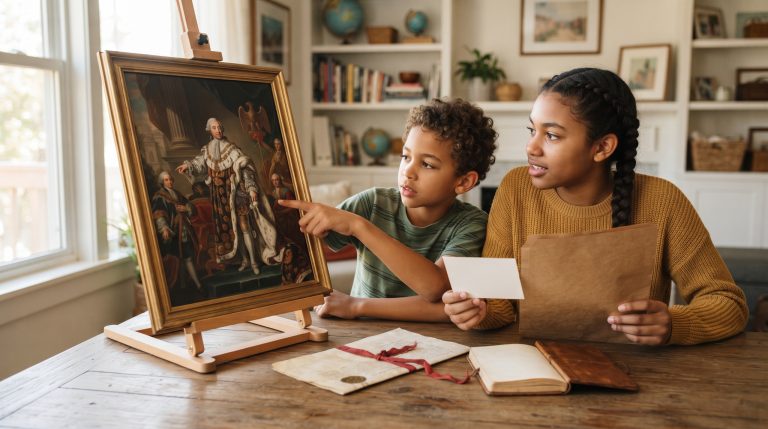
For example, if a child is studying ancient Rome, a memorization-heavy approach may ask for the names of emperors or the dates of major events. A richer approach might still include those, but it would also ask: Why did Roman public spaces matter? What did clothing reveal about status? Why would gladiatorial games attract huge crowds? What can architecture tell us about power? What can a street scene reveal about daily life?
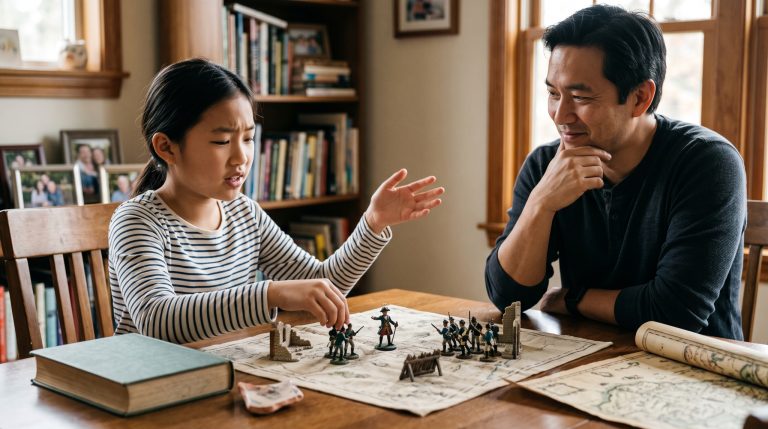
If a child is studying the American Revolution, a memorization-heavy approach may focus on 1776, George Washington, the Declaration of Independence, and major battles. A historical-thinking approach asks: Why did colonists disagree about independence? Why did some remain loyal to Britain? What risks did rebellion create? How did ordinary families experience the conflict? How did ideas about liberty coexist with slavery?
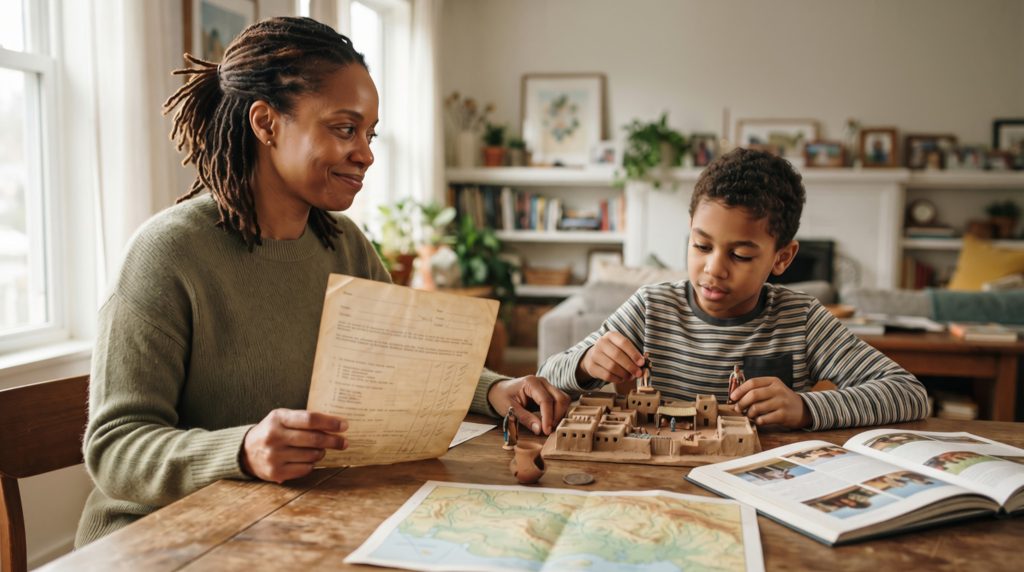
If a child is studying ancient Egypt, a memorization-heavy approach may focus on pharaohs, pyramids, and the Nile. A historical-thinking approach asks: Why did the Nile shape Egyptian society? What did monumental architecture communicate? How did religion, labor, kingship, and geography connect?
In each case, names and dates still matter. But they are no longer the destination. They are part of the map.
Practical Takeaways for Homeschooling Parents
The first step is not necessarily buying a new curriculum. Often, the first step is noticing the model of history education you inherited.
Ask yourself:
What did history feel like when I was a student?
Did I experience it as stories, questions, and evidence?
Or did I experience it mostly as memorization?
When my child struggles, do I automatically respond with more recall?
Do I feel guilty when we spend time discussing instead of filling in blanks?
Do I secretly believe that “real history” means memorizing lots of names and dates?
These questions are not meant to create blame. They are meant to create freedom.
Once parents recognize the inherited model, they can begin making small changes.
Replace some “what” questions with “why” questions.
After reading a section, ask the child to explain what problem people were facing.
When a name appears, ask why that person mattered.
When a date appears, place it in relation to something else rather than treating it as a lone fact.
Use maps, images, objects, paintings, architecture, and primary sources as things to investigate, not just illustrations to glance at.
Let children narrate what they think happened and then ask, “What makes you think that?”
Compare two accounts of the same event and ask why they differ.
When a child forgets a fact, ask whether the fact was connected to a meaningful idea in the first place.
These are modest shifts, but they change the atmosphere of learning.
They tell the child: history is not just something to remember. It is something to understand.
You Do Not Have to Teach the Way You Were Taught
For parents who hated history, this may be the most important point:
Your experience of history was not the only possible experience.
You may not have hated history itself. You may have hated a version of history that reduced the past to disconnected information.
That distinction matters.
It means your child does not have to inherit your boredom. Your child does not have to inherit your frustration. Your child does not have to inherit the feeling that history is a subject for people who are good at memorizing names and dates.
History can be taught as investigation.
It can be taught through stories, sources, questions, images, artifacts, maps, arguments, causes, consequences, and human choices. It can help children understand how people lived, what they valued, what they feared, what they built, what they destroyed, and how their decisions still shape the world.
That kind of history still requires knowledge. It still requires attention. It still requires facts. But the facts serve understanding.
And when facts serve understanding, they are more likely to stay.
Conclusion
The question “Are we doing too much memorization of dates and names instead of actual understanding?” is partly about teaching methods. But for many homeschooling parents, it is also about educational inheritance.
Parents who disliked history often learned it through a memorization-heavy model. When they begin teaching their own children, they may unintentionally recreate that model because it is the only one that feels familiar.
Recognizing that pattern is not a reason for guilt. It is an opportunity.
The larger answer to the HPQ includes memory, cognition, historical thinking, curriculum design, discussion, assessment, and developmental readiness. This article contributes one piece of that answer: before parents can fully rethink history education, they may need to recognize the version of history they inherited.
Your child does not have to receive the same history education you received.
And you do not have to teach history as though memorization were the whole point.
Turn History From Recall Into Investigation
If you hated history because it felt like disconnected names, dates, and quizzes, Spot the Anachronism gives your child a different way in. Each month, your family gets a visual history scene built for active noticing: What belongs? What does not? What clue proves it? Instead of asking your child to memorize first and care later, Spot the Anachronism turns facts into evidence inside a scene they can inspect, question, and discuss. It is a repeatable monthly practice for parents who want history to feel less like inherited schoolwork and more like discovery.
This Article Is Part Of A Larger Series
Question: Are we doing too much memorization of dates and names instead of actual understanding?
Series Position: Article 6 of 11
This article explores one evidence-supported aspect of the larger question. Future articles examine additional research-supported approaches to increasing engagement with history.
Related Facebook Discussions
- A related Facebook discussion looks at how a Roman scene becomes believable only when its details work together as one connected world.
- Another discussion explores how fatigue, posture, and physical effort can make historical people feel more human to students.
- This Facebook post asks how a Roman street changes when students notice many lives crossing at once instead of one staged main subject.