Why Did This Happen? The One Question That Changes History Education
Many homeschooling parents eventually ask some version of the same question: Are we doing too much memorization of dates and names instead of actual understanding?
It is an understandable concern. History often arrives in curriculum as a long sequence of people, places, battles, inventions, rulers, movements, and dates. A child may be able to tell you that an event happened in a certain year, or that a particular person was involved, and yet still seem unable to explain what the event meant or why it mattered. Parents notice this gap. They see the difference between a child who can recite information and a child who is actually making sense of the past.
This article explores one specific part of that larger concern: the role of causal reasoning in historical understanding. In simpler terms, it asks: What happens when we stop making “What happened?” the center of history learning and begin asking, “Why did this happen?”
That single question changes the work children are doing.
It does not make facts irrelevant. It makes facts useful.
Most Students Learn What Happened
A great deal of history instruction trains children to describe events. They learn that the American Revolution happened, that Rome expanded across the Mediterranean, that the Civil War was fought between North and South, that the printing press changed Europe, or that ancient civilizations rose and fell.
That kind of knowledge matters. Children cannot reason well about history if they know nothing about what happened. Chronology, names, places, and events provide the raw material of historical thought.
But description is not the same as understanding.
A child might say:
“The Roman Republic ended, and Augustus became the first emperor.”
That statement may be accurate. But it does not yet show much historical understanding. It does not explain why the Republic became unstable, why military leaders gained so much power, why ordinary Romans accepted change, or why Augustus succeeded where others had failed.
Similarly, a child might say:
“The American colonies declared independence in 1776.”
Again, that is useful information. But the deeper historical work begins when the child asks why independence became thinkable, why compromise failed, why some colonists supported revolution while others opposed it, and why events escalated when they did.
The problem is not that children learn what happened. The problem is when history stops there.
Historians Ask Different Questions
Historians do not spend most of their time memorizing isolated facts. They use facts to build explanations.
They ask questions such as:
Why did this event happen when it did?
What conditions made it possible?
Which causes mattered most?
What were the consequences?
How did different groups experience the same event differently?
What changed, and what stayed the same?
This is why “Why did this happen?” is such a powerful question. It moves a child from recall into reasoning. It asks the child to connect pieces of information rather than merely store them.
When a student explains why an empire expanded, why a revolution began, why a law changed, or why a society collapsed, the student is practicing historical causation. That means the student is thinking about cause-and-effect relationships in the past.
Historical causation is not always simple. Events rarely have just one cause. Wars, reforms, migrations, inventions, religious changes, economic crises, and political collapses usually emerge from multiple causes working together. Some causes are immediate. Others develop slowly. Some are visible in dramatic events. Others are hidden in long-term pressures.
This is why causal reasoning is so valuable. It teaches children that history is not a list. It is a web of relationships.
The Ladder of Historical Understanding
One useful way to think about historical understanding is as a ladder.
At the first level, a child can answer:
“What happened?”
This is the level of basic recall and description. It includes names, dates, places, and sequence. It is necessary, but it is not enough.
At the next level, the child asks:
“What caused it?”
Now the child begins connecting events. Instead of simply saying that Rome’s Republic collapsed, the child might point to military loyalty shifting from the state to generals, widening inequality, political violence, expansion, and institutional weakness.
At the next level, the child asks:
“What happened because of it?”
This moves from causes to consequences. The child begins seeing that events matter because they lead to other developments. The collapse of one political order changes laws, power structures, social expectations, and future possibilities.
At a deeper level, the child asks:
“Which causes mattered most?”
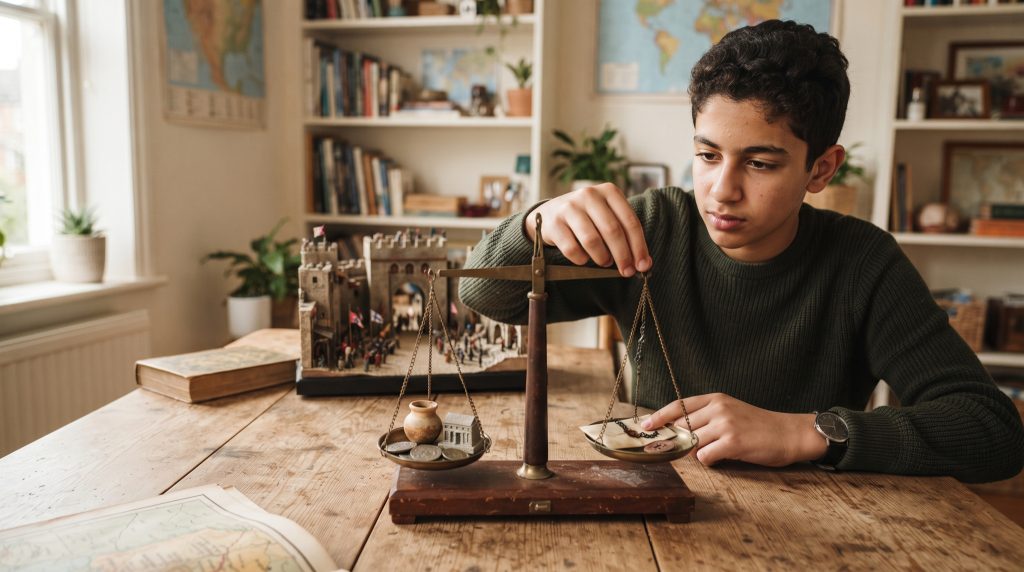
This is where historical thinking becomes especially rich. The child is no longer just listing causes. The child is weighing them. Was economic pressure more important than political ambition? Did one leader matter more than broader social conditions? Would the event likely have happened without a particular crisis?
That kind of question cannot be answered by memorization alone. It requires judgment.
And judgment is one of the clearest signs that a child is beginning to understand history.
One Question Changes Everything
The practical shift for homeschooling parents can be surprisingly simple.
Instead of asking only:
“When did Rome fall?”
ask:
“Why did Rome’s western empire weaken?”
Instead of asking:
“Who won the battle?”
ask:
“Why did that side win?”
Instead of asking:
“What year did the colonies declare independence?”
ask:
“Why did independence become the solution some colonists were willing to risk?”
Instead of asking:
“Who was Julius Caesar?”
ask:
“Why did Caesar become so powerful, and why did that frighten some Romans?”
The difference is not cosmetic. It changes what the child’s mind has to do.
A recall question asks the child to retrieve information.
A causal question asks the child to organize information.
That organization matters for memory, too. Children are more likely to remember facts when those facts are part of an explanatory structure. A date attached to no larger meaning is easy to forget. A date connected to a crisis, decision, turning point, or consequence becomes part of a story the child can reconstruct.
This is one reason children often remember stories better than timelines. Stories contain causation. One thing leads to another. People make choices. Conditions build pressure. Events create consequences. When history is taught only as disconnected facts, it loses the structure that makes it memorable.
What This Looks Like in Homeschooling
Causal questioning does not require a new curriculum. It can be added to almost any history lesson.
Suppose your child reads a section about the fall of the Roman Republic. A memorization-heavy discussion might ask:
Who was Julius Caesar?
Who was Augustus?
What was the Senate?
When did the Republic end?
Those questions may be useful as starting points. But the discussion becomes more historically meaningful when you add:
Why were Roman generals able to become so powerful?
Why did ordinary people support strong leaders?
Why did the Senate struggle to control the situation?
Why might some Romans have preferred an emperor if the Republic had become unstable?
Now the child has to think historically. The facts are still there, but they are being used as evidence.
Or imagine a lesson on the American Revolution. You might begin with basic information: taxes, Parliament, colonial assemblies, protests, the Declaration of Independence. Then you can ask:
Why did some colonists think British rule had become unfair?
Why did others remain loyal to Britain?
Why did protests become more serious over time?
Why did compromise become harder?
Why does it matter that not everyone agreed?
These questions help children avoid the false impression that history was inevitable. People in the past did not know how events would turn out. They made decisions under pressure, with limited information, competing loyalties, and real consequences.
That is where history becomes human.
Causal Questions Make Facts More Rigorous, Not Less
Some parents worry that moving away from memorization means lowering standards. But causal reasoning does not make history easier. In many ways, it makes history more demanding.
A child cannot give a strong explanation without facts.
To explain why a revolution began, the child must know something about the society, its grievances, its leaders, its economy, its political institutions, and the events that escalated conflict. To explain why an army won a battle, the child needs to know about geography, leadership, supply, strategy, morale, numbers, technology, and sometimes luck.
Causal questions require children to use facts more carefully.
The goal is not to stop learning names and dates. The goal is to stop treating names and dates as the finish line.
Facts become more meaningful when they serve explanation. A date can mark a turning point. A name can represent a decision-maker. A battle can reveal a shift in power. A law can show changing values. A place can explain strategy, trade, or conflict.
When facts are connected to causes and consequences, they stop floating loose.
Historical-Learning Application
In historical learning, “Why did this happen?” develops several important habits at once.
First, it builds observation. Children begin noticing details that might explain an event: geography, resources, leadership, technology, social class, belief, fear, ambition, weather, disease, trade, and conflict. They learn that not every detail matters equally, but some details become clues.
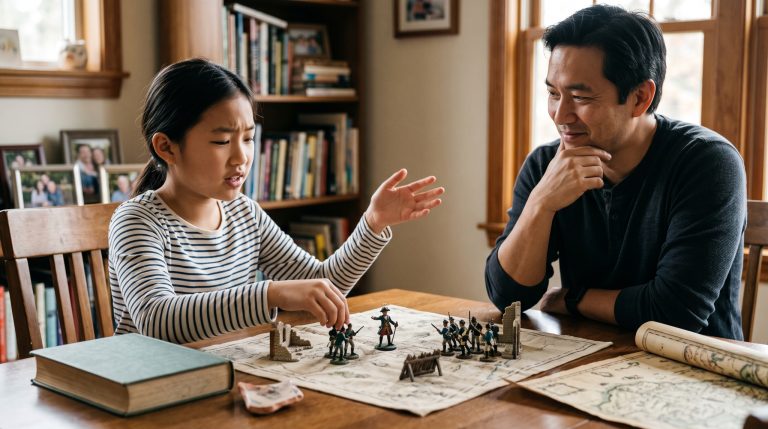
Second, it builds discussion. A parent and child can disagree productively about which cause mattered most. One child might argue that economic pressure caused an event. Another might point to political decisions. A parent might ask, “What evidence makes you think that?” This turns history into conversation rather than recitation.
Third, it builds evaluation. Children learn that some explanations are stronger than others. “Because they were bad people” is usually too shallow. “Because several groups had competing interests, and the existing political system could not resolve the conflict” is more historically useful. Children gradually learn to prefer explanations that account for more evidence.
Fourth, it supports memory. Cause-and-effect structures give children a mental framework. Instead of remembering isolated facts, they remember relationships: this pressure led to that conflict; this decision created that consequence; this invention changed that practice.
Finally, it builds historical interpretation. Children begin to see that history is not merely received. It is interpreted. Historians construct explanations from evidence, and reasonable people may debate how much weight to give different causes.
That is a much richer form of learning than memorizing a list of dates.
Practical Takeaways for Homeschooling Parents
You can begin using causal reasoning immediately by making “why” part of your normal history rhythm.
After reading a lesson, ask your child to name two or three causes of an event. They do not need a perfect answer. The goal is to practice connecting information.
When your child gives one cause, ask, “Was that the only reason?” This helps the child move beyond single-cause explanations.
When several causes are on the table, ask, “Which one mattered most?” This encourages judgment and prioritization.
When studying a major event, make a simple cause-and-effect chart. Put the event in the middle. On the left, list causes. On the right, list consequences. This helps children see history as connected movement rather than isolated information.
When your child gives an explanation, ask, “What makes you think that?” This gently introduces evidence-based reasoning.
When a curriculum asks mostly recall questions, keep them, but add one causal question afterward. For example: “Now that we know what happened, why do you think it happened?”
Most importantly, do not require every answer to be polished. Historical reasoning develops through practice. A young child may begin with simple explanations. An older student can begin weighing long-term causes, short-term triggers, and competing interpretations.
The habit matters.
Conclusion
The question “Are we doing too much memorization of dates and names instead of actual understanding?” cannot be answered by rejecting facts. Children need factual knowledge to think well about history.
But facts alone do not create understanding.
This article has focused on one key piece of the larger answer: children begin to understand history more deeply when they learn to explain why events happened. Causal reasoning turns facts into evidence, timelines into relationships, and lessons into investigations.
A child who can recite what happened has learned something.
A child who can explain why it happened is beginning to think historically.
That does not settle the whole question of memorization and understanding. But it does point to one of the simplest and most powerful shifts a homeschooling parent can make: keep the facts, but make explanation the goal.
Give Your Child a Reason to Ask “Why?”
Spot the Anachronism turns history into a visual mystery. Each month, your child studies a detailed historical scene, searches for what does not belong, and explains why it breaks the world of the past. Instead of stopping at names and dates, they practice observation, evidence, and historical reasoning — the same skills that help history finally make sense.
This Article Is Part Of A Larger Series
Question: Are we doing too much memorization of dates and names instead of actual understanding?
Series Position: Article 4 of 11
This article explores one evidence-supported aspect of the larger question. Future articles examine additional research-supported approaches to increasing engagement with history.
Related Facebook Discussions
- See how asking whether every element belongs to the same operational world turns observation into historical explanation.
- Explore how asking what commerce does to movement, space, and material surroundings reveals why a marketplace should look the way it does.
- Consider how belts, fasteners, and other small details become evidence when students ask why they do or do not belong.