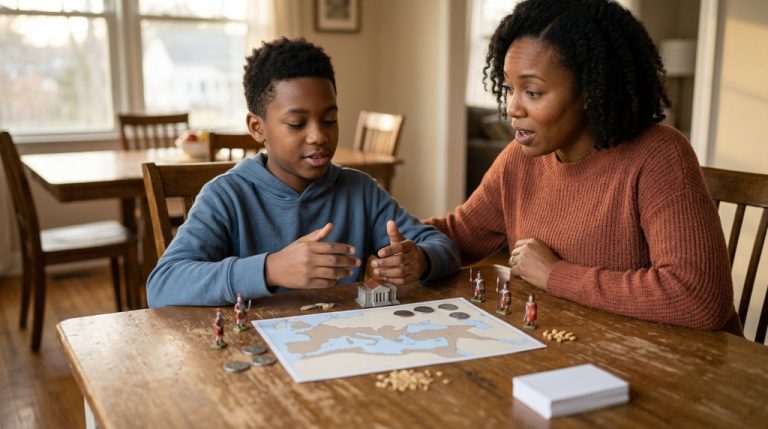
The Conversation That Does Double Duty: Assessing History Through Discussion

“How do I know if my child is actually retaining what they’ve learned in history?”
Many homeschooling parents reach this question from the same uncomfortable place.
They do not want history to become a cycle of quizzes, worksheets, and tests. They want their children to understand the past, think about it, and discuss it meaningfully.
At the same time, they need some way to know whether learning is actually happening.
Without grades or formal assessments, retention can feel invisible. A parent may wonder whether a child’s interest during a lesson led to durable understanding or whether the material disappeared as soon as the book closed.
Ordinary conversation can provide far more evidence than many parents realize.
An open-ended discussion about previously studied history can reveal what a child remembers, how the child understands it, where misconceptions remain, and what connections are beginning to form. At the same time, the child must retrieve and reorganize the material, which strengthens memory.
Conversation therefore does double duty.
It helps parents assess historical learning while giving children another opportunity to deepen that learning.
This article examines that specific part of the larger retention question: how discussion can show parents what their children know without turning history into a testing environment.
Why Many Assessment Conversations Fail
Not every conversation about history functions as useful assessment.
Parents may intend to begin a discussion but unintentionally create an oral quiz.
“What year did Rome fall?”
“Who was the first emperor?”
“What was the capital of the Byzantine Empire?”
These questions measure whether a child can retrieve particular facts. That information can be useful, but the questions reveal only a narrow part of learning.
A child who cannot remember the year 476 may still understand why the Western Roman Empire became unstable. A child who forgets Augustus’s name may still explain how one ruler gained control after years of civil war. A child who cannot immediately name Constantinople may remember why its location made it strategically important.
Closed questions can therefore underestimate what a child knows.
They also tend to end quickly.
The parent asks. The child answers or does not. The exchange is over.
Open-ended questions create more room for thought.
Instead of asking:
“What year did Rome fall?”
A parent might ask:
“What problems made the Roman Empire increasingly difficult to govern?”
Instead of:
“Who was Julius Caesar?”
A parent might ask:
“Why did Caesar become so powerful, and why did that frighten some Romans?”
Instead of:
“What was the American Revolution?”
A parent might ask:
“Why did disagreement between Britain and the colonies become impossible to settle peacefully?”
These questions invite children to explain relationships among events. They reveal not only whether facts remain but whether the child can use those facts to reason.
The goal is not to eliminate factual questions. It is to stop allowing them to dominate the conversation.
What Memory Research Suggests About Conversation
Research on parent-child conversation has consistently shown that the way adults talk with children about past experiences affects memory.
When parents ask open-ended questions, encourage children to add details, and invite them to explain what happened, children practice retrieving and organizing memory.
This kind of discussion is sometimes described as elaborative conversation.
The parent does not simply provide the account. The child participates actively in reconstructing it.
That distinction matters.
A parent who gives a long explanation may help the child hear the information again, but the parent is doing most of the cognitive work.
A child who generates the explanation must search memory, select relevant details, organize them, and express their relationships.
That active contribution strengthens recall.
The same principle applies to historical learning.
Suppose a parent says:
“Remember, the colonies were angry because Britain taxed them after the French and Indian War, and then the protests became more serious.”
The child hears a useful review.
But if the parent asks:
“Why did Britain begin taxing the colonies, and why did the colonists object?”
the child must retrieve the explanation.
The second exchange reveals more about what the child understands. It also provides stronger memory practice.
Conversation becomes most educational when the child is producing ideas rather than merely listening to them.
The Difference Between Testing and Discussing
Testing and discussion can involve similar topics, but they create different intellectual and emotional experiences.
Testing usually seeks a correct answer.
Discussion seeks to understand what the child thinks.
A testing exchange might sound like this:
“Who crossed the Rubicon?”
“Alexander the Great?”
“No. We studied this yesterday.”
The parent learns that the child did not retrieve Julius Caesar’s name. The child learns that the answer was wrong.
A discussion might begin differently:
“What was happening when a Roman general brought his army into Italy even though he had been ordered not to?”
The child might answer:
“He was challenging the government. I can’t remember his name, but I think the leaders were afraid he was using the army to take power.”
That answer contains a retrieval gap, but it also contains historical understanding.
The parent can then say:
“You’re thinking of Julius Caesar. Why was bringing the army across the boundary such a serious act?”
Now the forgotten name is restored within a meaningful discussion.
The difference is not that discussion ignores accuracy.
The difference is that accuracy is placed within a broader effort to understand the child’s reasoning.
Testing tends to divide responses into right and wrong. Discussion allows parents to hear partial understanding, uncertainty, misconception, curiosity, and developing interpretation.
Those forms of evidence are especially important in history because historical learning is rarely all-or-nothing.
Questions That Reveal Real Understanding
Good historical conversations begin with questions broad enough to invite thought but focused enough to give the child somewhere to begin.
Questions about causation
- Why do you think this happened?
- What problems had been building before the event?
- Was there one cause or several?
- What made the situation difficult to resolve?
- What happened because of that decision?
These questions reveal whether the child sees events as connected.
Questions about motivation
- What did this person want?
- Why might people have supported this leader?
- What were they afraid would happen?
- What choices were available to them?
- Why might different groups have made different decisions?
These questions encourage the child to think about historical people within their circumstances.
Questions about comparison
- How was this civilization similar to the last one we studied?
- What did these two rulers do differently?
- Does this conflict remind you of another one?
- What changed between these periods?
- What stayed the same?
Comparison shows whether knowledge is becoming connected across lessons.
Questions about evidence
- How do historians know this happened?
- Who created this source?
- What might this account leave out?
- Would everyone at the time have described the event the same way?
- What additional evidence would help us understand it?
These questions introduce sourcing and perspective without requiring academic terminology.
Questions about significance
- Why does this event matter?
- What changed afterward?
- Which part of the story seems most important?
- What surprised you?
- What do you think people later misunderstood about this event?
These prompts reveal what the child has selected as meaningful.
Questions about alternatives
- What might have happened if this decision had been different?
- Could the conflict have been avoided?
- What other choice could the leader have made?
- What would have changed if one side had won?
Historical “what if” questions should not replace evidence, but they can reveal whether a child understands the forces shaping an event.
To imagine a plausible alternative, the child must first understand the original situation.
Why Open-Ended Discussion Reveals More
A child may know more than can be produced in response to a narrow question.
Open-ended conversation provides multiple routes into memory.
A question about Rome’s decline may trigger thoughts about military pressure. That may lead to economic problems, political instability, or the challenge of governing a large territory. One remembered idea cues another.
Conversation also allows the parent to follow the child’s thinking.
The child might begin with an incomplete explanation but become more precise as the discussion continues. A misconception may appear and become available for correction. A spontaneous comparison may reveal learning the parent did not know was present.
This is difficult to capture through a worksheet.
A written response shows the final answer. A conversation can show the process by which the child reaches it.
That process matters because it reveals whether the child is reasoning, guessing, recalling, connecting, or repeating memorized language.
Discussion also makes room for uncertainty.
A child may say:
“I’m not sure, but I think the ruler made the problem worse because he stopped listening to the other leaders.”
That answer is not polished, but it shows the beginning of an interpretation.
Parents can ask:
“What makes you think that?”
The child must then identify supporting evidence.
A meaningful historical discussion can emerge from an uncertain answer.
How Conversation Strengthens Retention
Conversation is not only a way to inspect memory.
It changes memory.
Whenever a child recalls an event, explains a cause, compares two societies, or reconstructs a sequence, the child is practicing retrieval.
Retrieval makes knowledge easier to access later.
This is the same basic mechanism that makes narration effective. The difference is that narration usually asks the child to produce a more continuous retelling, while conversation develops through questions, responses, follow-up, and shared exploration.
Discussion also encourages elaboration.
A child does not merely recall that an event happened. The child connects it with motives, consequences, earlier events, or other periods.
Those connections give the knowledge more structure.
For example, a child may begin by recalling that Caesar was assassinated.
During discussion, the child connects that event with Roman fear of kings, the Senate’s loss of influence, the loyalty of armies to generals, and the civil wars that followed.
The memory is no longer an isolated event.
It has become part of a network.
Knowledge held in a richer network is more useful because more cues can activate it later.
A later discussion of political legitimacy, military power, or succession may bring the Roman example back to mind.
Conversation therefore strengthens retention not through repetition alone but through connection.
The Child Must Do More of the Talking
A conversation cannot reveal much about a child’s learning if the parent supplies most of the content.
This is a common difficulty.
A parent asks a question. The child hesitates. The silence feels uncomfortable. The parent begins offering hints.
“It had something to do with taxes, remember? Britain needed money after the war, and the colonists were upset because…”
Soon, the parent has retaught the lesson.
That may be useful instruction, but it is not effective assessment.
To discover what the child knows, parents need to tolerate some silence.
Children may need time to search memory and organize a response.
A helpful pattern is:
- Ask one open-ended question.
- Wait.
- Let the child answer fully.
- Ask a follow-up based on the answer.
- Clarify or correct after the child has had the opportunity to think.
The parent’s role is not passive. Good follow-up questions can deepen the conversation.
But the child should generate most of the historical content.
The more the child explains, the more visible the learning becomes.
Psychological Safety Matters
Children often reveal more when they do not feel that every answer is being scored.
Pressure can interfere with retrieval.
A child who knows that a wrong answer will be immediately corrected may become cautious, give shorter responses, or say, “I don’t know,” rather than risk an error.
A conversational tone reduces that pressure.
This does not require pretending every answer is correct. It means responding in ways that keep the child thinking.
Instead of:
“No, that’s wrong.”
A parent might say:
“You’re remembering part of it. What else was happening at the time?”
Instead of:
“You should know this.”
A parent might say:
“That detail is hard to retrieve. What part do you remember clearly?”
Instead of immediately supplying an answer:
“What makes you think that?”
These responses preserve intellectual accountability while making room for partial knowledge.
Psychological safety is not the absence of rigor.
It is a condition that allows children to expose their actual thinking rather than protect themselves from evaluation.
Historical-Learning Application
Imagine that your family studied the French Revolution several weeks ago.
During dinner, a news story raises a question about public anger toward political leaders.
You ask:
“Does this remind you of anything we studied in history?”
Your child says:
“Maybe the French Revolution, because people were angry that the rich had more power and didn’t have the same problems.”
You follow up:
“Was inequality the only cause?”
The child pauses.
“No. The government also owed a lot of money, and food was expensive. I think people were already angry before everything started.”
You ask:
“What made the situation turn into a revolution instead of just complaints?”
The child responds:
“The government couldn’t fix the money problem, and people stopped trusting the king. Then every new problem made the others worse.”
This conversation reveals several forms of historical retention.
The child remembers economic inequality, government debt, food prices, political distrust, and the cumulative nature of the crisis.
The child does not provide every date or identify every political group, but the explanation demonstrates causal reasoning.
The discussion also strengthens retention.
The child has retrieved the main ideas and reorganized them into an explanation. The current event has provided a new context in which the older learning becomes useful.
The parent might then ask:
“What is different about the situation in the news?”
That question prevents an oversimplified comparison and encourages contextual thinking.
In a few minutes, the conversation has assessed memory, revealed understanding, corrected possible overgeneralization, and strengthened the child’s ability to use history.
Conversation and Narration Are Related but Different
Narration and discussion both rely on retrieval, but they are not identical.
Narration asks the child to reconstruct a lesson or event in a sustained way.
“Tell me what happened in the American Revolution.”
Discussion is more interactive.
“Why did the colonies decide independence was necessary?”
“What alternatives did they have?”
“Did all colonists agree?”
Narration shows how the child organizes the whole account.
Discussion allows the parent and child to examine particular ideas more deeply.
Both methods can support assessment.
A parent might begin with narration and then move into conversation. The child tells the story back, and the parent asks follow-up questions about cause, motivation, evidence, or significance.
The important distinction is that discussion should remain exploratory rather than becoming a disguised quiz.
Where Historical Conversations Can Happen
Discussion does not require a formal lesson period.
In fact, history may become easier to discuss when the conversation arises naturally.
Useful opportunities include:
- during meals
- while driving
- after a documentary or historical film
- during a walk
- while visiting a museum or historic site
- after reading historical fiction
- during a current-events discussion
- while looking at a map
- before bed
- while cooking a meal connected with a historical culture
- during a family game involving strategy or government
These settings can reduce the sense that the child is being tested.
The parent can also create simple recurring opportunities.
A weekly conversation might begin with:
“What is one thing from history that stayed with you this week?”
“What question are you still thinking about?”
“What event would you like to understand better?”
The purpose is not to turn every family interaction into school.
It is to recognize that historical learning can be observed and strengthened in ordinary life.
What Parents Should Listen For
During discussion, parents can listen for evidence beyond correct names and dates.
Coherent sequence
Can the child explain what happened before and after an event?
Causal reasoning
Does the child identify why events occurred and what resulted from them?
Historical vocabulary
Does the child use terms naturally and appropriately?
Perspective
Can the child recognize that different people understood the event differently?
Comparison
Does the child connect the topic to another time, place, or society?
Evidence awareness
Does the child ask how we know or recognize limitations in a source?
Emotional and moral engagement
Does the child care about the choices, consequences, or experiences involved?
Transfer
Does the child apply historical understanding to literature, current events, or unfamiliar situations?
Misconceptions
Does the child combine events, oversimplify causes, or project modern assumptions onto the past?
Misconceptions are not reasons to avoid conversation.
They are reasons conversation is valuable.
They become visible early enough to address.
Practical Takeaways for Homeschooling Parents
Ask fewer questions with one predetermined answer and more questions that invite explanation.
Use prompts such as:
- Why do you think that happened?
- What happened because of it?
- What does this remind you of?
- What surprised you?
- Why might people at the time have seen this differently?
- What evidence supports that idea?
- How was this period different from another one we studied?
Listen longer before correcting.
Give your child time to retrieve and organize an answer. A pause does not necessarily mean the knowledge is absent.
Follow the child’s connections.
An unexpected comparison or question may provide stronger evidence of retention than the topic you intended to discuss.
Keep the conversation low stakes.
Do not score every response or turn every historical discussion into a performance.
Correct selectively and constructively.
Address important misunderstandings, but allow the child to finish explaining first.
Notice patterns over time.
One conversation may be incomplete. Repeated discussions can show growing vocabulary, stronger causal reasoning, and more sophisticated comparisons.
Let children disagree.
A child who challenges an interpretation and gives reasons is demonstrating active historical thought.
Use conversation alongside other forms of evidence.
Discussion is powerful, but it does not need to replace narration, written work, timelines, projects, or factual review. It adds a flexible and revealing form of assessment to the larger picture.
Most importantly, remember that the purpose is not to catch the child forgetting.
The purpose is to discover how the child is thinking.
Conclusion
Homeschooling parents do not need a formal test every time they want evidence that history is sticking.
Open-ended conversation can reveal what a child remembers, how the child understands it, where the gaps are, and which ideas have become meaningful.
It also strengthens the learning it reveals.
Each time a child recalls an event, explains a cause, considers a motivation, or connects one period with another, the child practices retrieval and builds a richer network of historical understanding.
That is why conversation does double duty.
It functions as assessment because it makes learning visible.
It functions as instruction because it helps make that learning more durable.
Conversation does not answer every question about historical retention. Parents still need to consider review, forgetting, narration, documentation, and other forms of assessment.
But it resolves one important tension.
You do not have to choose between avoiding tests and having no evidence.
Sometimes, the clearest evidence of learning emerges when history stops being something your child must prove and becomes something your family can discuss.
Give Every History Conversation Something Worth Discussing
If you want conversation to reveal what your child actually understands, give them something worth explaining. Each monthly Spot the Anachronism challenge asks your child to inspect a historical scene, identify what does not belong, explain why, and support the conclusion with visual evidence. You get a low-pressure, repeatable way to hear your child’s reasoning while strengthening retrieval, connections, and historical judgment – without turning history into another quiz.
This Article Is Part Of A Larger Series
Question: How do I know if my child is actually retaining what they’ve learned in history?
Series Position: Article 4 of 11 (Assessment Alternatives Cluster)
This article explores one evidence-supported aspect of the larger question. Readers interested in the full answer should explore the complete series.
Related Facebook Discussions
- A related discussion shows how replacing “Does it look Roman?” with “What is this object doing?” turns visual recognition into historical reasoning.
- Another discussion demonstrates how asking what a building’s surfaces reveal can lead children from observation into evidence-based interpretation.
- A classroom-focused discussion uses Roman hair to show how one open-ended question can expose modern assumptions and invite culturally grounded reasoning.