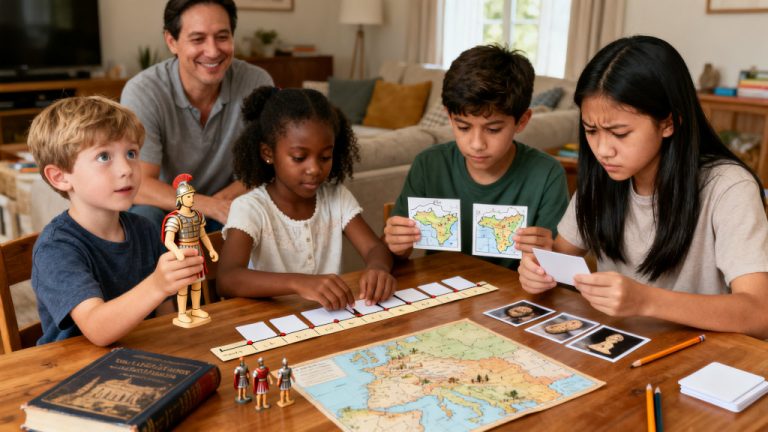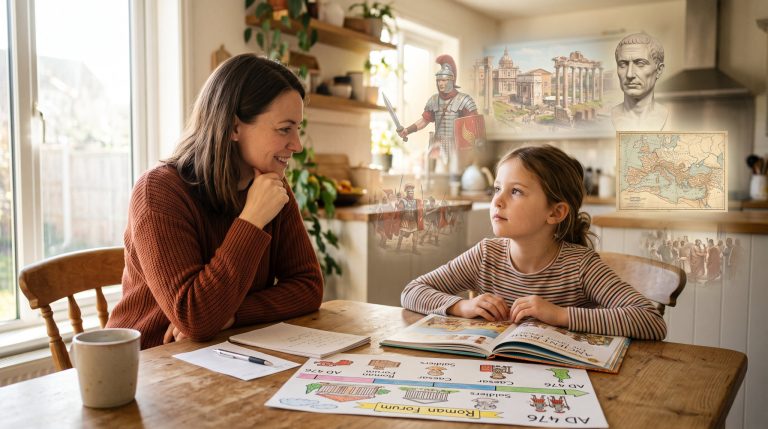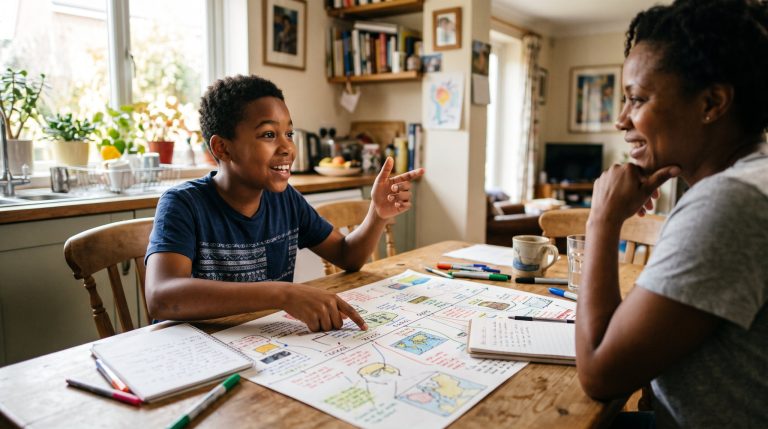
Too Much History, Too Little Memory
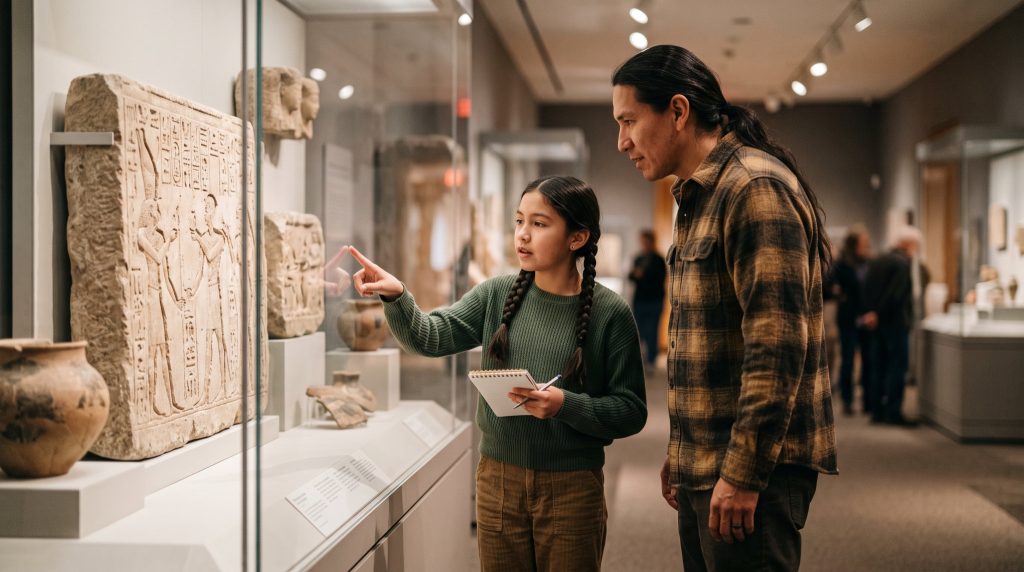
Many homeschooling parents have experienced a version of the same frustrating realization.
You finish an entire history curriculum.
You covered ancient civilizations.
You studied Greece and Rome.
You explored the Middle Ages.
You worked through the Renaissance.
You discussed revolutions, wars, inventions, and empires.
The books are finished.
The assignments are complete.
The boxes are checked.
And then, months later, you discover something unsettling.
Your child remembers surprisingly little of it.
Not nothing.
But far less than the amount of time and effort invested would seem to justify.
At that moment, many parents ask the same question:
“How can we have covered so much and retained so little?”
The answer may have less to do with your child and more to do with a powerful assumption built into many educational systems.
We often assume that covering more content creates more learning.
In reality, covering more content often creates more forgetting.
The Coverage Myth
Educational culture tends to reward completion.
Curriculum advertisements proudly emphasize the amount of material included.
Schools often measure success by how much content has been covered during a semester or school year.
Parents naturally absorb the same message.
More pages completed feels productive.
More chapters finished feels educational.
Faster progress feels like evidence of success.
The result is a powerful assumption:
If we expose children to more history, they will learn more history.
Unfortunately, memory does not work that way.
Exposure is not the same thing as retention.
A child can encounter hundreds of historical figures, events, and concepts without developing durable knowledge of most of them.
The problem is not effort.
The problem is that memory requires something more than exposure.
It requires time.
Why Memory Needs Time
Think about the difference between meeting someone briefly and becoming friends with them.
You can be introduced to dozens of people at a large gathering.
You may remember a few names.
Most will disappear quickly.
Why?
Because the interaction was brief.
There was little opportunity for connection.
No meaningful relationship formed.
History often works the same way.
When children encounter a topic briefly and then immediately move on, the memory receives very little opportunity to deepen.
Durable memory develops through several processes:
- encoding
- connection-making
- retrieval
- reinforcement
These processes take time.
A lesson introduces information.
But introduction is only the beginning.
The brain must connect new information to existing knowledge.
It must organize events into meaningful structures.
It must revisit ideas through discussion and retrieval.
It must determine why something matters.
When curriculum pacing moves too quickly, these processes are crowded out.
The child encounters the information.
Then the class moves on.
The memory never has a chance to grow.
The Conveyor Belt Problem
Imagine standing beside a conveyor belt moving at high speed.
Objects pass in front of you one after another.
You see them.
You recognize them.
You briefly notice their features.
Then they disappear.
History can feel like that for many students.
A king appears.
A war occurs.
A civilization rises.
An empire falls.
A reformer emerges.
A revolution begins.
Then the next chapter arrives.
And the next.
And the next.
Nothing remains in view long enough to become deeply meaningful.
The child develops a vague sense of familiarity with many topics but a strong understanding of very few.
History becomes a sequence of introductions rather than a body of knowledge.
This experience often creates frustration for both parent and child.
The parent wonders why nothing seems to stick.
The child begins to feel that history is an endless stream of information they are expected to remember but rarely have time to understand.
What Gets Lost When We Move Too Fast
When curriculum prioritizes coverage above all else, something important disappears.
Curiosity.
Children rarely become deeply interested in topics they encounter only briefly.
Interest develops through repeated encounters, deeper questions, and sustained engagement.
If a fascinating topic appears on Monday and disappears by Wednesday, curiosity never has time to mature.
Historical thinking also suffers.
Students need time to ask questions such as:
- Why did this happen?
- What alternatives were possible?
- What motivated these decisions?
- How did one event influence another?
These questions require reflection.
Reflection requires time.
Rapid progression often eliminates both.
Emotional connection weakens as well.
The stories that remain with us are usually the ones we spend time with.
We remember historical figures when we understand their struggles, ambitions, fears, and choices.
That understanding rarely develops from a brief encounter.
Most importantly, memory itself suffers.
The brain remembers what it repeatedly processes, revisits, and uses.
Moving too quickly reduces all three.
Breadth Versus Depth
Imagine two different approaches to a history year.
In the first approach, a student briefly encounters fifty major historical events.
The pace is fast.
The curriculum moves steadily forward.
Little time exists for discussion, narration, comparison, or reflection.
In the second approach, the student studies ten major events deeply.
They discuss causes and consequences.
They revisit important ideas.
They compare events across time.
They ask questions.
They construct explanations.
Which student is likely to remember more history a year later?
The answer often surprises people.
The student who studied fewer topics frequently retains more.
Why?
Because depth creates memory.
Depth creates connections.
Depth creates understanding.
Depth creates opportunities for retrieval and reinforcement.
The first student may have encountered more information.
The second student built stronger mental structures.
And memory depends far more on structure than exposure.
How Historians Actually Think
Consider how historians approach the past.
Historians do not simply collect facts.
They investigate relationships.
They analyze causes.
They compare interpretations.
They examine evidence.
They explore consequences.
In other words, they spend time thinking deeply about relatively limited topics.
Students benefit from a similar approach.
A child who deeply understands the Roman Republic gains more educational value than a child who briefly encounters dozens of disconnected civilizations.
A child who can explain why the American Revolution happened possesses something more valuable than a child who merely recognizes a list of dates.
Understanding creates a framework into which future knowledge can fit.
Coverage alone rarely accomplishes that.
What This Looks Like in a Homeschool
The encouraging news is that homeschooling provides unusual flexibility.
Parents are not required to maintain the pace imposed by large institutions.
You can slow down.
You can linger.
You can follow curiosity.
If your child becomes fascinated by Ancient Egypt, spend another week there.
If a discussion about Roman engineering sparks interest, explore it further.
If a historical figure captures your child’s imagination, read additional biographies.
The goal is not to ignore broad historical knowledge.
The goal is to recognize that memory grows when children have time to think.
Narration becomes more valuable.
Discussions become richer.
Questions become more interesting.
Historical understanding becomes deeper.
And memory becomes stronger.
A Better Measure of Success
Many parents evaluate history education by asking:
“How much did we get through?”
A more useful question might be:
“How much stayed?”
How many events can your child explain?
How many historical figures remain meaningful?
How many ideas continue appearing in conversation weeks later?
What connections can they make without assistance?
These questions focus on retention rather than completion.
And retention is ultimately what makes history useful.
A history curriculum that covers a thousand pages but leaves little lasting knowledge may not be serving its purpose.
A curriculum that covers fewer topics but creates durable understanding often provides far greater value.
The Goal Is Not Coverage
History is not a race.
The objective is not to touch every event as quickly as possible.
The objective is to help children develop an understanding of the past that remains available long after the lesson ends.
That requires time.
It requires depth.
It requires opportunities for discussion, narration, retrieval, and reflection.
Most importantly, it requires a willingness to resist the assumption that more is automatically better.
Because when it comes to memory, more exposure often produces more forgetting.
Children remember what they have time to think about.
They remember what they revisit.
They remember what becomes meaningful.
And that means the most important question in history education is not:
“How much history did we cover?”
The more important question is:
“How much history became part of how my child thinks?”
The answer to that question tells us far more about learning than any completed textbook ever will.
Depth Is What Stays
This article argues that racing through history produces forgetting, while lingering on fewer topics builds durable memory. Spot the Anachronism is designed for exactly that kind of lingering. Instead of covering another scene and moving on, you and your child slow down over a single Roman image — studying it together, asking why a detail feels wrong, comparing it to what you already know, and reasoning through it out loud. One image explored deeply in conversation does more for memory than a dozen glanced at quickly. Sit with a scene, talk it through, and let the questions unfold at their own pace.
This Article Is Part Of A Larger Series
Question: Why doesn’t the information stick? My child forgets everything right after a lesson.
Current article: Article 6 of 11 — Structural Causes Cluster
This article explores one evidence-supported aspect of the larger question. Future articles examine additional research-supported approaches to increasing engagement with history.
Related Facebook Discussions
- One way to see historical figures as real people is to notice the signs of effort, fatigue, and daily life visible in their bodies.
- Notice how everyday details can become far more interesting when you start examining how people actually used historical spaces.
- Historical curiosity often begins when we stop looking at what people built and start asking why they built it that way.