Chronological vs. Thematic History: Why Some Children Engage More When You Stop Starting at the Beginning
The Child Who Could Not Care Less About Ancient Mesopotamia
Many homeschooling parents have experienced some version of this situation.
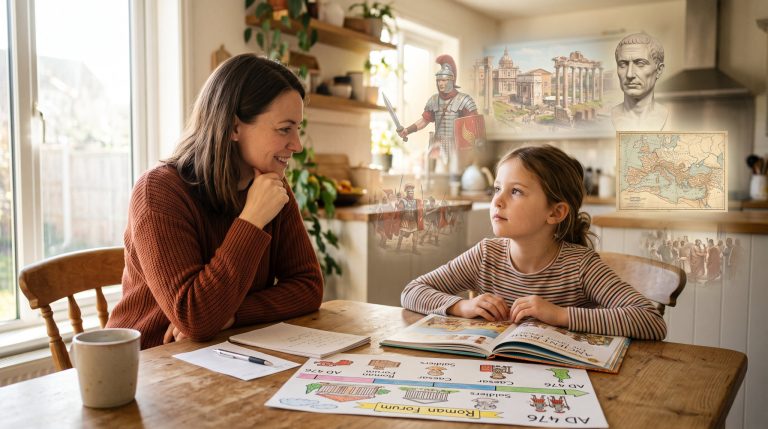
You begin a history program exactly where the curriculum says to begin.
Ancient Mesopotamia.
Then Egypt.
Then Greece.
Then Rome.
The sequence is logical.
The progression makes sense.
The child, however, seems entirely unmoved.
The lessons feel like an endless procession of unfamiliar names, places, civilizations, and dates.
Then something unexpected happens.
A documentary about castles captures their attention.
A lesson about Viking exploration sparks curiosity.
A discussion about ancient warfare suddenly generates questions.
A historical mystery becomes fascinating.
The child who seemed uninterested in history is suddenly interested in a particular part of history.
This raises an important question:
Does history always have to begin at the beginning?
Many homeschooling parents ask:
How do I make history engaging when my child finds it completely boring?
This article explores one possible answer.
Sometimes the challenge is not the historical content.
Sometimes the challenge is the structure through which that content is being presented.
Chronology is essential for historical understanding, but it is not always the most effective entry point for generating interest.
Why Chronological History Became the Default
There are good reasons history is commonly taught chronologically.
Chronology helps learners understand:
- sequence
- causation
- continuity
- change over time
Historical events rarely make sense in isolation.
To understand why one event occurred, students often need to understand what happened beforehand.
Chronological organization provides a framework for making those relationships visible.
For example:
Understanding the causes of a revolution generally requires understanding the conditions that preceded it.
Understanding an empire’s collapse often requires understanding how that empire developed.
Chronology helps answer an important historical question:
How did we get here?
For this reason, chronological history remains an important educational tool.
The issue is not that chronology is wrong.
The issue is that chronology serves a different purpose than engagement.
Those two goals sometimes align.
They do not always align.
Why Chronology Sometimes Fails to Generate Interest
Many learners struggle not because chronology lacks value but because it lacks immediate relevance.
From a child’s perspective, a traditional history sequence can feel overwhelming.
Every lesson introduces:
- new names
- new places
- new cultures
- new vocabulary
- new events
The learner may spend so much energy processing unfamiliar information that it becomes difficult to identify why any particular topic matters.
This often creates a feeling of distance.
History becomes a sequence of things to remember rather than a collection of ideas to explore.
Some learners eventually build enough context for the timeline to become meaningful.
Others disengage long before that happens.
When parents interpret this disengagement as evidence that the child dislikes history, they may overlook another possibility:
The learner may be struggling with the organization of the experience rather than the subject itself.
The Power of Themes
A thematic approach begins from a different place.
Instead of asking:
What happened next?
it asks:
What interests us?
Themes can include topics such as:
- exploration
- inventions
- warfare
- leadership
- daily life
- technology
- trade
- architecture
- survival
- communication
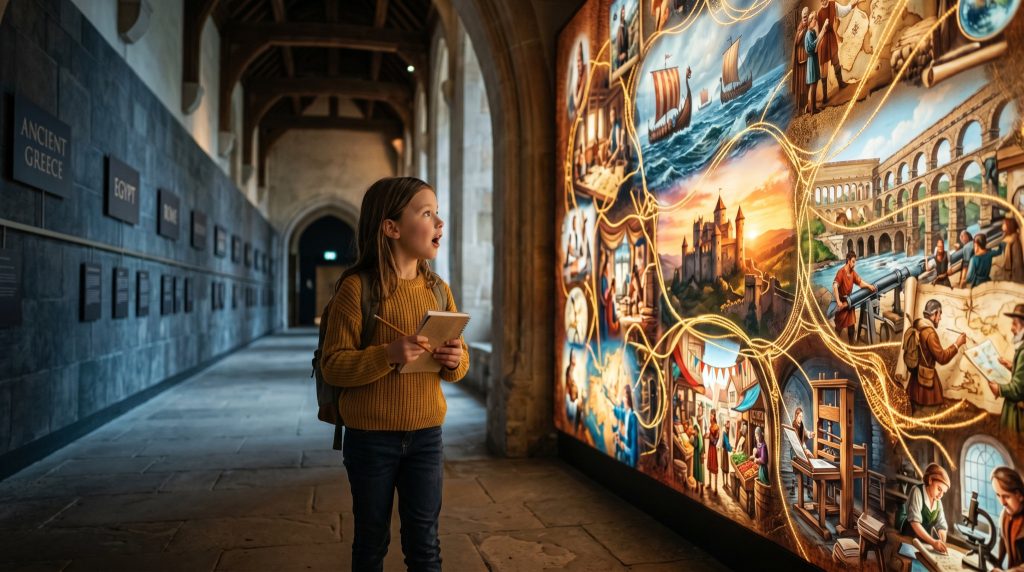
Rather than moving steadily through a timeline, learners investigate how a particular theme appears across different historical periods.
For example:
A child fascinated by technology might explore:
- Roman engineering
- medieval watermills
- printing presses
- steam engines
- early computers
A child interested in exploration might examine:
- Polynesian navigation
- Viking voyages
- Chinese maritime expeditions
- European exploration
The timeline remains present.
But it is no longer the primary organizing structure.
The theme becomes the entry point.
How Themes Create Historical Connections
One advantage of thematic learning is that it naturally highlights patterns.
When learners study a theme across multiple periods, they begin noticing recurring questions:
- How do societies solve problems?
- How does technology change daily life?
- Why do conflicts emerge?
- How do leaders gain influence?
- What causes innovation?
These questions connect distant historical periods in meaningful ways.
Instead of seeing history as a long sequence of unrelated events, learners begin recognizing recurring human experiences.
This supports an important aspect of historical understanding.
History is not only about what happened.
It is also about identifying relationships, patterns, and continuities across time.
Themes often make those relationships easier to see.
The False Choice Between Chronology and Themes
Discussions about history education sometimes create the impression that parents must choose between chronological learning and thematic learning.
In practice, that is often a false choice.
Both approaches serve useful purposes.
Chronology helps learners understand:
- sequence
- timing
- causation
- historical development
Themes help learners understand:
- patterns
- relevance
- recurring challenges
- human experiences
The most productive approach is often integration.
A learner may first become interested through a theme.
That interest can later be connected to chronology.
For example:
A fascination with castles may lead to questions about medieval Europe.
Those questions may lead to broader chronological understanding.
A curiosity about ancient warfare may lead to exploration of different civilizations.
The theme creates engagement.
Chronology provides context.
The two approaches can strengthen one another rather than compete.
Historical-Learning Application
For historical learning specifically, thematic approaches can support several important skills.
Understanding
Themes help learners connect individual events to larger ideas and recurring human experiences.
Historical Thinking
Comparing similar themes across different periods encourages analysis and interpretation.
Observation
Students become more attentive to recurring patterns and similarities.
Memory
Meaningful organizational structures often improve retention because information is connected rather than isolated.
Discussion
Themes naturally generate broader conversations.
Students often enjoy debating how different societies addressed similar challenges.
Inquiry
Questions such as:
How did different cultures solve this problem?
or
Why does this pattern keep appearing?
naturally encourage investigation.
Thematic learning can therefore become a powerful pathway into deeper historical understanding.
Practical Takeaways
If your child struggles with traditional chronological history, consider experimenting with alternative entry points.
Begin with Existing Interests
Look for topics your child already finds engaging.
Interest provides momentum.
Use Thematic Mini-Studies
Short investigations can reveal which themes generate the strongest engagement.
Follow Questions
When curiosity emerges, allow time to explore it.
Questions often lead naturally into historical learning.
Build Bridges Back to Chronology
Once interest develops, connect the topic to its broader historical context.
Focus on Understanding Before Coverage
Coverage is valuable, but understanding often develops more effectively when learners care about the material.
Remember That Entry Points Matter
The goal is not merely moving through a timeline.
The goal is helping learners make sense of the past.
Conclusion
Chronology remains an essential tool for understanding history.
It helps learners understand sequence, causation, and change over time.
However, chronology is not always the most effective starting point for engagement.
Many children become interested in history through themes, questions, people, problems, and ideas before they become interested in timelines.
For these learners, thematic exploration is not a shortcut around historical understanding.
It is a pathway toward it.
This article does not argue that chronology should be abandoned.
Instead, it offers a different perspective on where engagement can begin.
Sometimes the most effective way into history is not to start at the beginning.
Sometimes it is to start with something the learner already cares about.
Start With Curiosity, Then Build Context
Many children become interested in history when they begin with a question, mystery, object, or detail that captures their attention. Spot the Anachronism uses curiosity as the entry point. By looking closely, asking questions, and identifying what does not belong, learners naturally practice observation, inquiry, and historical thinking before worrying about timelines or dates.
This Article Is Part Of A Larger Series
Question: How do I make history engaging when my child finds it completely boring?
Current article: Article 8 of 10 — Curriculum Structure & Sequencing
This article explores one evidence-supported aspect of the larger question. Future articles examine additional research-supported approaches to increasing engagement with history.
Related Facebook Discussions
- History becomes more engaging when children begin noticing how different parts of a historical world connect and influence one another.
- Looking at how different societies organized public spaces can reveal patterns that appear throughout history.
- Exploring how people bought, sold, and shared space can be a fascinating way to connect with history beyond timelines and dates.