The Spark Before the Interest: Why Curiosity Usually Comes Before Motivation
The Wrong Goal

Many homeschooling parents ask a version of the same question:
How do I make my child interested in history?
It is an understandable question.
When a child appears bored, disengaged, or resistant, interest feels like the missing ingredient. If they were interested, they would pay attention. If they paid attention, learning would be easier.
The logic seems straightforward.
But there is a hidden assumption inside it.
The assumption is that interest comes first.
In reality, research on learning and motivation suggests something different. Long-term interests rarely appear fully formed. They usually begin as small moments of curiosity, surprise, confusion, intrigue, or wonder.
This article explores a specific aspect of the larger question:
How do I make history engaging when my child finds it completely boring?
The answer explored here is not:
Make them love history.
Instead, it is:
Create opportunities for curiosity.
Passion is a large goal.
Curiosity is a much smaller one.
And smaller goals are often where meaningful engagement begins.
How Interests Actually Develop
When adults talk about interests, they often think about the finished version.
A child who loves dinosaurs.
A teenager fascinated by astronomy.
An adult who spends years studying military history.
These interests can appear so strong and stable that it is easy to forget how they began.
Most interests do not emerge overnight.
They grow.
A single question leads to another.
A surprising discovery leads to further exploration.
A brief moment of attention becomes repeated attention.
Repeated attention becomes engagement.
Engagement gradually develops into sustained interest.
Educational psychology describes interest as something that often develops in stages rather than appearing instantly.
This matters because many parents become discouraged when a child does not immediately embrace a subject.
They assume the absence of enthusiasm means the absence of potential.
In reality, the child may simply be at an earlier stage of the process.
Why Motivation Usually Doesn’t Come First
Many educational conversations assume a sequence that looks like this:
Motivation → Learning
The learner becomes motivated.
Then they engage.
Then they learn.
While this certainly happens sometimes, another sequence is often more accurate:
Notice → Curiosity → Exploration → Interest → Motivation
The learner notices something unusual.
Curiosity follows.
Exploration begins.
Interest develops.
Motivation grows from the interest.
This distinction is important.
If parents assume motivation must come first, they may spend enormous energy trying to persuade a child to care.
If they understand that curiosity often comes first, the task becomes much more manageable.
The goal shifts from creating passion to creating attention.
A child does not need to be highly motivated to wonder about something.
They only need a reason to notice it.
What Creates Historical Sparks?
History contains countless opportunities for curiosity.
The challenge is that these opportunities are often hidden beneath summaries, assignments, and factual coverage.
Curiosity tends to emerge when learners encounter something unexpected.
Mysteries
People are naturally drawn to unanswered questions.
Why did a civilization disappear?
How was a monument built?
What really happened during a disputed event?
Mysteries create a reason to keep thinking.
Surprising Facts
Unexpected information attracts attention.
The more surprising the detail, the more likely learners are to pause and wonder.
Strange Customs
Children are often fascinated by practices that feel unfamiliar.
Historical cultures provide endless examples of people doing things differently than we do today.
Unusual Objects
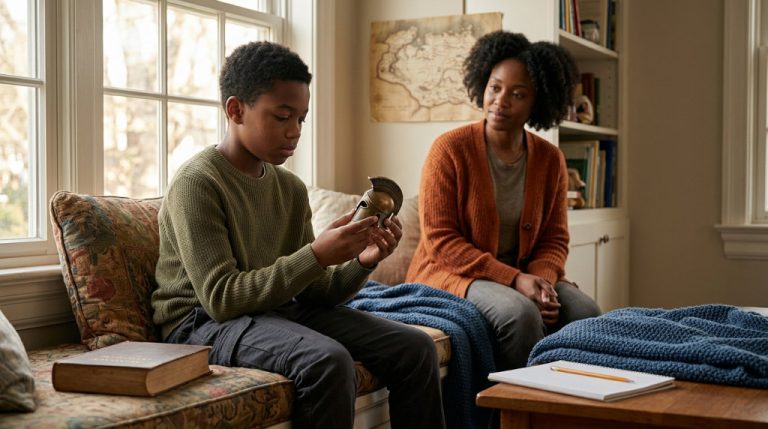
Artifacts invite questions.
A tool, weapon, coin, letter, or piece of clothing often sparks curiosity because it feels tangible and real.
Images
Historical photographs, paintings, maps, and reconstructed scenes can create immediate questions.
People naturally want to know:
What is happening here?
Why does it look like that?
Who are these people?
These moments may seem small.
Yet they are often where interest begins.
Why Small Moments Matter
One reason parents overlook curiosity is that it often appears briefly.
A child asks a question.
Makes an observation.
Expresses surprise.
Then moves on.
Because the interest seems temporary, adults sometimes dismiss it.
That can be a mistake.
Many long-term interests begin with very small moments of attention.
A child fascinated by ancient Egypt may have started with a single image of a pyramid.
An interest in medieval history may have begun with one story about a castle.
An enthusiasm for archaeology may have started with one unusual artifact.
The early stages of interest development are often fragile.
They do not look like commitment.
They look like curiosity.
The goal is not to force those moments into major projects immediately.
The goal is to notice them and allow them to grow.
Recognizing Early Signs of Engagement
Parents sometimes miss emerging interest because they are looking for stronger signals.
They expect enthusiasm.
They expect initiative.
They expect independent study.
Those signs may come later.
Earlier signs are often much smaller.
Look for things such as:
- unexpected questions
- voluntary comments
- requests for clarification
- connections to previous conversations
- curiosity about a person, event, or object
- continued discussion after the lesson ends
A child who asks:
“Why would someone do that?”
may already be demonstrating more engagement than they realize.
A child who returns to a topic several days later may be showing the beginnings of sustained interest.
These moments are important because they reveal attention turning into curiosity.
Curiosity is often the first visible step toward deeper learning.
Historical-Learning Application
History offers unique opportunities to cultivate curiosity because the past is filled with mysteries, puzzles, and unfamiliar experiences.
Parents can intentionally create opportunities for noticing and wondering.
For example:
Instead of beginning with an explanation, begin with an image.
Ask:
What do you notice?
Instead of introducing a historical event through a summary, begin with a question.
Ask:
Why do you think this happened?
Instead of immediately providing answers, allow time for observation and speculation.
Curiosity often emerges during the search for an explanation.
Historical learning benefits when students have opportunities to:
- observe before being told
- wonder before being instructed
- question before being assessed
These experiences support understanding, inquiry, analysis, discussion, and historical thinking.
Practical Takeaways
If your child currently shows little interest in history, consider shifting your goal.
Focus on Curiosity, Not Passion
You do not need to create a lifelong love of history this week.
You only need to create opportunities for noticing and wondering.
Start Small
A surprising image, unusual object, strange custom, or unanswered question can be enough.
Follow Questions
When curiosity appears, treat it as valuable information.
Questions often reveal where future engagement may develop.
Avoid Overloading Early Interest
A child who expresses curiosity does not necessarily need a full assignment.
Sometimes curiosity grows best when it remains exploratory.
Pay Attention to Repeated Interest
Topics that reappear over time often signal emerging engagement.
Value Brief Moments
Short periods of curiosity are not failures.
They are often the first stage of a much larger process.
Conclusion
Many parents assume that motivation must exist before meaningful learning can occur.
Research on interest development suggests the opposite sequence is often true.
Long-term interests rarely appear suddenly.
They usually begin with small moments of curiosity.
A surprising detail.
An unusual image.
An unanswered question.
A mystery worth exploring.
These sparks may seem insignificant, but they often become the foundation upon which deeper engagement is built.
This article does not claim that curiosity alone solves every challenge related to history education.
It does, however, provide one important piece of the larger answer.
Do not focus first on creating passion.
Focus on creating opportunities to wonder.
The spark often comes before the interest.
Curiosity Starts With Observation
This article explores how small moments of curiosity often grow into lasting interest. Spot the Anachronism helps children practice the same habit by encouraging them to look closely, notice unexpected details, ask questions, and investigate what they see. Every comparison begins with observation—and observation is often where curiosity begins.
This Article Is Part Of A Larger Series
Question: How do I make history engaging when my child finds it completely boring?
Current article: Article 7 of 10 — Interest Development Pathway
This article explores one evidence-supported aspect of the larger question.
Readers interested in the full answer should explore the complete series. And investigations are often far more interesting than memorization.