Think Like a Historian: The Surprising Cure for History Boredom
The Question Historians Ask That Students Rarely Hear
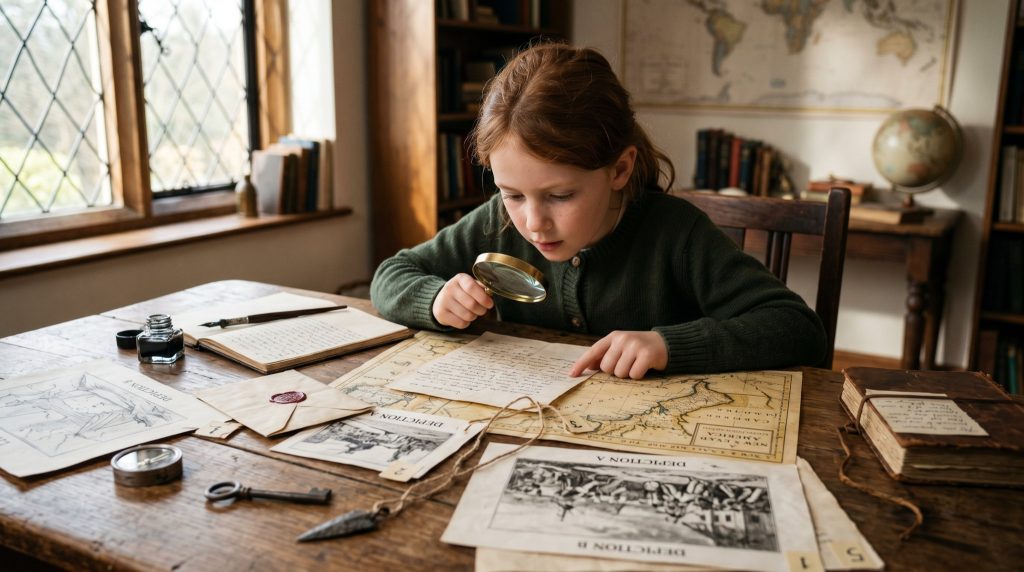
Imagine beginning a history lesson with this question:
Did this event really happen the way people say it did?
Most children immediately become interested.
Not because they suddenly love history.
Because they love mysteries.
They love puzzles.
They love unanswered questions.
Yet many history lessons begin somewhere very different.
Students are often presented with completed stories, established conclusions, and textbook summaries. Their task is to learn the answers.
Historians, however, do not begin with answers.
They begin with questions.
That difference may help explain why so many children describe history as boring.
When homeschooling parents ask:
“How do I make history engaging when my child finds it completely boring?”
they are often looking for better content, better books, or better activities.
Those can certainly help.
But this article explores a different possibility:
History often becomes more engaging when children begin thinking like historians instead of acting like fact collectors.
The goal is not simply to learn more about the past.
The goal is to participate in the process of understanding it.
What Most People Think History Is
Ask adults what history means and many will describe something like this:
- dates
- names
- battles
- timelines
- textbooks
- important events
None of these things are wrong.
History certainly includes them.
The problem is that this definition often reduces history to information.
Students learn what happened.
They memorize who was involved.
They recall important dates.
In this model, success is frequently measured by how much information can be remembered.
Unfortunately, many children find this approach uninspiring.
Facts by themselves can feel disconnected from meaningful questions.
A date is difficult to care about when it exists only as a date.
A name is difficult to remember when it is attached to no larger purpose.
This is one reason history is often experienced as memorization rather than discovery.
The child becomes a consumer of information rather than an investigator.
What Historians Actually Do
Historians work very differently.
They spend far less time memorizing information than many people imagine.
Instead, they investigate evidence.
They ask questions.
They compare accounts.
They evaluate claims.
They consider competing interpretations.
Research on historical thinking has highlighted an important distinction between how historians approach the past and how history is often taught. Historians regularly engage in practices such as sourcing, contextualization, corroboration, and interpretation. Students are frequently exposed primarily to the final conclusions of that work rather than the process itself.
Consider the kinds of questions historians ask:
- Who created this source?
- Why was it created?
- What evidence supports this claim?
- What information might be missing?
- Why do different accounts disagree?
These are not memorization questions.
They are investigation questions.
History, in practice, is much closer to detective work than many students realize.
Why Investigation Is More Engaging Than Memorization
Human beings are naturally curious.
We enjoy solving problems.
We enjoy uncovering hidden information.
We enjoy figuring things out.
A completed answer often ends curiosity.
A compelling question creates it.
Imagine two lessons.
Lesson A
Read a summary about a historical event and answer review questions.
Lesson B
Examine two conflicting accounts of the same event and determine which seems more trustworthy.
Both lessons involve history.
One primarily requires recall.
The other requires investigation.
Most learners find investigation more engaging because it provides a problem to solve.
The learner becomes intellectually active.
They are no longer asking:
What am I supposed to remember?
They are asking:
What do I think happened?
Research in educational psychology suggests that meaningful learning increases when learners actively construct understanding rather than passively receive information. Questions create purpose, and purpose often increases engagement.
Historical Questions Children Can Explore
One reason historical thinking is accessible is that it does not require advanced expertise.
Children can engage in historical inquiry at many different ages.
For example:
How Do We Know?
Instead of simply accepting a claim, ask:
How do historians know this happened?
This question immediately shifts attention toward evidence.
Who Created This?
Show a photograph, letter, painting, diary entry, or newspaper article and ask:
Who made this and why?
Children often enjoy considering perspective and motive.
What Might Be Missing?
Every source has limitations.
Asking what is absent encourages deeper thinking.
Why Do People Disagree?
Historical interpretations sometimes conflict.
Rather than treating disagreement as a problem, historical thinking treats it as an opportunity for investigation.
What Is the Evidence?
Evidence-based reasoning helps learners move beyond guessing toward explanation.
Questions like these transform history from a body of information into an intellectual activity.
Small Shifts That Change Everything
One of the encouraging findings from history education research is that parents do not need to abandon structure in order to introduce historical thinking.
Small changes can have a surprisingly large impact.
Consider replacing:
What happened?
with:
How do we know what happened?
Or replacing:
What is the correct answer?
with:
What evidence supports that answer?
Or replacing:
Remember this fact.
with:
Why might this fact matter?
These questions invite participation.
The learner becomes part of the reasoning process.
History feels less like information transfer and more like intellectual exploration.
Importantly, the facts do not disappear.
Historical thinking simply gives those facts a purpose.
Historical-Learning Application
Historical thinking supports several important dimensions of learning.
Understanding
Students learn not only historical conclusions but how those conclusions are reached.
Observation
Examining photographs, maps, artifacts, letters, and artwork encourages careful attention to evidence.
Analysis
Students evaluate claims rather than merely accepting them.
Interpretation
Learners discover that history often involves multiple perspectives and competing explanations.
Discussion
Questions naturally generate conversation.
Historical inquiry often produces richer discussions than factual recall exercises.
Memory
Information connected to meaningful questions is often easier to remember than isolated facts.
Thinking
Most importantly, students begin practicing the habits of mind that historians actually use.
History becomes something they do, not simply something they receive.
Practical Takeaways
If your child experiences history primarily as memorization, consider introducing small opportunities for investigation.
Ask More Questions
Use historical content as a starting point for inquiry rather than as an endpoint.
Introduce Evidence
Whenever possible, allow children to examine sources directly.
Photographs, letters, maps, and artifacts can become powerful entry points.
Encourage Multiple Explanations
Ask whether more than one interpretation might be possible.
Model Uncertainty
Not every historical question has a simple answer.
Showing that uncertainty exists can make history more intellectually alive.
Focus on Reasoning
Pay attention not only to what conclusions children reach but how they reached them.
The thinking process matters.
Let Curiosity Lead
When children ask unexpected questions, consider treating those questions as opportunities rather than distractions.
Many investigations begin that way.
Conclusion
Many children find history boring because they encounter it primarily as a collection of facts to remember.
While facts are important, they represent only part of what history actually is.
Historians do not spend their lives memorizing conclusions.
They investigate evidence, evaluate claims, compare interpretations, and ask questions.
When learners are invited into those same processes, history often becomes more engaging, more meaningful, and more intellectually satisfying.
This article does not claim that historical thinking solves every engagement challenge.
It does, however, offer one important piece of the larger answer.
History is not merely knowledge about the past.
History is an investigation into the past.
And investigations are often far more interesting than memorization.
History Gets Interesting When Students Investigate
This article argues that history becomes engaging when children stop acting like fact collectors and start thinking like historians. Spot the Anachronism develops the same habit. Students examine evidence, notice details, question assumptions, and build explanations based on what they observe. Instead of being told the answer, they learn to investigate the past for themselves.
This Article Is Part Of A Larger Series
Question: How do I make history engaging when my child finds it completely boring?
Current article: Article 6 of 10 — Historical Thinking Pathway
This article explores one evidence-supported aspect of the larger question. Future articles examine additional research-supported approaches to increasing engagement with history.
Related Facebook Discussions
- Seeing how an entire scene either supports or undermines a historical interpretation is a useful exercise in historical thinking.
- This discussion shows how historians learn to notice evidence that most people overlook.
- This example explores how asking better questions can change the way we interpret historical scenes.