The Missing Ingredient: Choice — Why Ownership Makes History More Engaging
The Child Who Suddenly Cared
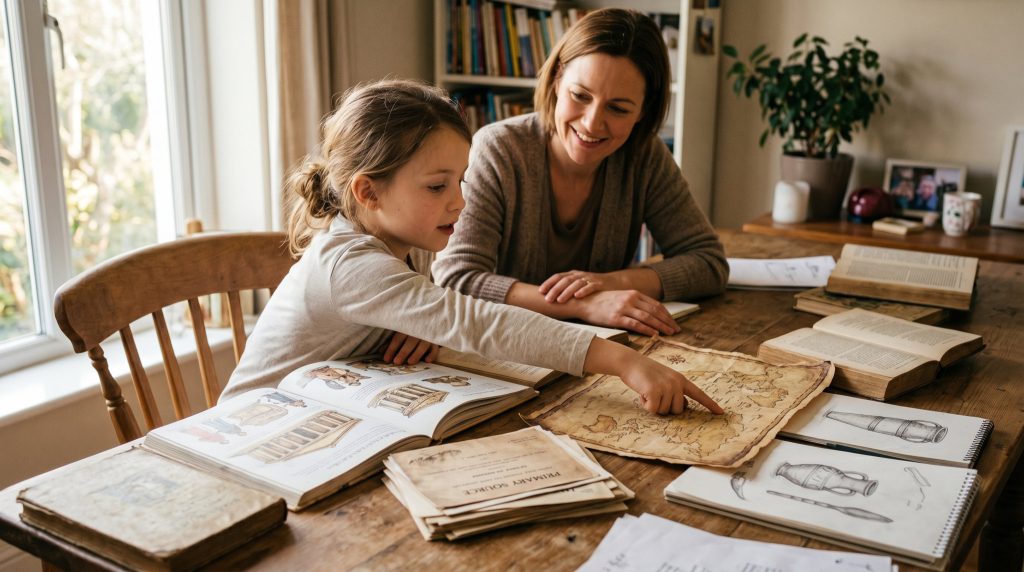
Many homeschooling parents have experienced a surprising moment.
A child who seemed completely uninterested in history suddenly becomes fascinated.
They start asking questions.
They voluntarily read more.
They want to share discoveries at dinner.
They begin talking about historical figures as though they know them personally.
The surprising part is that the transformation often happens after something very small changes.
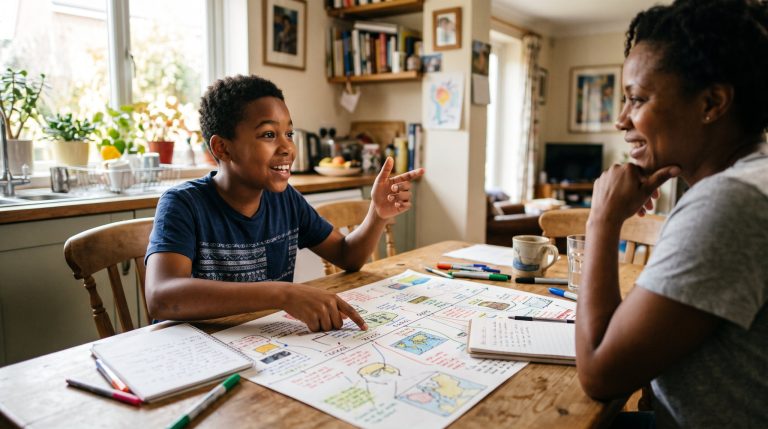
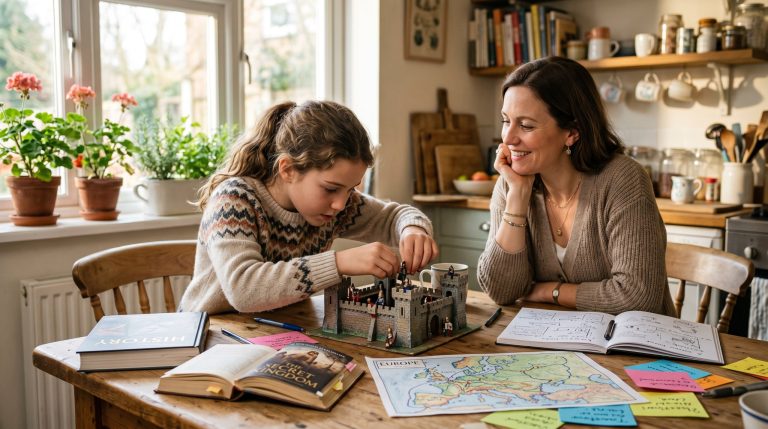
Sometimes the child chooses the topic.
Sometimes they select the book.
Sometimes they pursue a question that caught their attention.
Sometimes they decide how they want to present what they learned.
The content may not have changed very much.
But their level of engagement changes dramatically.
Why?
When parents ask:
“How do I make history engaging when my child finds it completely boring?”
they often focus on content.
Which curriculum?
Which book?
Which activity?
Those questions matter.
But research on motivation suggests another question that may be equally important:
How much ownership does the learner have?
This article explores one specific aspect of the larger answer:
Children often become more engaged with history when they feel they have a meaningful role in directing the learning experience.
The Hidden Variable Most Parents Miss
When history lessons struggle, many parents naturally assume the problem lies in the material itself.
The book is not engaging enough.
The curriculum is not interesting enough.
The activities are not exciting enough.
Sometimes those explanations are correct.
But they do not explain every situation.
Consider two students learning about the same historical period.
One is assigned a topic and instructed exactly how to study it.
The other is allowed to choose a question they want to investigate within that same period.
The historical content may be nearly identical.
The experience feels very different.
One learner receives a task.
The other pursues an interest.
This distinction matters because motivation is influenced not only by what people learn but also by how much ownership they feel over the process.
Children who experience history entirely as an external assignment often disengage.
Children who feel they are exploring something meaningful to them are often more willing to invest attention and effort.
What Motivation Research Says About Choice
Educational psychology has long recognized the importance of autonomy in motivation.
One influential framework, often referred to as Self-Determination Theory, identifies autonomy as one of the core psychological conditions that support engagement and persistence.
In simple terms, people tend to become more invested when they feel they have meaningful input into what they are doing.
This does not mean unlimited freedom.
It does not mean children should control every aspect of their education.
It means that even small opportunities for choice can change how learners experience a subject.
Think about the difference between these two situations:
Situation A
Read this chapter and answer these questions.
Situation B
We are studying this period. Which of these three questions would you most like to investigate?
Both situations involve learning history.
The second invites participation.
The learner becomes a contributor rather than simply a recipient.
Research consistently suggests that learners are more likely to invest effort when they perceive a degree of ownership over the work.
What Historians Actually Do
An interesting irony exists within many history programs.
Students are often taught history in a way that looks very different from how historians actually practice history.
Historians do not typically sit down and passively receive information.
They pursue questions.
They investigate problems.
They follow leads.
They examine evidence.
They decide which questions seem worth answering.
Historical work is deeply connected to curiosity.
A historian might ask:
- Why did this event occur?
- What evidence supports this interpretation?
- What was life like for ordinary people?
- How did this decision affect later events?
These questions create direction and purpose.
In many ways, learner ownership mirrors authentic historical practice.
When students begin asking their own historical questions, they are engaging in a simplified version of the same process.
History becomes something explored rather than merely assigned.
Small Choices Matter More Than Parents Think
One reason parents sometimes hesitate to introduce choice is the assumption that meaningful ownership requires abandoning structure.
Fortunately, that is not the case.
Ownership can emerge through surprisingly small decisions.
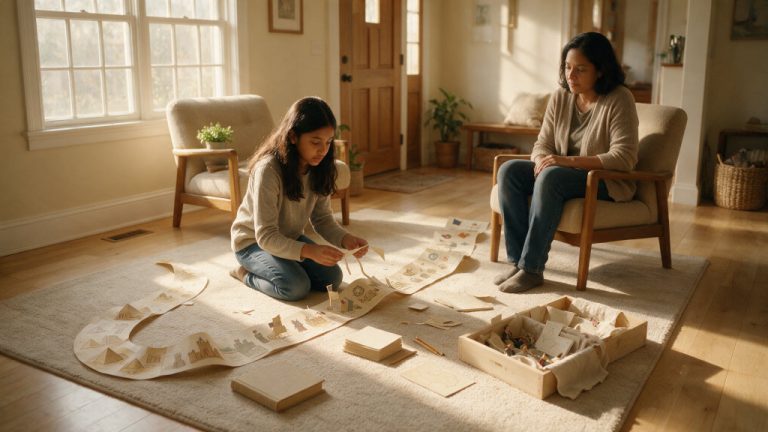
A child might choose:
- which historical figure to study
- which book to read first
- which primary source to examine
- which project format to use
- which question to investigate
None of these choices require abandoning educational goals.
Yet each gives the learner a larger role in shaping the experience.
The effect can be significant because people tend to care more about things they help create.
A project becomes different when it feels like:
“My investigation”
instead of:
“An assignment someone gave me.”
This shift from compliance to participation often increases attention, curiosity, and persistence.
The Difference Between Freedom and Chaos
Many parents worry that increasing choice means sacrificing rigor or educational coverage.
This concern is understandable.
However, meaningful ownership is not the same thing as unlimited freedom.
A useful distinction is:
Freedom without structure
can become chaotic.
Choice within structure
can become empowering.
For example:
A parent might decide that the family will study ancient Egypt.
The child might choose whether to focus on:
- daily life
- architecture
- religion
- technology
- famous rulers
The educational boundaries remain intact.
The learner still experiences ownership.
This approach allows engagement and structure to coexist.
In fact, many learners become more willing to engage with challenging material when they feel they have some voice in the process.
Historical-Learning Application
Ownership influences several aspects of historical learning.
Understanding
Students often work harder to understand topics they selected themselves.
Questions feel more meaningful because they originated from personal curiosity.
Historical Thinking
Choice encourages learners to formulate questions, pursue evidence, and evaluate explanations.
These are foundational historical-thinking skills.
Observation
Students tend to pay closer attention when examining sources, artifacts, images, or documents connected to their interests.
Analysis
Ownership increases willingness to wrestle with complexity and uncertainty.
Memory
Information connected to self-directed interests is often easier to remember because it already carries personal significance.
Discussion
Learners typically contribute more to conversations when discussing topics they care about.
Inquiry
Perhaps most importantly, autonomy naturally supports inquiry.
Questions emerge because learners are personally invested in finding answers.
In this way, ownership supports understanding, remembering, discussing, analyzing, evaluating, and thinking about history.
Practical Takeaways
If your child seems emotionally checked out of history, consider whether ownership may be part of the problem.
Some practical approaches include:
Offer Bounded Choices
Provide several acceptable options rather than a single required path.
Ask What Interests Them
Look for recurring themes, questions, or historical figures that attract attention.
Follow Curiosity Before Coverage
Interest often creates momentum that leads to deeper learning.
Allow Multiple Formats
Some learners prefer writing.
Others prefer presentations, artwork, discussions, or research projects.
Encourage Questions
Treat student questions as valuable starting points rather than interruptions.
Observe What Happens Naturally
Pay attention to moments when your child voluntarily explores historical topics.
Those moments often reveal where ownership already exists.
The goal is not to surrender educational responsibility.
The goal is to create opportunities for meaningful participation.
Conclusion
When children disengage from history, parents often assume the solution is finding better content.
Sometimes that is true.
But content is only part of the equation.
Motivation research suggests that ownership matters as well.
Children are often more willing to engage when they have a meaningful role in shaping the learning experience.
Small opportunities for choice can increase curiosity, participation, persistence, and investment.
This article does not claim that ownership alone solves every engagement problem.
Rather, it highlights one important piece of the larger answer.
Sometimes the missing ingredient is not a different curriculum.
Sometimes the missing ingredient is a larger role for the learner.
Spot the Anachronism Gives Learners a Role
One reason children disengage from history is that they often experience it as something done to them rather than something they actively participate in.
Spot the Anachronism changes that dynamic.
Instead of receiving information, learners investigate evidence, make observations, test ideas, and defend their conclusions.
The activity creates a small but meaningful sense of ownership over the learning process—one of the factors research consistently associates with greater engagement.
History becomes something students explore rather than simply complete.
See how Spot the Anachronism turns observation into participation.
This Article Is Part Of A Larger Series
Question: How do I make history engaging when my child finds it completely boring?
Current article: Article 5 of 10 — Motivation & Agency
This article explores one evidence-supported aspect of the larger question. Future articles examine additional research-supported approaches to increasing engagement with history.
Related Facebook Discussions
- Historical engagement often begins with a question. This visual investigation explores how historians learn to look for systems rather than isolated facts.
- Ownership grows when learners investigate evidence for themselves. This example shows how a simple question can transform the way we see a historical scene.
- Historians don’t just collect facts—they ask questions about how a place functioned. This example explores how evidence can reveal the hidden logic of a historical environment.