Getting a toddler to cooperate for Christmas card photos: play instead of pose
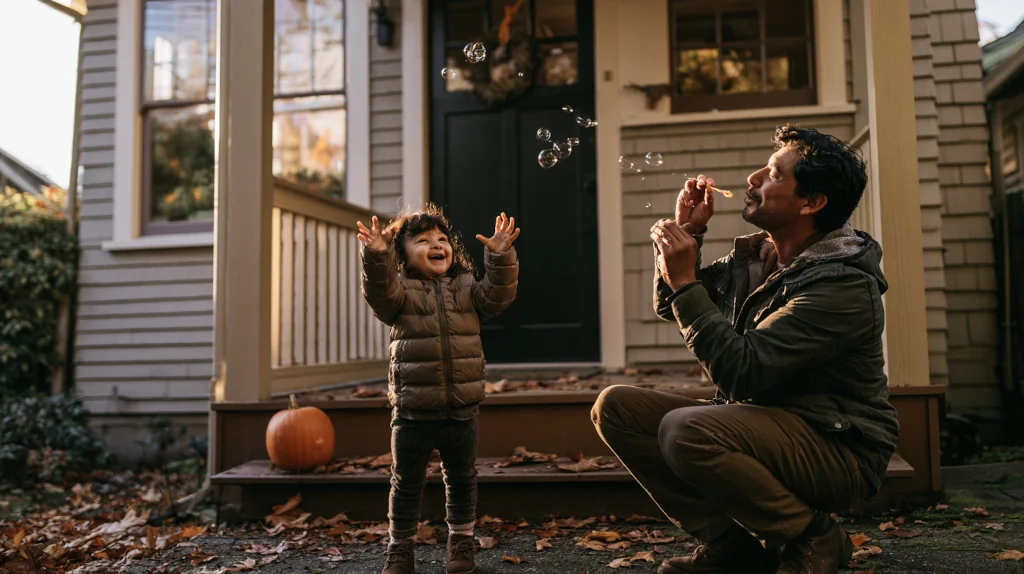
It is Saturday morning, and you are kneeling on the front walk with your phone.
“Sit on the step. Just for one second. Please.”
Your two-year-old sits for half a second, then stands up and points at a squirrel.
You ask again.
This time she lies down on the walk.
Many parents ask some version of this: “Do your toddlers give you a hard time taking photos ? Especially this holiday season of Xmas cards . Our 2 year old won’t let us”
One direct answer: stop asking for a pose and start a game, keep it short, and keep whatever good moment the game gives you.
This article explores one part of that larger question: how to get one good photo of a toddler without a standoff, and when to stop trying.
Key Takeaways
- Following a toddler’s lead often works better than repeating directions, though no approach works every time.
- The goal can be one good photo of the child, not the whole family at once.
- Short sessions, timed after sleep and a snack, give a child the best chance.
- A game the child already loves can do the work a command cannot.
- Distress is a signal to stop; a hard day says nothing fixed about the child.
Directing versus following
Most photo attempts with toddlers run the same way.
The adult decides where the child should be, how they should sit, and when they should smile.
Then the adult asks.
And asks again.
Each request is reasonable on its own.
Together, they add up to a lot of directions for a two-year-old.
Parenting guidance on toddler play suggests a different approach: follow the child’s lead and keep directions few.
That guidance was written about play, not photography.
Applying it to a photo is an extrapolation, not a proven method.
Still, the logic carries over.
When the child chooses what happens, there is less to resist.
The camera follows the child, instead of the child following the camera.
It is closer to waiting for a bird at a feeder than chasing one across the yard.
You set up something the child will come to, and then you wait.
Lower the target to one photo
The pressure often comes from trying to get everything at once.
Everyone in the frame. Everyone looking. Everyone smiling.
As earlier articles in this series discussed, the card may not need that.
A single good photo of the toddler, alone, is a much smaller goal.
It can sit beside photos of the rest of the family, go into a collage, or be brought together with them in one scene.
That smaller goal changes the whole session.
Nobody else has to be ready at the same moment.
Nobody has to hold a smile while the youngest is coaxed back into place.
Choose the moment before the outfit
Photographers who work with young children often give similar advice about timing:
- After a nap, not before one.
- After a snack, not when a meal is overdue.
- In a familiar place, such as home, the backyard or a favorite park.
- With room to move, not perched on a chair.
These are practitioner recommendations, not results from controlled studies.
They also match what many parents already know.
A rested, fed child in a familiar place has more patience to spare.
Keep the session short.
Ten minutes of play is often plenty.
If a good moment comes in the first two minutes, the session can end there.
Give them something to do
A toddler asked to do nothing will usually do something else.
A toddler given something to do is often busy enough to forget the camera.
Ideas parents and photographers mention include:
- Blowing bubbles toward the child.
- Reading a favorite book together.
- Tossing a pile of leaves or rolling a soft ball.
- Singing a song the child knows, with a pause for them to fill in.
- Letting the child hold a favorite toy or an ornament that is safe to drop.
It helps when one adult plays and a different adult holds the phone.
The child watches the person playing, which often turns their face toward the camera.
Get down to the child’s eye level.
Take many pictures.
Expect to keep one.
Know when to stop
No technique makes every toddler cooperate.
Some days the game works.
Some days it does not.
Stop when the child is crying, turning away, clinging, or asking to be done.
Pushing past those signals rarely gets a better picture.
It can make the next attempt harder.
A hard session does not mean anything fixed about the child.
Two-year-olds change quickly, and a tired afternoon can look very different from the next morning.
Trying again on another day is a reasonable plan.
So is looking back through the photos already on your phone, as the previous article discussed.
Practical Takeaways
- Aim for one photo of the toddler alone. The rest of the family can be photographed separately.
- Pick the time first: after sleep and a snack, in a familiar place.
- Bring a game, not a script: bubbles, a book, leaves, a song.
- Split the jobs: one adult plays, another takes the pictures.
- Keep it short, and stop at the first clear sign of distress.
Most importantly, play first. The photo comes second.
Conclusion
This article does not answer the whole question of getting a card when a two-year-old will not cooperate.
It answers one part: how to get one good photo of the child without a standoff.
Following the child’s lead, choosing the timing and keeping the goal small often help.
None of them guarantees a result, and stopping early is part of the method.
The next article in this series looks at the technical side: getting a sharp picture of a child who never stops moving.
A pose has to be asked for.
A moment only has to be noticed.
One Good Photo of Your Toddler Is Enough
A Hawkes’ Impossible Portraits holiday card works from one photo of each person, taken whenever each one was ready, so your two-year-old’s best moment from a short game can join everyone else in one Christmas, Hanukkah or Kwanzaa scene. Nobody has to wear a holiday outfit for the photo: for each person you choose the scene’s outfit, the clothes in their photo, or clothes from another photo. A portrait can include up to seven family members, one of them a cat or dog if you like, and every portrait gets an automatic identity check, pets included. The Founder box is $19.99 for 10 premium folded 7×5 cards on heavyweight silk-coated stock with premium envelopes; shipping and tax are added at checkout. See the before-to-after examples.
FAQ
How do I get my toddler to cooperate for Christmas photos?
Try turning the session into a game the child already enjoys, keep it short, and let one adult play while another takes pictures. No approach works every time.
What is the best time of day to photograph a toddler?
Photographers often suggest after a nap and after a snack, when the child is rested and fed. The right time depends on your child’s routine.
How long should a toddler photo session last?
Short is usually better. Ten minutes of play is often enough, and the session can end as soon as you have one good picture.
Does my toddler need to look at the camera?
Not always. A child looking at the person playing with them, or laughing at bubbles, can show who they are just as well.
What if my toddler cries during the photo session?
Stop. Crying, turning away or clinging are signs the child has had enough. Try again another day, or look through photos you already have.
This Article Is Part Of A Larger Series
Question: Do your toddlers give you a hard time taking photos ? Especially this holiday season of Xmas cards . Our 2 year old won’t let us
Current article: Article 5 of 13 – Mid-series
This article explores one evidence-supported aspect of the larger question.
Readers interested in the full answer should explore the complete series.