
Why won’t my toddler pose for Christmas card photos?
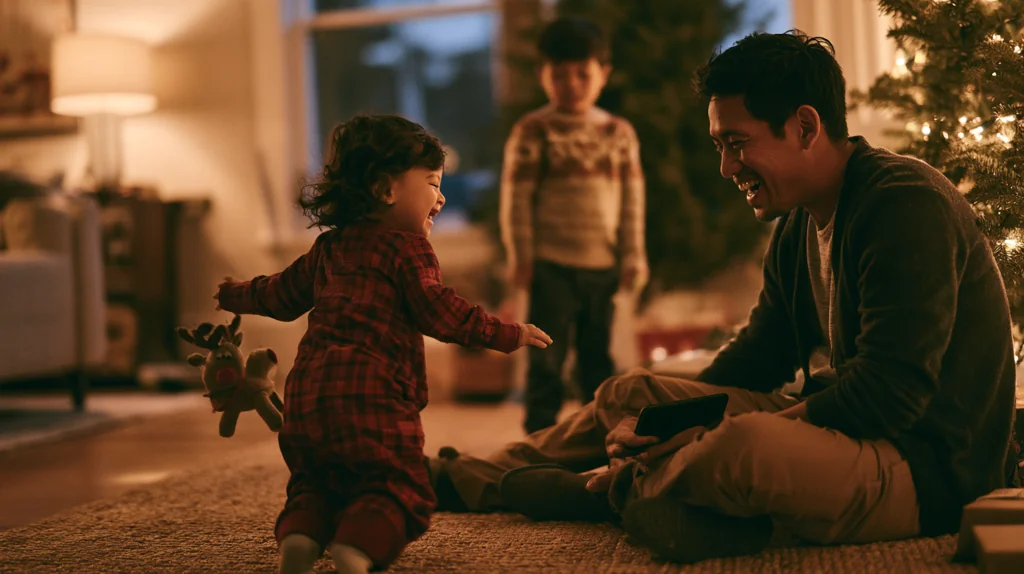
The tree is lit.
Everyone is dressed.
Your six-year-old is standing exactly where you asked.
You count to three, and your two-year-old is already halfway across the room, holding an ornament that was not supposed to come off the tree.
One parent put the feeling into a single line online: “Do your toddlers give you a hard time taking photos ? Especially this holiday season of Xmas cards . Our 2 year old won’t let us”
The short answer is yes, many do.
And it is usually not a sign that anything is wrong with the child, or with the parent.
Around age two, refusing to sit, smile and look at a camera on cue is ordinary.
This article explores one part of that larger question: why toddlers resist the holiday photo in the first place.
Key Takeaways
- Resisting a posed photo is common and developmentally ordinary around age two.
- A lot of what looks like “won’t” is closer to “can’t yet.”
- Holiday conditions (new clothes, new places, late nights, excited adults) can make it harder.
- One bad photo session does not describe a child’s personality.
- When the photo keeps failing, the plan needs to change, not the child.
What a posed photo asks of a two-year-old
It helps to look at the request from the child’s side.
A posed family photo asks a two-year-old to stop moving.
To stay in one spot.
To look at a small object someone is holding.
To make a particular face.
And to do all of it at a moment chosen by someone else.
Adults do this without thinking.
For a two-year-old, each of those steps is a real demand.
Put together, it is a lot.
It may be a bit like asking someone to keep their eyes open in the middle of a sneeze.
They might manage it once.
Asking for it again and again is a different matter.
Won’t, or can’t yet?
Public health guidance on toddler development describes this age in a way many parents will recognize.
Two-year-olds are working hard on independence.
They want to do things their own way.
They move constantly.
Their feelings are strong, and their ability to manage those feelings is still developing.
That same guidance encourages parents to give directions a young child can actually follow, and to tell the difference between a child who will not do something and a child who cannot do it yet.
The photo is a good test of that difference.
“Sit still and smile” sounds like one simple instruction.
To a two-year-old, it is several difficult ones at once.
When the child runs off, it can feel like defiance.
Often it is closer to a child doing exactly what two-year-olds are built to do.
Defiance and development can look the same from behind a camera.
They are not the same thing.
Why the holidays can make it harder
The holiday photo rarely happens on an ordinary afternoon.
It often happens in a scratchy sweater the child has never worn.
In a room that has been rearranged around a tree.
At the end of a busy day, or before a late dinner.
With adults who are excited, a little rushed, and suddenly very interested in where the child is looking.
Each of those things can make cooperation harder for a small child.
Photographers who work with toddlers often suggest the obvious fixes first: a rested child, a fed child, a familiar place, and a short session with room to move.
That advice comes from practice rather than controlled studies.
It is still worth taking seriously, because it describes the conditions most likely to help.
One bad session is not a personality
After a photo attempt goes badly, it is easy to start describing the child.
“She hates the camera.”
“He is just difficult.”
Toddlers change quickly.
What a child cannot manage in November may come easily a few months later.
A hard session usually says more about that day, that hour and that request than about who the child is.
There is no way to know the exact reasons for any particular child from the outside.
Some children are more sensitive to noise, clothing or crowds.
Some are simply tired.
What is clear is that one frustrating evening is not a verdict.
Practical Takeaways
- Change the timing. Try when the child is rested and fed, not at the end of the day.
- Shrink the request. Ask for one thing, such as looking at a sibling, instead of a full pose.
- Keep it short. A few minutes is often more realistic than a planned session.
- Agree on a stopping point in advance. When the child is genuinely upset, stop. The photo is not worth the tears, and pushing usually makes the next try harder.
- Ask what the card really needs. It may not need everyone posed together in one frame. Later articles in this series look at that question directly.
Most importantly, take the pressure off yourself.
A toddler who will not pose is not evidence that your family is doing something wrong.
Conclusion
This article does not answer the whole question of how to get a holiday card with a two-year-old in it.
It answers the first part: why the posed photo is so hard.
The resistance is common.
It makes sense for the age.
And it is a reason to change the plan rather than a reason to blame anyone.
The rest of the series builds on that, looking at what a good card photo actually needs, and at ways to include everyone without a standoff in front of the tree.
Your two-year-old is not failing the photo.
The photo is asking too much of a two-year-old.
FAQ
Is it normal for a two-year-old to refuse to pose for pictures?
Yes. Around age two, children are working on independence, move constantly and are still learning to manage strong feelings. Refusing to sit and smile on cue is common for this age.
Does it mean my child is being defiant?
Not necessarily. A posed photo asks for stillness, attention and cooperation all at once. Much of what looks like defiance is closer to a child who cannot do all of that yet.
Why is it worse at Christmas?
Holiday photos often involve unfamiliar clothes, rearranged rooms, busy days and excited adults. Each of these can make cooperation harder for a small child.
Should I keep trying until I get the shot?
Keep attempts short and stop when the child is genuinely upset. Pushing through distress usually makes later attempts harder, not easier.
Will my child always be like this in photos?
Toddlers change quickly. One difficult session describes that day and that request more than it describes the child.
This Article Is Part Of A Larger Series
Question: Do your toddlers give you a hard time taking photos ? Especially this holiday season of Xmas cards . Our 2 year old won’t let us
Current article: Article 1 of 13 – Foundation article
This article explores one evidence-supported aspect of the larger question.
Readers interested in the full answer should explore the complete series.