When your toddler won’t cooperate for Christmas photos: how to still get a card you love

It is late, and the house is finally quiet.
Your two-year-old is asleep in the crib, one sock off, after a day that included three attempts at the holiday photo.
You sit on the nursery floor in the glow of the nightlight and type a question into a parents’ group on your phone.
You just want to know if it is only you.
Many parents ask some version of this: “Do your toddlers give you a hard time taking photos ? Especially this holiday season of Xmas cards . Our 2 year old won’t let us”
One direct answer: it is not only you, and you do not need your toddler to cooperate; you need everyone in the card, which can come from the photos you already have, short gentle sessions, or separate pictures brought together.
This final article brings the whole series together into one plan.
Key Takeaways
- A two-year-old resisting a pose is ordinary development, not a parenting failure.
- The goal can be everyone recognizably themselves, not everyone smiling at once.
- The card does not need one group photo; it needs one good picture of each person.
- Most of those pictures may already be on your phone; the rest can come from short, playful sessions.
- The card is a family record, and you choose how much of the work, and how much sharing, it involves.
Cooperation versus inclusion
The question behind this whole series sounds like a problem of cooperation.
The toddler will not cooperate, so the card cannot happen.
But the card was never really about cooperation.
It was about inclusion.
Everyone you love, on one card, looking like themselves.
Once the goal shifts from cooperation to inclusion, almost every part of the problem gets smaller.
A card built this way is a little like a quilt.
Each square is made on its own, at its own pace.
Sewn together, they make one thing.
Nobody asks the squares to be finished on the same afternoon.
Expect the resistance
The first article in this series explained why two-year-olds resist posing.
At this age, independence, movement and strong feelings are expected, and the ability to hold still on request is still developing.
A toddler who will not pose is often a toddler who cannot yet, not one who is being difficult.
Change the plan, not the child.
Change what success looks like
The second article looked at what makes a good card photo.
The perfect photo shows everyone smiling.
The right photo shows everyone being themselves.
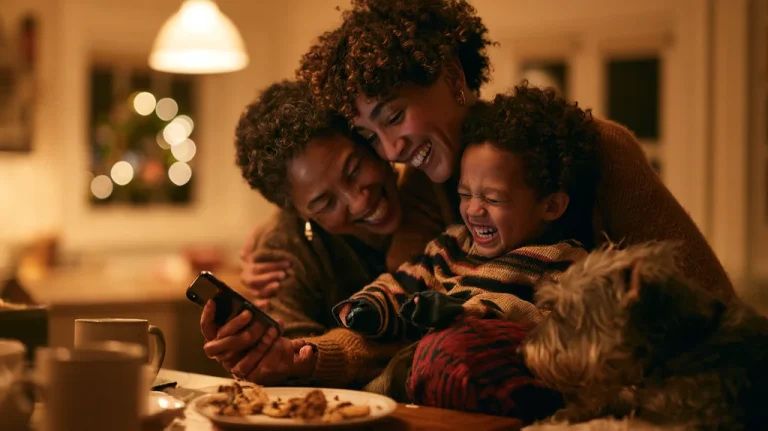
A laughing toddler looking away, a dog mid-lick, a candid from an ordinary day: these often say more about a family than a stiff pose.
Drop the group-photo requirement
The third article asked whether everyone needs to be in one picture.
They do not.
Everyone needs to be in the card.
Separate pictures can sit side by side, go into a collage, or be brought together into one scene.
That single change removes the hardest requirement of all: getting everyone ready at the same moment.
Check what you already have
The fourth article pointed to the camera roll.
It is rare to have one picture where everyone looks good at once.
It is common to have one good picture of each person on their own.
Check your phone before you book the photo day.
Get the missing photos gently
For anyone still missing, the fifth and sixth articles offered two kinds of help.
Play instead of pose. Follow your toddler’s lead, keep sessions short, time them after sleep and a snack, and stop when your child has had enough.
Fix the light, not the child. Most blur comes from too little light; a big window by day and many quick frames often catch the moment.
Build the card
The seventh article compared card formats: matching outfits, a year-in-review collage, or one family scene.
Only matching outfits need everyone dressed alike at the same moment.
The eighth article covered print readiness: a screen shines, paper reflects, so check light, sharpness, crop and the proof before you order.
Lighten the load
The ninth article listed the many jobs hiding behind one card, and why the photo feels heaviest: it is the one step that depends on a toddler.
The tenth turned that into a plan: decide who needs to be on the card, check your photos, fill the gaps, work backward from the arrival date, share the jobs, and keep a backup.
You are allowed to simplify, delay or skip any part of it.
Protect and keep
The eleventh article separated sending from posting.
A card goes to a person; a post goes to everyone.
You can share your family with the people you choose and keep your child’s face off public feeds.
The twelfth article looked at the card over time.
A performance is for the audience.
A record is for the family.
Years from now, the honest card, toddler and all, is often the one you will want most.
The plan on one page
- Expect resistance; it is not a failure.
- Aim for everyone recognizably themselves.
- Choose a format that does not need everyone at once.
- Find one good picture of each person on your phone.
- Fill any gaps with short, playful sessions in good light.
- Check each picture for print before ordering.
- Work backward from the arrival date and leave a buffer.
- Share the jobs and decide who sees the card.
- Keep a dated copy for your family’s record.
Practical Takeaways
- Stop chasing the pose. Your toddler does not need to cooperate.
- Start from your phone, one person at a time.
- Keep any new photo sessions short, playful and bright.
- Choose a format that includes everyone without needing them together.
- Lighten the load, protect your child’s image, and keep the card as a record.
Most importantly: we don’t need them to. We’ll still get a card we love.
Conclusion
The parent who typed that question late at night was not failing.
They were asking a two-year-old to do something most two-year-olds cannot yet do, for a card that never needed it.
A card everyone in the family will love can come from ordinary pictures, a little play, good light, a simple plan, and the decision to include everyone exactly as they are.
Your two-year-old does not have to cooperate.
They only have to be included.
The Card You Wanted, Without the Pose
A Hawkes’ Impossible Portraits holiday card puts your real family, unmistakably themselves, together in one Christmas, Hanukkah or Kwanzaa scene, built from one photo of each person, so your two-year-old never has to pose with anyone. Up to seven family members can be included, one of them a cat or dog if you like. You upload the photos after you order, choose what each person wears (the scene’s outfit, the clothes in their photo, or clothes from another photo), and every portrait gets an automatic identity check; you can run a portrait again and choose among the versions that pass. Portraits in your Family Gallery are private by default. The Founder box is $19.99 for 10 premium folded 7×5 cards with premium envelopes; shipping and tax are added at checkout. See the before-to-after examples.
FAQ
My toddler won’t pose for Christmas photos. What should I do?
Stop asking for the pose. Look for one good picture of your toddler on your phone, or take a short, playful session in good light, and build the card from separate pictures of each person.
Can I make a family Christmas card without a group photo?
Yes. Separate pictures of each person can sit side by side, go into a collage, or be brought together into one family scene.
Is it normal for a two-year-old to refuse photos?
Yes. Independence, movement and strong feelings are expected at this age, and holding still on request is still developing.
How do I make Christmas cards less stressful with a toddler?
Replace the big photo day with a plan: check existing photos, fill gaps with short sessions, choose a format that does not need everyone at once, and order with time to spare.
What if the photo isn’t perfect?
That is often fine. A card that shows everyone recognizably themselves, including an unhappy toddler, is a record your family may treasure more than a perfect pose.
This Article Is Part Of A Larger Series
Question: Do your toddlers give you a hard time taking photos ? Especially this holiday season of Xmas cards . Our 2 year old won’t let us
Current article: Article 13 of 13 – Capstone article
This article explores one evidence-supported aspect of the larger question.
Readers interested in the full answer should explore the complete series.