The Cognitive Load Trap
A homeschooling parent sits down with their child to begin a history lesson.
The topic is the Battle of Marathon.
Within a few minutes the child encounters:
- Greece
- Persia
- Athens
- city-states
- hoplites
- invasions
- military tactics
- ancient geography
The parent notices the child staring blankly at the page.
Attention begins to drift.
Questions stop.
Interest fades.
By the end of the lesson, very little seems to have been retained.
The natural conclusion is often:
“My child just isn’t interested in history.”
Sometimes that explanation is correct.
Often it isn’t.
What looks like boredom may actually be something else entirely.
The child may not be rejecting history.
The child may be overwhelmed by it.
This distinction matters because the solution to boredom is very different from the solution to overload.
And many history lessons fail not because children are unwilling to learn, but because their minds are being asked to process more unfamiliar information than they can effectively handle at one time.
Why Working Memory Matters
To understand this problem, it helps to understand a simple fact about how learning works.
The brain cannot process unlimited amounts of new information simultaneously.
Learning begins in a system psychologists often call working memory.
You can think of working memory as a mental workspace.
It is where information is temporarily held while the brain tries to make sense of it.
Working memory is powerful.
But it is also limited.
When too much unfamiliar information arrives at once, the system becomes overloaded.
Imagine trying to carry twelve grocery bags in a single trip.
At some point, something gets dropped.
The problem is not effort.
The problem is capacity.
Working memory operates in a similar way.
When a lesson introduces too many unfamiliar elements simultaneously, some information simply never gets processed effectively.
And information that is not processed cannot be stored reliably.
The Hidden Difference Between Attention and Understanding
Many parents assume that attention automatically leads to learning.
If the child is listening, learning must be happening.
If the child is paying attention, memory should follow.
Unfortunately, the relationship is not that simple.
A child can be attentive and still fail to understand.
Imagine listening to a lecture filled with unfamiliar technical terminology.
You might concentrate carefully.
You might genuinely try to follow along.
Yet after ten minutes, you may realize that very little is making sense.
The problem is not attention.
The problem is that understanding never fully developed.
History lessons often create the same experience.
Children may listen carefully while struggling to organize what they are hearing.
The information enters awareness but never forms a meaningful structure.
Without structure, memory has nothing stable to attach itself to.
The lesson feels confusing.
Confusion becomes frustrating.
Frustration often looks like boredom.
From the outside, the child appears disengaged.
Inside, they may simply be overwhelmed.
Why History Is Especially Vulnerable
History presents a unique challenge because it frequently introduces multiple layers of unfamiliar information at the same time.
A single lesson may contain:
- new people
- new locations
- new governments
- new cultural practices
- new historical periods
- new vocabulary
- new relationships between events
Consider a lesson about Ancient Rome.
A child may encounter senators, consuls, patricians, plebeians, republics, legions, provinces, and political alliances all within the same chapter.
To an adult with background knowledge, these ideas connect naturally.
To a child, they can feel like disconnected fragments.
Nothing yet has a place to belong.
History textbooks often make this problem worse.
Because authors already understand the material, they may underestimate how much prior knowledge is required to make sense of a topic.
The result is a lesson that feels clear to the writer but overwhelming to the learner.
When overload occurs, memory formation suffers.
The information may never become organized enough to be stored effectively.
How Schemas Reduce Cognitive Load
Fortunately, the brain has a solution.
Psychologists often call it a schema.
A schema is simply an organized mental framework.
It is a structure that helps the brain make sense of new information.
Imagine a child who already understands the basic story of Ancient Egypt.
They know there were pharaohs.
They know the Nile River mattered.
They know pyramids served as tombs.
These ideas form a simple schema.
Now imagine introducing mummification.
Because a framework already exists, the new information has somewhere to fit.
The child is not starting from nothing.
The schema carries part of the cognitive load.
This is why prior knowledge matters so much.
The more organized understanding a child already possesses, the easier it becomes to learn additional information.
Learning accelerates because the brain spends less effort building structure and more effort expanding it.
Why Stories Work Better Than Fact Lists
This principle helps explain why stories are often so effective.
Stories provide structure.
A narrative organizes information around people, goals, conflicts, and consequences.
Instead of memorizing isolated facts, children follow a sequence of events.
The information has relationships.
It has context.
It has meaning.
Compare these two approaches.
The first presents a list:
- Athens
- Persia
- Marathon
- Darius
- hoplites
The second tells a story about a powerful empire attempting to conquer a smaller Greek city-state and the citizens who chose to fight against overwhelming odds.
Which version is easier to follow?
Which version is easier to remember?
Most children naturally prefer the second.
The story reduces cognitive load because it organizes information into a coherent structure.
Historical fiction often produces similar benefits.
Children become invested in characters and events.
The narrative framework helps unfamiliar information feel manageable.
The story becomes a scaffold that supports understanding.
Building Historical Understanding Without Overload
The solution to cognitive overload is not making history simplistic.
Children are capable of learning remarkably complex ideas.
The goal is to introduce complexity gradually.
Think about building a house.
You do not begin with the roof.
You start with the foundation.
History works the same way.
Introduce people before systems.
Introduce stories before abstractions.
Introduce questions before explanations.
Help children develop a basic understanding of a historical period before adding layers of detail.
For example, before explaining the political structure of the Roman Republic, introduce the people who lived within it.
Before discussing economic systems, tell the stories of individuals affected by those systems.
Before analyzing historical causes, establish a clear narrative of events.
Complexity becomes easier when understanding already exists.
What This Looks Like in a Homeschool
Homeschooling offers a tremendous advantage here.
Parents can adjust pacing.
You are not required to cover a predetermined amount of material every week.
If a lesson introduces too many unfamiliar concepts, slow down.
Spend additional time establishing context.
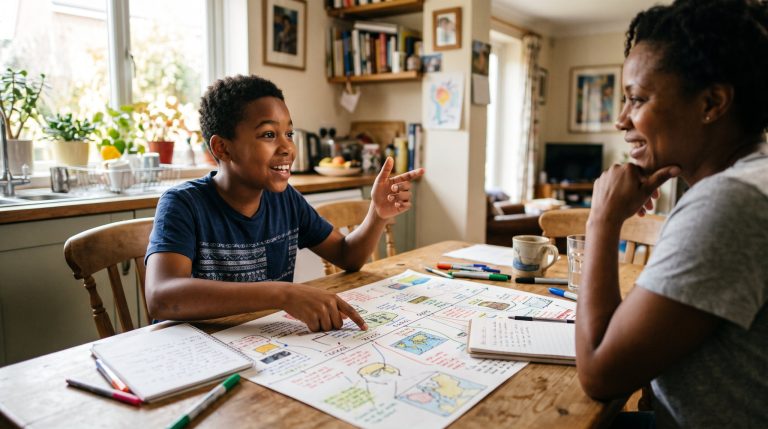
Ask questions such as:
- What do you already know about this topic?
- Who seems most important in this story?
- What surprised you?
- Why do you think this happened?
These conversations help children organize information rather than simply receive it.
Simple activities can also reduce overload.
Story retellings.
Character maps.
Cause-and-effect chains.
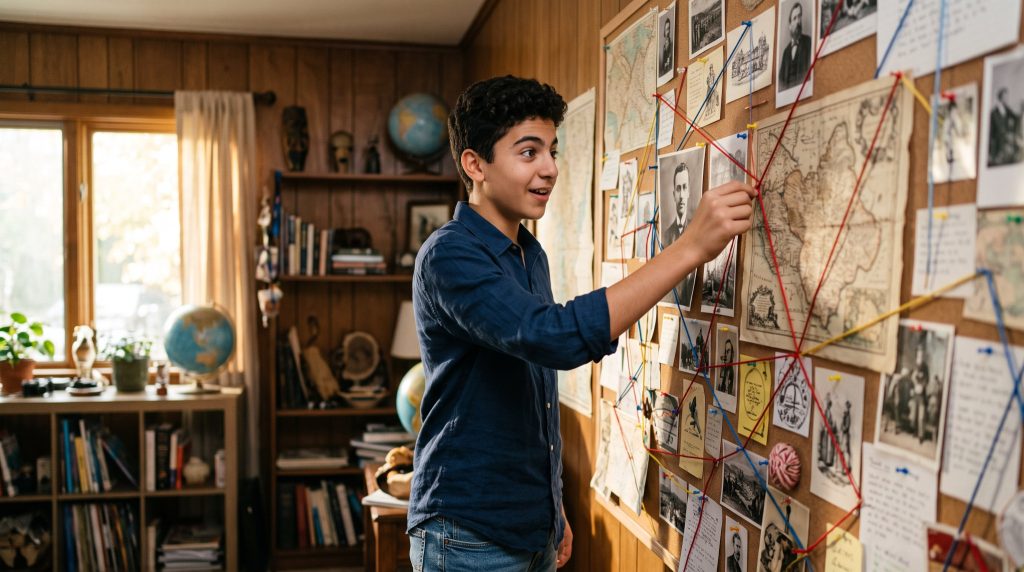
Relationship webs.
Basic timelines.
Each activity helps transform disconnected information into meaningful structure.
And meaningful structure is what memory needs.
When Boredom Isn’t Really Boredom
Perhaps the most important lesson is this:
Not all boredom has the same cause.
Sometimes children are bored because a lesson lacks relevance or interest.
But sometimes boredom emerges because understanding has broken down.
The child cannot see how the pieces fit together.
The information feels random.
The effort required to make sense of everything becomes exhausting.
At that point, disengagement becomes a form of self-protection.
The brain begins withdrawing attention from a task that feels impossible.
Parents often interpret this as laziness or lack of interest.
In reality, the child may simply need better support.
They need organization.
They need context.
They need structure.
Most of all, they need information presented in a way that their minds can successfully process.
The Real Problem
When children struggle with history, it is tempting to assume they need more discipline, more effort, or more repetition.
Sometimes the real issue is much simpler.
The lesson contained more unfamiliar information than their working memory could effectively manage.
The result was not poor retention.
The result was failed encoding.
The memory never had a chance to form properly because understanding never became stable.
This is why slowing down often speeds up learning.
This is why stories frequently outperform fact lists.
This is why prior knowledge matters.
And this is why a child who seems bored may actually be overwhelmed.
History becomes easier to enjoy when it becomes easier to understand.
It becomes easier to remember when information has a place to belong.
And it becomes easier to learn when we stop treating learning as information delivery and start treating it as the gradual construction of understanding.
Because many children are not rejecting history.
They are simply drowning in disconnected information.
Once we help them organize it, everything begins to change.
One Question at a Time
This article explains that history often fails not because a child is bored but because too much unfamiliar information arrives at once and working memory overloads. Spot the Anachronism helps precisely because it narrows the field. Instead of a whole era demanding attention, you and your child look at one Roman scene and ask one manageable question at a time – what feels off here, and why? Each small observation gives the next piece of knowledge somewhere to attach, building the kind of organized framework this article describes. Start with what your child already recognizes, let them anchor there, and add one layer at a time through conversation. A single scene explored slowly keeps the load light enough for real understanding to form.
This Article Is Part Of A Larger Series
Question: Why doesn’t the information stick? My child forgets everything right after a lesson.
Current article: Article 7 of 11 — Structural Causes Cluster
This article explores one evidence-supported aspect of the larger question. Future articles examine additional research-supported approaches to increasing engagement with history.
Related Facebook Discussions
- Understanding grows when each piece has somewhere to fit, the way this exercise asks whether every part of a Roman scene belongs to one connected world.
- A single focused question, like whether a space was built to manage crowds, keeps observation light enough for understanding to take hold.
- Focusing on one concrete detail, like how light actually filled a Roman room, is how history stays manageable instead of becoming a flood of disconnected facts.