The Most Powerful Learning Tool Homeschoolers Already Use

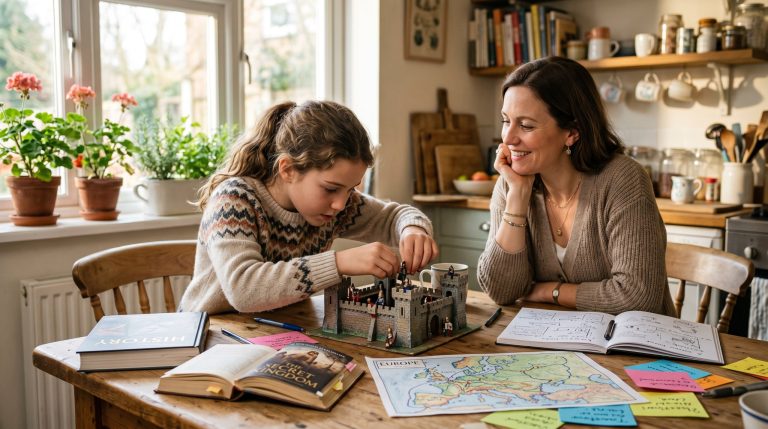
Many homeschooling parents have a simple routine at the end of a lesson.
They close the book and ask:
“Tell me what you remember.”
For some families, this practice is a formal part of their homeschool method. For others, it happens naturally around the kitchen table, during a car ride, or while cleaning up after lunch.
Either way, most parents think of this moment as assessment.
They are trying to find out whether the child was paying attention.
Whether the lesson made sense.
Whether learning occurred.
What many parents do not realize is that this simple practice may be doing something far more important.
The narration itself may be creating the learning.
That idea surprises many homeschoolers because we tend to think of learning as something that happens during the lesson.
The reading is the learning.
The documentary is the learning.
The discussion is the learning.
The narration simply checks the results.
Modern research on memory suggests a different picture.
In many cases, the act of retelling is not merely measuring learning.
It is helping to build it.
Why Parents Misunderstand Narration
The misunderstanding is understandable.
When we ask children to narrate, we usually want information.
Did they understand the chapter?
Did they follow the story?
Did they hear the important details?
If the narration is strong, we feel encouraged.
If the narration is weak, we worry.
The narration becomes a scorecard.
But that perspective misses what is happening inside the child’s mind.
Imagine a child reads a chapter about the voyage of Christopher Columbus.
When the reading ends, the information is fresh.
The child recognizes the names.
The events feel familiar.
The story seems understood.
Then the parent asks:
“Tell me what happened.”
Suddenly the child’s role changes.
Instead of receiving information, they must reconstruct it.
They must decide what mattered.
They must organize events.
They must connect causes and consequences.
They must transform information from something they heard into something they can explain.
That process is not merely revealing learning.
It is creating stronger learning.
What Happens When a Child Retells a Story
To understand why narration is so powerful, it helps to think about what the brain is being asked to do.
Listening is relatively passive.
Retelling is active.
When a child narrates, they must retrieve information from memory.
They cannot simply recognize it on a page.
They must bring it back.
That retrieval process is one of the most powerful ways to strengthen memory.
Every successful retrieval acts like a workout for the memory system.
The memory becomes easier to access in the future.
The connections become stronger.
The information becomes more durable.
But retrieval is only part of the story.
Narration also requires organization.
A child must determine:
What happened first?
What happened next?
Why did that matter?
Which details belong together?
Which details are most important?
This process turns scattered information into a coherent structure.
And coherent structures are easier for the brain to remember.
A child who narrates is not simply repeating information.
They are rebuilding it.
Why History Is Especially Well Suited for Narration
Some subjects lend themselves naturally to narration.
History may be the best example.
History is fundamentally about people.
Choices.
Conflicts.
Mistakes.
Victories.
Consequences.
Stories.
Human beings are naturally drawn to stories because stories organize information into meaningful sequences.
We remember narratives more easily than disconnected facts.
Consider the difference between these two learning experiences:
The first child memorizes:
- 1066
- William the Conqueror
- Battle of Hastings
The second child tells the story of a Norman duke crossing the English Channel, fighting for a throne, and permanently changing English history.
Which memory is likely to survive longer?
The story provides context.
The facts have somewhere to live.
History is full of these narrative structures.
Kings and queens.
Explorers.
Inventors.
Revolutions.
Empires.
Families.
Wars.
Narration naturally fits the shape of the subject.
When children retell history, they are working with the material in the form the brain already prefers.
Narration Builds More Than Memory
The benefits of narration extend far beyond retention.
Narration builds confidence.
A child who successfully explains a historical event begins to see themselves as someone who understands history.
That matters.
Many children experience school as a process of receiving information and then discovering what they cannot remember.
Narration changes the relationship.
The child becomes the storyteller.
The explainer.
The interpreter.
The person making sense of the past.
That shift creates ownership.
The lesson is no longer the author’s story.
It becomes the child’s story.
Narration also encourages curiosity.
Children often discover questions while retelling.
They realize they are unsure why someone made a decision.
They notice a gap in the sequence of events.
They wonder what happened afterward.
These questions arise naturally because narration requires active thinking.
And active thinking often produces genuine interest.
Perhaps most importantly, narration supports historical empathy.
When children explain why historical figures acted as they did, they begin to view those figures as real people facing real decisions.
History becomes less about facts and more about human experience.
That transformation can dramatically increase engagement.
What Narration Looks Like in Real Homeschooling
One reason narration is so valuable is its flexibility.
Young children might give a narration consisting of only a few sentences.
After hearing a story about Ancient Egypt, a child might say:
“The pharaoh wanted a big tomb, and lots of people worked on it. Then they buried him there.”
Simple.
Incomplete.
Still valuable.
Older children might provide much richer explanations.
After studying the American Revolution, they may discuss taxation, representation, political philosophy, and competing perspectives.
The form of narration can vary as well.
Some children prefer speaking.
Others enjoy writing.
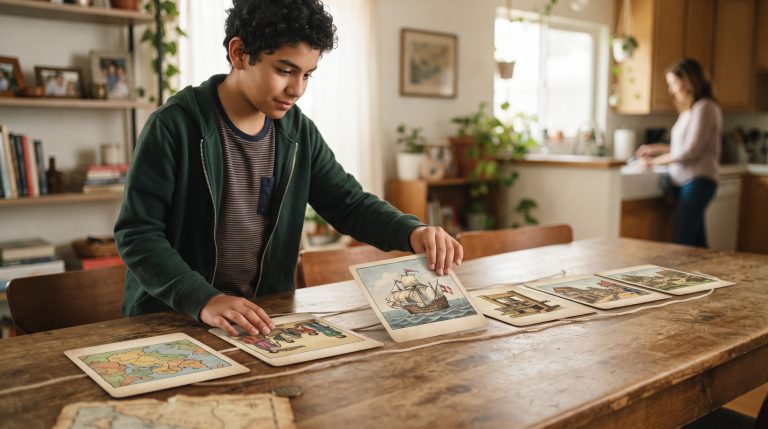
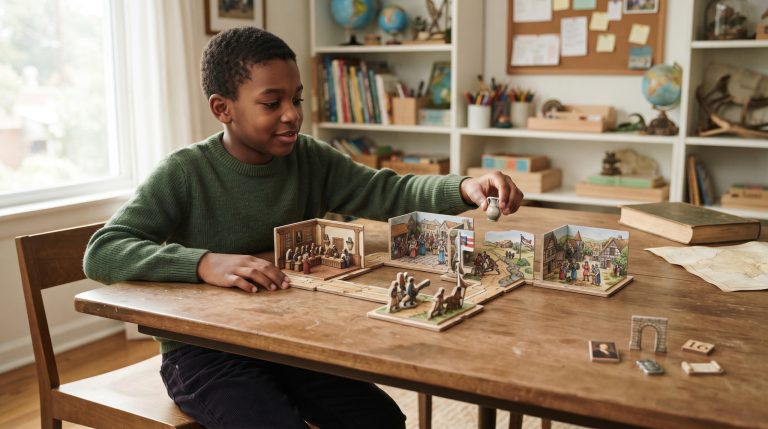
Some draw pictures and explain them.
Some build timelines.
Some create comic strips.
Some retell events from the perspective of a historical figure.
The format matters less than the process.
The essential feature is reconstruction.
The child is making sense of what they learned and expressing it in their own way.
Narration and Historical Understanding
A common misconception is that narration is primarily about remembering details.
In reality, good narration often reveals understanding.
Suppose two children learn about the fall of the Roman Empire.
One remembers that the empire fell in the fifth century.
The other explains that the empire struggled with political instability, economic pressures, military challenges, and external invasions.
The second child may not remember every date.
But they understand the story.
They understand relationships.
They understand causes.
That understanding is often more valuable than isolated factual recall.
Narration encourages children to think about significance.
What mattered?
Why did it matter?
How did one event lead to another?
These are the kinds of questions historians ask.
In that sense, narration moves children closer to historical thinking itself.
They are not merely collecting facts.
They are constructing explanations.
How Parents Can Start Using Narration More Effectively
The encouraging news is that many homeschooling parents already use narration.
The challenge is often not starting.
It is changing how we think about it.
Instead of treating narration as a test, treat it as part of the lesson.
Allow children to struggle a little.
Retrieval effort is part of the value.
Avoid the temptation to correct every detail immediately.
Focus first on reconstruction.
Encourage open-ended responses.
Ask questions such as:
- What happened?
- Why do you think that happened?
- What surprised you?
- What would you have done?
- What happened because of that decision?
These questions invite children to think rather than recite.
And thinking is what strengthens learning.
Narration can also happen outside formal lesson time.
At dinner.
During walks.
In the car.
After documentaries.
Following museum visits.
Whenever children are invited to tell the story back, they are engaging in the same powerful process.
The Learning Tool Hidden in Plain Sight
Many homeschool parents spend years searching for better ways to make history engaging.
They look for better curriculum.
Better books.
Better videos.
Better activities.
Sometimes those changes help.
But one of the most effective tools may already be part of the homeschool day.
Narration requires no special purchase.
No subscription.
No complicated preparation.
It simply asks children to retrieve, organize, and explain what they have encountered.
And those acts strengthen memory, deepen understanding, encourage ownership, and often increase engagement.
That is why narration deserves to be viewed differently.
It is not merely a way to discover whether your child learned something.
It is one of the ways your child learns.
The next time you ask,
“Tell me what you remember,”
remember that you may not be checking learning.
You may be helping to create it.
Learning Happens When Children Explain
One of the most powerful ways to strengthen learning is to ask children to explain what they have just encountered. When they retrieve information, organize it, and tell the story in their own words, they are doing more than demonstrating understanding—they are building it.
Spot the Anachronism uses a similar process. Children must observe carefully, identify evidence, explain their reasoning, and defend their conclusions. Those acts of retrieval, analysis, and explanation help transform passive exposure into active learning.
This Article Is Part Of A Larger Series
Question: Why doesn’t the information stick? My child forgets everything right after a lesson.
Current article: Article 3 of 11 — Memory-Building Cluster
This article explores one evidence-supported aspect of the larger question. Future articles examine additional research-supported approaches to increasing engagement with history.