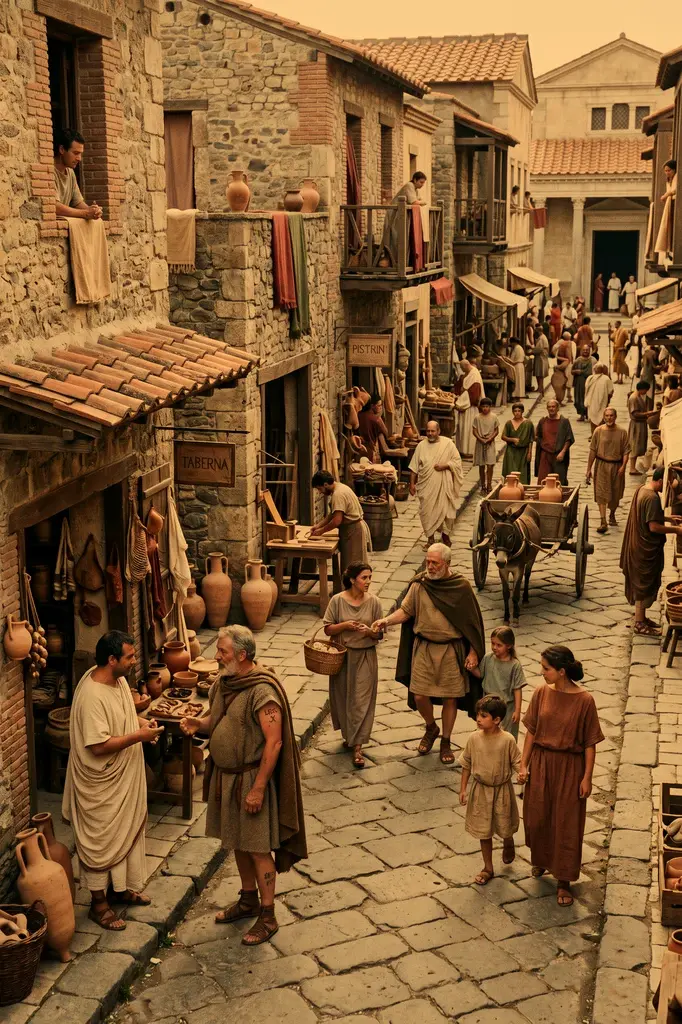
Visual Reconstructions Inspired by Pompeii: The Living City
Over the past several months, I have been creating historically grounded visual reconstructions for the Hawkes Adventures archive. While reading Pompeii: The Living City, I repeatedly encountered passages that made me stop and think, “I would like to see that.”
Some passages described architecture. Others described crowds, rituals, businesses, family life, entertainment, or details of everyday Roman experience that are rarely visualized. What struck me most was how often the people of Pompeii felt familiar. Their city was separated from us by nearly two thousand years, yet many of the situations, emotions, and social experiences described in the book felt surprisingly recognizable.
This collection brings together images from the Hawkes Adventures archive that were directly inspired by passages from Pompeii: The Living City. Each entry pairs the original text with the resulting reconstruction, creating a visual conversation between the written description and a modern attempt to imagine what that moment may have looked like.
These images are not intended as definitive representations of the ancient world. They are visual interpretations informed by archaeological evidence, historical research, and the ongoing historical evaluation process used throughout the Hawkes Adventures archive.
Thank you for writing a book that repeatedly made me pause, imagine, and create.
— Neal Helman
L. M. Hawkes / Hawkes Adventures
Title: Crowd Entering Roman Amphitheater
Description: A mixed civilian crowd in earth-toned tunics and wraps descends a broad stone stairway and streams along the curving cavea wall of an amphitheater, several carrying baskets and bundles. Round-arched vaulted entrances line the masonry below tiered seating, with pine-covered hills on the skyline.
Prompt Family: FAMILY 03 — THEATRE CIRCULATION NETWORK
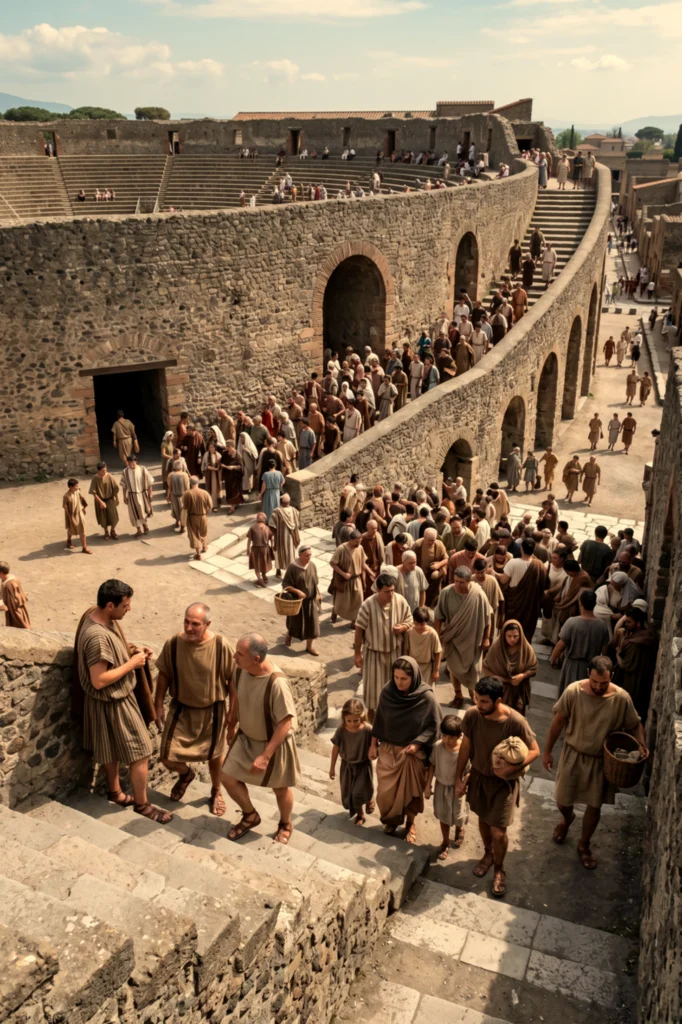
Inspiring Text: (Chapter 3, page 78) The spring festivities had begun in the ancient sanctuary of the fertility gods, beyond the Nuceria cemetery, where the Sarno broadened out towards the sea. Crowds from the city and countryside had come to offer sacrifices in the name of Ceres, the earth mother who brought rebirth after winter. Fannius Synistor and a handful of other landowners who were only occasional visitors to the region stood mingled with the local elite, but humble tenant farmers were there too, and peasants clad in little more than animal skins. All were eager to propitiate the goddess for a successful growing season, and the priestess Alleia, daughter of the esteemed decurion Alleius Nigidius Maius, was present to act as their intermediary. Synistor watched as the first stage of the ceremony concluded and the statue of the goddess was raised and carried off in procession, up towards the city and the theatre, where the rites would continue. The sacrificial meat was left sizzling on a fire, the appetising smell a reminder to those who would later return to dine. When Synistor and his companions reached the corridor that formed the lower entrance to the theatre, several of the highly favoured freedmen from the Augustales association were there already. Together they awaited the moment when they could enter to claim their seats in the front rows. From inside and above, the excited chatter of the humbler spectators echoed against the narrow walls as unseen women, freedmen and slaves hurried round the perimeter of the theatre complex, clambering up to the rim of the semi-circular auditorium from which they could swarm down to claim their seats in the appointed areas. Expectations were high. Synistor knew all about the actor Paris from his exploits in Rome, but his presence here was something of a novelty. The man beside him volunteered that talk in the bars and at dinner parties had been of nothing else for weeks. Even now, when the performance was about to begin, the touts were still asking astronomical prices for the tiles shaped like rings and plucked chickens that granted admission. With Paris on the stage, and Poppaea, Nero’s mistress, in the audience, for one short day it felt almost as though Pompeii were the centre of the world.
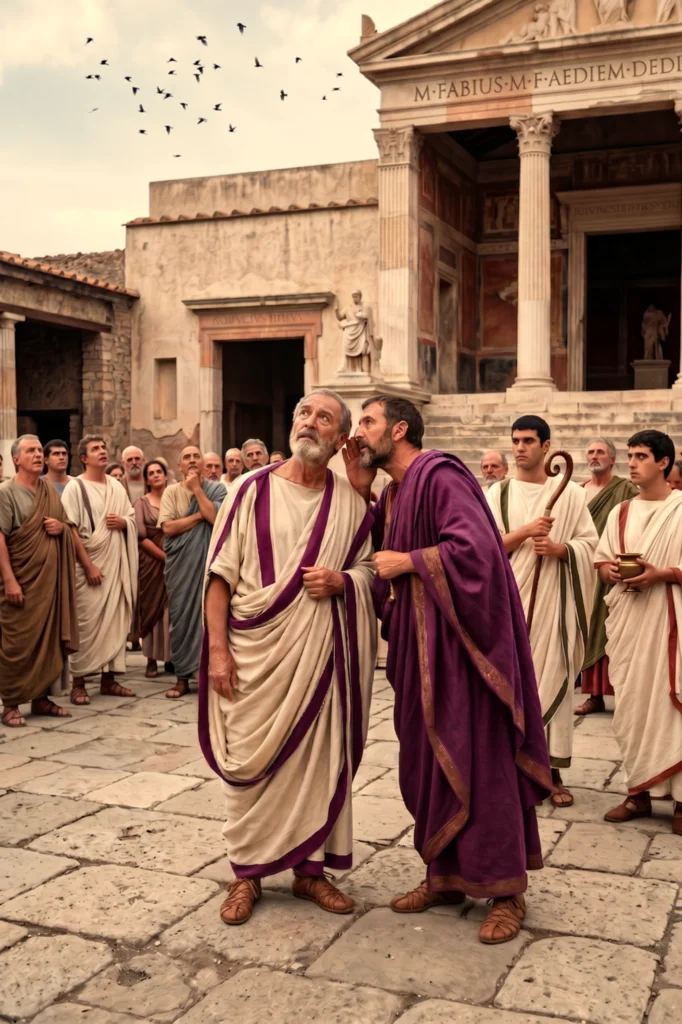
Title: Augury Before a Roman Temple
Description: A senior magistrate and an augur in bordered togas confer in a temple forecourt as a flock of birds wheels overhead; an attendant holds a lituus and a dedicatory inscription runs across the temple architrave.
Prompt Family: FAMILY 01 — AUGUR CORRECTING MAGISTRATE
Inspiring Text: (Chapter 4, page 85 ) Thoughts of the morning’s ceremonies weighed heavy on his mind. When the senior magistrate Albucius Iustus had gazed up at the flight of birds up above and seen in them signs of a calm and steady year ahead, instead of nodding his agreement as he usually did, the augur who stood beside him in purple robes had whispered in his ear. Iustus had again turned his face skywards. The skittering flight of the starlings presaged hard months ahead, he now warned. And the augur concurred. Valens knew how these things worked. Skilled though they might be at reading signs of the gods’ intentions, the augurs were not immune to the mood of unease that was carried in with the news from Rome. There, the monstrous birth of a serpent from a woman’s womb and the many bolts of lightning that had struck targets across the city, including a married couple who were felled as they embraced, gave credence to the rumours of discord in the imperial family. The sun itself had been briefly extinguished. If there were clouds on the horizon, then the augurs of Pompeii were not going to risk their reputations merely to oblige a local magistrate who wanted his term of office to end on an optimistic note. Since becoming flamen of Nero, Valens had basked in the reflected glory of the dynamic young Emperor. There was no doubting the popularity of an emperor who trailed the good times in his wake. Stories of his nocturnal shenanigans in the back streets of Rome had been easily laughed off as high spirits. But Valens knew how fast the public mood might turn if Nero became tainted with bad luck. Already he had heard that there were those in Rome questioning the direction that the Emperor’s reign was taking, and before long those murmurings of dissent might be heard in Pompeii too.
Title: Magistrate Receiving a Petitioner in an Atrium
Description: A bordered-toga magistrate seated on a dais receives a stooped petitioner presenting a wax tablet, attended by a youth stacking records on an iron-banded chest, in a frescoed atrium lit by an open compluvium.
Prompt Family: FAMILY 01 — MORNING SALUTATIO AUDIENCE
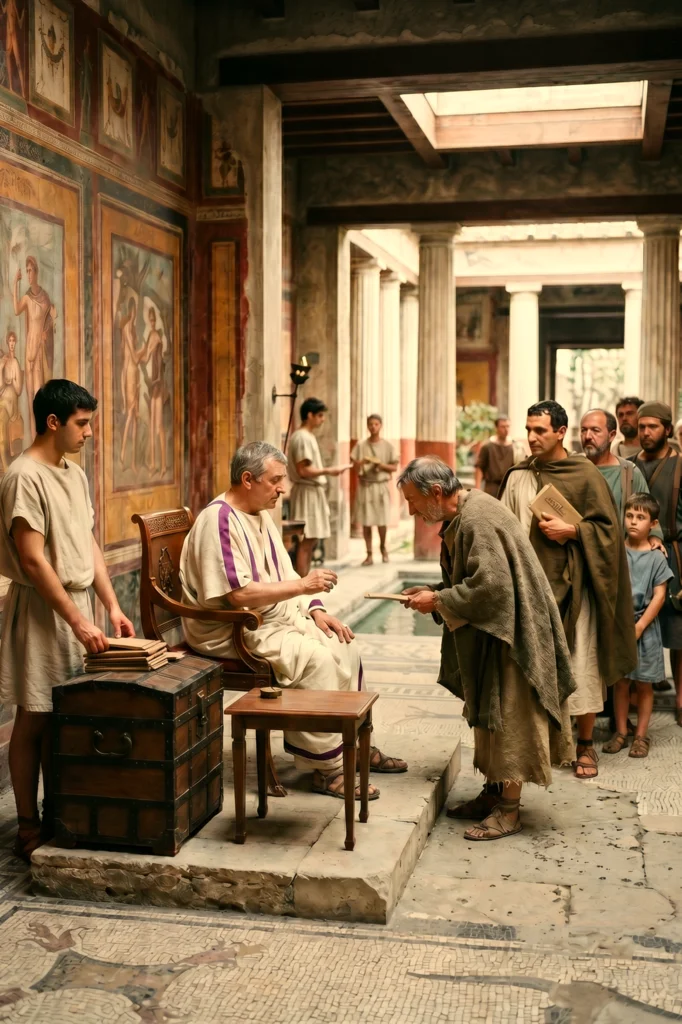
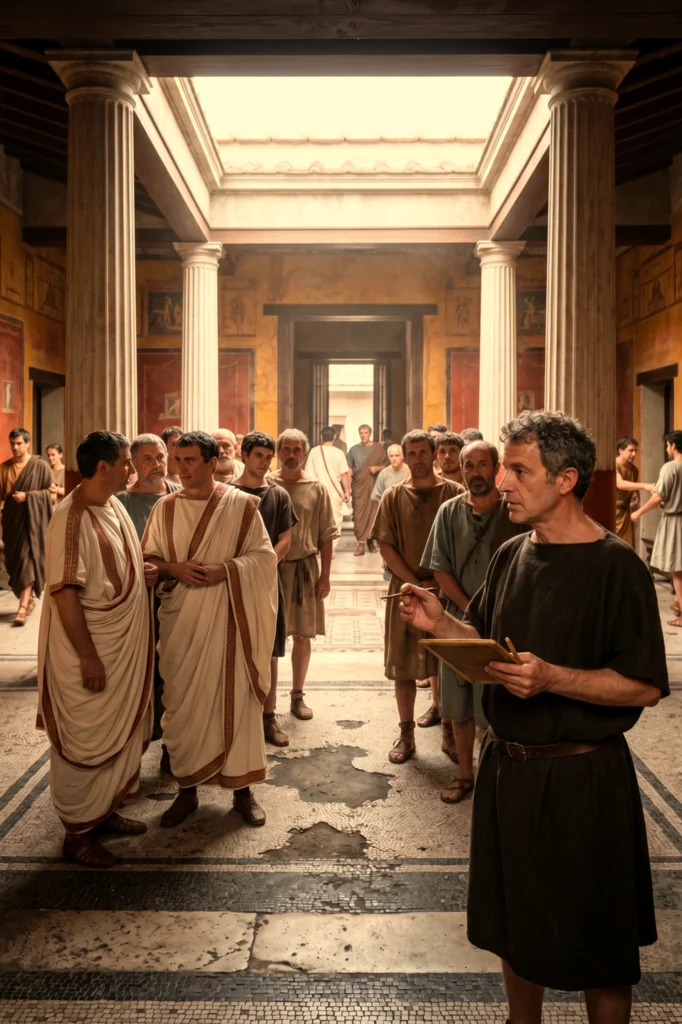
Inspiring Text: (Chapter 4, page 89) Maius drained a cup of water by way of breakfast, then headed out into the colonnade that surrounded his garden. Ahead of him he could see the throng as they jostled in the atrium, waiting for admittance to the room where he would shortly hold his audience. Taking a seat beside his money chest, he watched the nomenclator scan the assembled crowd of petitioners as they settled down to respectful silence, mentally sorting them by precedence. Some came to request his support in a trade dispute, or a word in the right ear about a loan, but most attended simply to claim their sportula – the financial handout that he so generously provided. Maius knew them all well, and how to manipulate their individual vanities and weaknesses: when to shame them with a slighting comment, and when to put them at their ease with friendly greetings; how to make it seem as if the coins slipped into their hand as they left were a mere token of esteem.
Title: Togate Assembly Recorded by a Nomenclator in an Atrium
Description: A crowd of toga-clad citizens gathers in a frescoed atrium lit by an open compluvium while a tunic-clad nomenclator in the foreground records names on a wax tablet.
Prompt Family: FAMILY 03 — NOMENCLATOR MANAGING PRECEDENCE
Inspiring Text: (Chapter 4, page 89) Same as previous.
Title: Villa Rustica at Harvest with Overseer
Description: A red-cloaked overseer with a staff supervises field laborers bundling grain into baskets on a stone path before a stone villa rustica, with cattle and a plowed field beyond.
Prompt Family: FAMILY 02 — RETIRED LEGIONARY FARMSTEAD
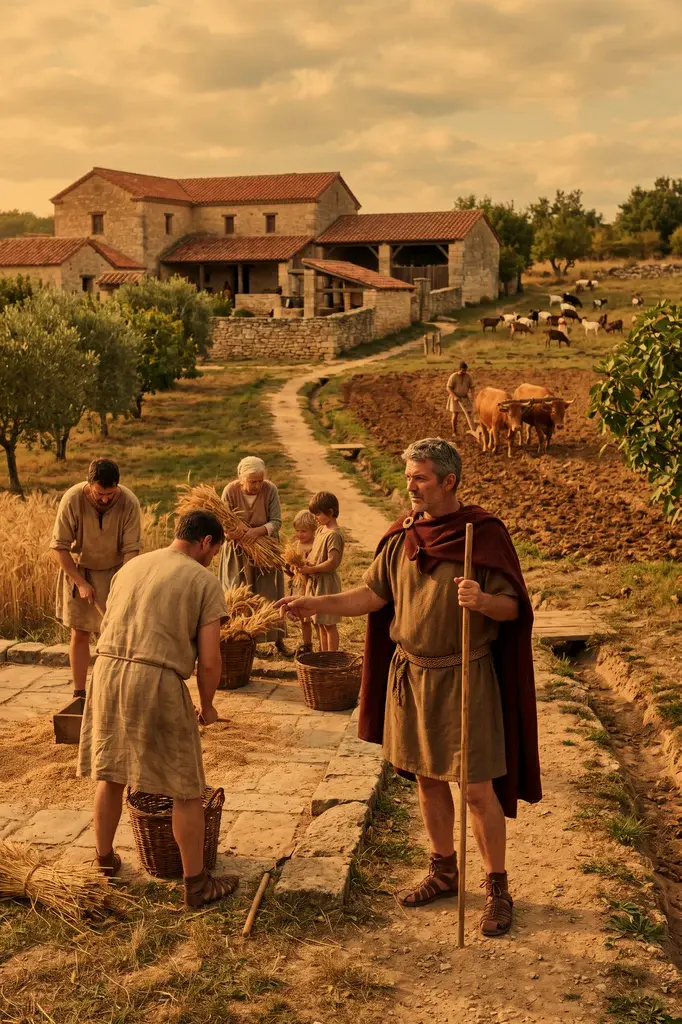
Inspiring Text: (Chapter 4, page 101) It was the third measure, though, that would have the greatest impact on the lives of the inhabitants of Campania: the foundation – or in Pompeii’s case the retrenchment – of a series of colonies to serve as settlements for army veterans. A steady stream of old soldiers were always in need of homes and a living on their retirement, and in the second half of the AD 50s there is likely to have been a particularly large influx of demobilised legionaries.
Title: Roman Market Street with a Taberna Sign
Description: A sloping cobbled market street of stone-and-brick buildings with a hanging TABERNA sign, tiled shop awnings, and a mule cart, busy with shoppers, vendors, and a colonnaded building beyond.
Prompt Family: FAMILY 03 — VETERAN COLONY STREET SCENE
Inspiring Text: (Chapter 4, page 101) Same as previous.