The Forgetting Is Normal. The Not-Knowing Is the Problem.
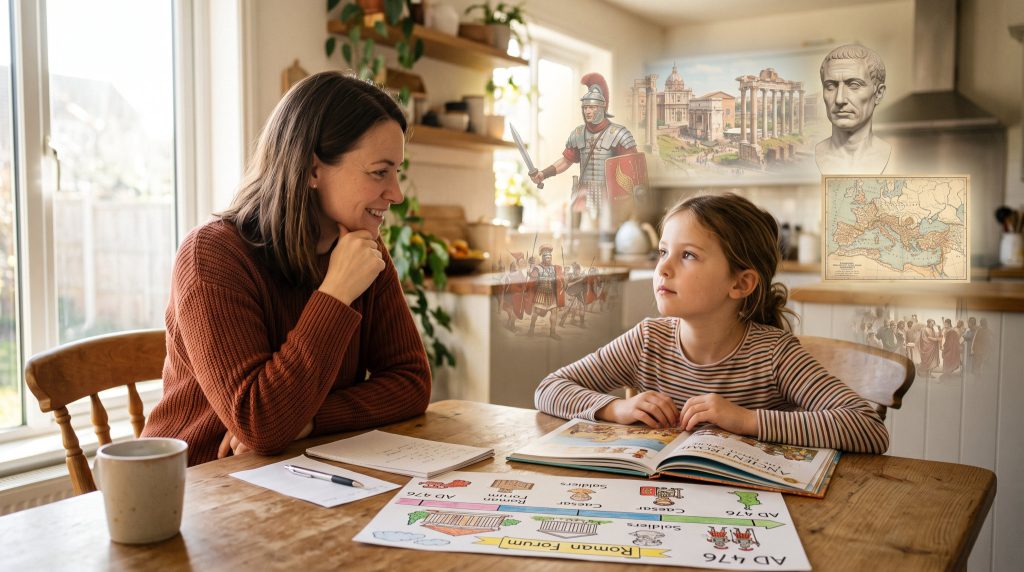
One of the most discouraging moments in homeschooling happens when a lesson seems to go perfectly.
Your child answers questions correctly.
They participate in the discussion.
They can explain the topic in their own words.
You finish the lesson feeling confident that real learning happened.
Then the next day arrives.
You casually ask a question about yesterday’s topic, and your child stares back at you as though they have never heard of it before.
The information appears to be gone.
For many homeschool parents, this moment creates immediate anxiety.
Maybe the curriculum isn’t working.
Maybe the lesson wasn’t taught well.
Maybe the child wasn’t paying attention.
Maybe something is wrong.
But what if none of those explanations are true?
What if the most surprising explanation is also the most accurate one?
What if forgetting is exactly what we should expect?
The Moment Every Homeschool Parent Has Experienced
If you have taught history for any length of time, you’ve probably experienced some version of this cycle.
You spend an hour discussing the Roman Republic.
Your child seems engaged.
They answer questions correctly.
They complete the activity successfully.
Everything appears to go well.
A week later, you ask who Julius Caesar was, and they hesitate.
You ask what a republic is, and they struggle to explain it.
You ask about the conflict you discussed in detail only days earlier, and they remember fragments at best.
The natural reaction is frustration.
“We just covered this.”
Many parents begin measuring success by how much information survives from one lesson to the next.
When information disappears, it feels as though learning has failed.
The problem is that this expectation misunderstands how memory works.
Why Forgetting Feels Like Failure
Most of us carry an invisible model of learning.
In that model, information enters the mind and stays there.
We picture memory as storage.
Teach something clearly enough and the information should remain available whenever we need it.
That assumption feels reasonable because it matches how we think physical storage works.
Put a book on a shelf and it stays there.
Save a file to a hard drive and it remains available.
Store dishes in a cabinet and they can be retrieved later.
Memory does not work that way.
Human memory is not a storage container.
It is a biological process.
Because of that, memories do not automatically remain accessible simply because they were encountered once.
The mistake many parents make is assuming that exposure should create retention.
When retention fails to appear, they conclude that something went wrong.
In reality, forgetting after a single exposure is often the expected outcome.
The surprise is not that information disappears.
The surprise is that we expect it not to.
The Surprising Truth About Memory
Memory researchers have known for a long time that forgetting is the default condition.
The brain is constantly exposed to enormous amounts of information.
Every day brings conversations, sights, sounds, experiences, facts, names, stories, and observations.
If every detail remained equally accessible forever, functioning would become difficult.
Instead, the brain filters.
It strengthens some memories.
It weakens others.
It preserves information that proves useful, meaningful, or repeatedly accessed.
Everything else gradually fades.
That process is not a flaw.
It is part of how memory is designed to work.
When a child forgets most of what was covered in a single history lesson, that does not necessarily indicate a problem with intelligence, effort, or instruction.
It indicates that the memory has not yet gone through the processes required for long-term retention.
This distinction matters.
The question is not:
“Why did my child forget?”
The question is:
“What helps a memory survive?”
Those are very different questions.
One assumes failure.
The other assumes normal memory functioning.
Exposure Is Not the Same Thing as Learning
One reason this issue causes so much confusion is that exposure feels like learning.
A child reads the chapter.
They watch the documentary.
They listen to the explanation.
They participate in discussion.
Everything feels successful.
The information seems familiar.
Familiarity creates the impression that learning has occurred.
Sometimes it has.
Sometimes it hasn’t.
Seeing information is not the same as retaining information.
Understanding information is not the same as remembering information.
Remembering information today is not the same as remembering it next month.
These are separate processes.
A child can understand a lesson perfectly and still forget most of it later.
That sounds contradictory until we recognize that exposure, understanding, retention, and retrieval are not identical events.
They are stages in a longer process.
History education often reveals this reality because it involves so much information.
Names.
Dates.
Places.
Events.
Relationships.
Causes.
Consequences.
Children can follow a lesson successfully while still lacking the reinforcement needed to preserve those memories over time.
What This Means for History
History is especially vulnerable to forgetting because much of it initially feels disconnected from a child’s daily life.
If a child learns that a Roman general crossed a river two thousand years ago, the information may be interesting, but it does not automatically become durable.
Without reinforcement, many details fade.
Parents often interpret this fading as evidence that history is harder than other subjects.
Sometimes history is not harder.
It simply makes forgetting more visible.
A child who forgets a math procedure immediately encounters consequences during the next math lesson.
A child who forgets a historical event may not encounter it again for days or weeks.
The forgetting becomes obvious.
This can create the illusion that history learning is uniquely fragile.
In reality, history is simply exposing a memory process that occurs across every subject.
The child is not necessarily forgetting because history is boring.
They are forgetting because memory naturally weakens information that has not yet been strengthened.
That is true whether the topic is ancient Egypt, fractions, grammar, or geography.
The Question Parents Should Be Asking Instead
Once we understand that forgetting is normal, the conversation changes.
Instead of asking:
“Why doesn’t my child remember this?”
We begin asking:
“What helps memories last?”
That shift changes everything.
It moves us away from blame.
It moves us away from panic.
It moves us toward curiosity.
We stop viewing forgetting as proof that homeschooling is failing.
We start viewing forgetting as information.
What survives?
What disappears?
What kinds of lessons remain memorable?
Which stories are recalled weeks later?
Which facts vanish immediately?
These observations tell us something useful about how learning is occurring.
They help us understand memory rather than fear it.
And they prepare us for the much more important question:
How do we strengthen what matters?
That question will guide the rest of this series.
What Parents Can Do Right Now
Before changing curriculum, increasing lesson time, or worrying about learning problems, consider adjusting expectations.
Expect some forgetting.
Expect information loss after lessons.
Expect details to fade.
Those outcomes are not evidence of failure.
Pay attention instead to patterns.
Notice which stories remain.
Notice which ideas return in conversation.
Notice which historical moments continue to capture your child’s imagination.
At the end of a week, ask simple questions about earlier lessons.
Have informal conversations during meals or car rides.
Invite your child to retell stories from memory.
Not as a test.
As an observation.
The goal is not to prove that learning happened.
The goal is to discover what survived.
That information is often more valuable than a perfect score on a worksheet completed immediately after the lesson.
Conclusion
The most important thing to understand about forgetting is that it is normal.
Your child is not broken because they forgot yesterday’s lesson.
You are not failing because information disappeared.
The curriculum is not automatically defective because details faded.
Forgetting is what memory naturally does.
The real educational challenge is not preventing forgetting altogether.
The challenge is creating the conditions that allow important memories to endure.
Once we understand that distinction, everything changes.
The question is no longer:
“Why did my child forget?”
The question becomes:
“What helps learning last?”
And that is where meaningful progress begins.
History Engagement Begins With Observation
Many children remember more when they actively notice details instead of passively receiving information. Spot the Anachronism turns historical observation into a game by asking learners to compare two versions of the same scene and discover what changed. As children search for clues, discuss evidence, and explain their reasoning, they practice the same careful observation skills that help learning become more memorable over time.
This Article Is Part Of A Larger Series
Question: Why doesn’t the information stick? My child forgets everything right after a lesson.
Current article: Article 1 of 11 — Foundation Cluster
This article explores one evidence-supported aspect of the larger question. Future articles examine additional research-supported approaches to increasing engagement with history.
Related Facebook Discussions
- See how connected systems often matter more than individual details when we try to understand complex historical topics.
- Explore why noticing many small details often reveals more than focusing on a single obvious subject.
- Discover how realistic human details can make historical scenes more memorable and easier to connect with.