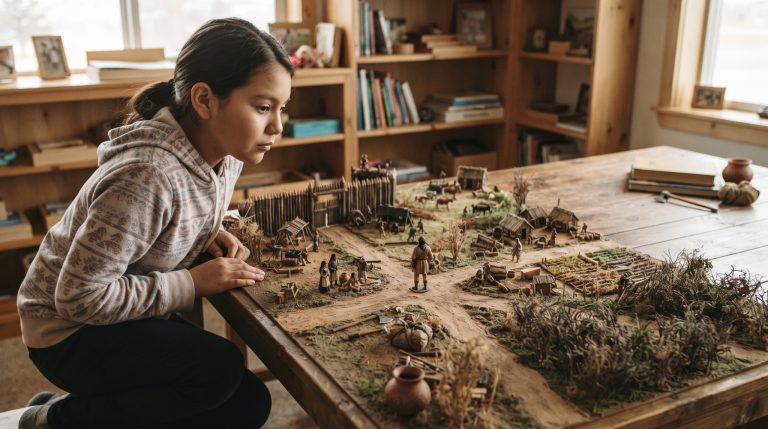
When Forgetting Isn’t Failure: The Case for a Long-Game Approach to History
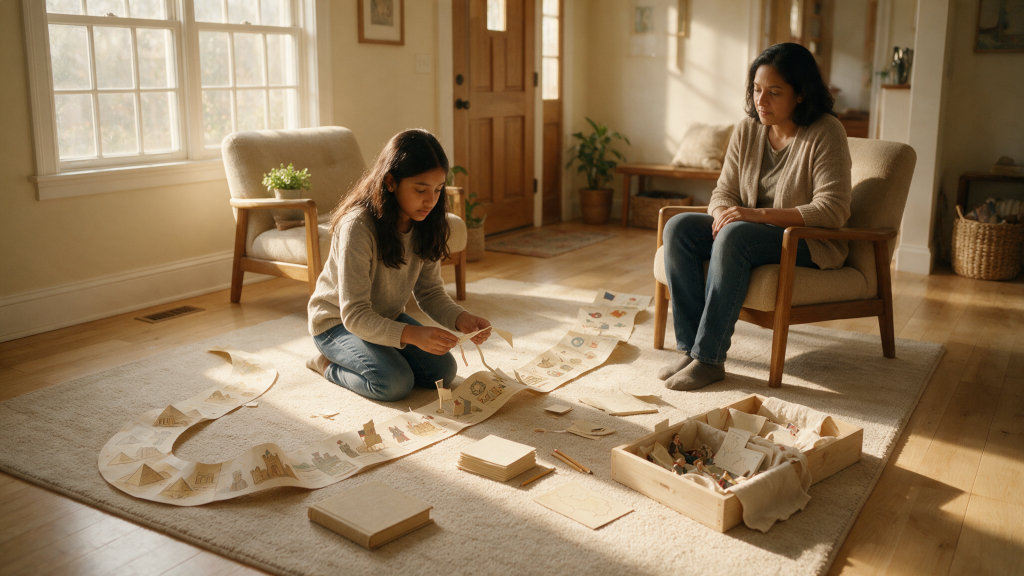
“How do I know if my child is actually retaining what they’ve learned in history?”
Sometimes that question arrives with disappointment rather than curiosity.
You return to a topic your family studied last year. Perhaps it was ancient Rome, medieval Europe, the American Revolution, or ancient Egypt.
You expect at least a rough account of what your child learned.
Instead, you hear:
“I don’t really remember.”
A few scattered details emerge. A dramatic story remains. One name sounds familiar. But much of the material that once filled weeks of lessons appears to be gone.
The fear beneath that moment is not merely that your child forgot a fact.
It is that all the reading, narration, discussion, map work, projects, and time may have accomplished nothing.
That fear deserves a direct answer.
History learning is often cumulative, delayed, and partly invisible. Children may forget large amounts of specific information while still building the mental frameworks that allow them to understand later history more quickly and deeply.
Immediate recall is evidence, but it is not the whole of learning.
This article examines the long-game perspective: how parents can recognize that history is working even when the results do not appear clearly after every unit or every year.
The Problem With Short-Term Expectations
Some kinds of learning produce immediate, visible performance.
A child learns a mathematical procedure and solves a problem.
A child practices a musical passage and plays it more accurately.
A child learns to spell a word and writes it correctly.
History often develops less visibly.
Historical knowledge consists of:
- people
- events
- chronology
- geography
- institutions
- beliefs
- social structures
- causes
- consequences
- evidence
- interpretation
- recurring patterns
These elements do not become an organized understanding after one lesson.
They accumulate through repeated encounters.
A young child studies a ruler who lost power.
Later, the child studies a disputed succession.
Years afterward, the child encounters a revolution, a civil war, and a collapsing empire.
Gradually, ideas about legitimacy, authority, political institutions, military loyalty, and public support begin connecting.
The child may not be able to identify the moment when those connections formed.
The parent may not be able to measure them after any one unit.
But the structure becomes more useful with each new topic.
This is why evaluating history only through short-term recall can be misleading.
The educational result may not yet be finished.
Recall and Learning Are Not the Same Thing
Recall is the ability to bring information to mind.
Learning is broader.
It includes acquiring knowledge, organizing it, connecting it with prior understanding, and becoming increasingly able to use it.
A child may fail to recall the date the Western Roman Empire ended while retaining an understanding that large political systems can weaken through interacting military, economic, and political pressures.
A child may forget the name of a particular pharaoh while retaining a framework connecting the Nile with agriculture, transportation, settlement, religion, and centralized authority.
A child may confuse the sequence of several revolutionary events while recognizing that political change can result from a combination of material hardship, institutional weakness, new ideas, and failed attempts at reform.
These are not complete forms of knowledge.
Dates, names, and chronology still matter.
But weak recall of some details does not prove that no historical learning remains.
The child may retain:
- familiarity
- broad categories
- causal patterns
- cultural reference points
- narrative structures
- historical vocabulary
- questions
- interpretive habits
These forms of knowledge often become visible only when new learning activates them.
Why Memory Performance Can Look Worse Than Knowledge Really Is
Parents often ask broad questions such as:
“What do you remember about Rome?”
That question requires the child to search an enormous field of information without much guidance.
The child may genuinely possess relevant knowledge but struggle to decide where to begin.
A more specific cue may produce a very different result:
“Why were some Romans afraid of Julius Caesar becoming too powerful?”
Now the child remembers the Senate, the army, civil war, fear of kingship, and Caesar’s assassination.
The first response looked like absence.
The second reveals an existing structure.
This does not mean parents should always supply the answer through hints. It means retrieval depends partly on cues and context.
Historical knowledge may also return quickly when the subject is revisited.
A child seems to remember little about ancient Egypt. After looking at a map of the Nile or seeing an image of a temple, earlier information begins returning.
That rapid recovery suggests that the child is not learning the topic entirely from the beginning.
Something remained.
The Pegs Are Real
One useful way to understand cumulative learning is through the idea of mental pegs.
Researchers often describe organized knowledge structures as schemas.
A schema gives new information somewhere to attach.
Without prior knowledge, every person, place, institution, and event must be processed as something unfamiliar.
With prior knowledge, the learner can recognize, compare, distinguish, and question.
Suppose a child studied ancient Rome several years ago.
Many details have faded.
Later, the child studies the Renaissance.
The revival of classical art, architecture, and literature makes more sense because Rome already exists as a cultural reference point.
The child studies medieval Christianity.
Rome already has geographic and institutional significance.
The child studies republican government.
The idea of a republic connects with senators, citizens, laws, and resistance to kingship.
The child studies European empires.
Questions about expansion, administration, taxation, borders, military power, and cultural influence attach to an earlier imperial model.
Rome has become a set of pegs.
The child may not consciously say:
“My study of Rome is now improving my understanding of Renaissance architecture and republican political thought.”
But that is how prior knowledge often works.
It shapes later comprehension from the background.
Early Exposure Changes Later Learning
The first encounter with a historical topic is rarely the final one.
A seven-year-old may meet Rome through stories of soldiers, roads, emperors, and gladiators.
A twelve-year-old may return to Rome through republican government, imperial administration, religious change, and political crisis.
A teenager may examine Roman sources, competing explanations for institutional collapse, provincial variation, and long-term influence.
The early exposure did not need to produce teenage-level understanding.
Its role was partly to make later learning possible.
When the topic returns:
- names are less unfamiliar
- places have meaning
- vocabulary already has associations
- major stories provide context
- misconceptions can be corrected
- the learner can ask better questions
Education often works through return.
The same topic is encountered at greater depth with greater intellectual capacity.
Forgetting between those encounters does not erase the value of the first one.
It creates the need and opportunity for reconstruction.
History Is Not a Set of Completed Units
Curricula often divide history into manageable sections.
Ancient Egypt is completed.
Ancient Greece is completed.
Rome is completed.
The Middle Ages are completed.
But historical understanding does not actually develop in sealed units.
Each period helps interpret the others.
Rome affects the study of:
- Christianity
- medieval Europe
- the Renaissance
- political thought
- law
- architecture
- language
- empire
The Reformation affects the study of:
- government
- war
- literacy
- printing
- religious authority
- migration
Industrialization affects the study of:
- labor
- cities
- class
- technology
- political reform
- imperialism
- environmental change
Knowledge grows across these boundaries.
A child may appear to have “finished and forgotten” one unit while that unit continues influencing everything that follows.
The long-game approach treats historical topics as recurring parts of a growing network rather than assignments that must remain permanently mastered after one pass.
Transfer May Be the Clearest Evidence
Transfer occurs when a learner uses prior knowledge in a new context.
It is among the strongest forms of evidence that learning has endured.
A child demonstrates transfer by saying:
“This empire had the same problem Rome had with controlling distant borders.”
“This argument about representation sounds like the one before the American Revolution.”
“That ruler used architecture to show power, like the pharaohs did.”
“This source was written by the winning side, so it might leave something out.”
The child may not have retained every original detail.
But the earlier knowledge has become usable.
That is a more significant outcome than merely recognizing the correct answer on a worksheet.
Transfer shows that the child is beginning to see history relationally.
Events are no longer isolated stories.
They become examples within larger questions about power, belief, conflict, institutions, geography, evidence, and human behavior.
Patterns Become More Visible Over Time
Historical patterns should be handled carefully.
Two events can resemble one another without being identical.
A weak historical comparison may flatten important differences.
But pattern recognition is still an important part of developing understanding.
Across years of study, children may begin noticing that:
- succession disputes often create instability
- taxation can become a political issue when legitimacy is weak
- empires depend on administration as well as military force
- geography influences trade, defense, and settlement
- technological changes produce social consequences
- political reforms can create unintended results
- ruling systems depend partly on public belief and cooperation
- historical sources reflect particular perspectives
These insights rarely come from one unit.
They emerge from accumulation.
A child who has studied one empire knows one story.
A child who has studied several can begin comparing imperial systems.
A child who has studied one revolution knows a sequence of events.
A child who has studied several can ask why revolutions arise and why their outcomes differ.
The educational payoff grows over time.
How Historians Actually Know History
Historians possess factual knowledge, often in great depth within their areas of expertise.
But historians do not carry every date, quotation, name, and archival detail in immediate memory.
They consult books, notes, documents, databases, and other scholars.
Their expertise includes knowing:
- which questions matter
- what kinds of evidence exist
- how events fit into broader contexts
- which interpretations are disputed
- what patterns may be relevant
- where comparisons are useful
- when a claim requires verification
- how to construct an explanation from evidence
This matters for parents because expert historical knowledge is not simply an enormous collection of memorized facts.
It is organized knowledge.
Facts are available within frameworks.
The historian knows how to find, evaluate, connect, and interpret them.
Children are beginning to build much simpler versions of those structures.
When a child asks, “Who wrote this?” or “Did everyone agree?” the child is developing a historical habit.
When a child recognizes that one cause is not enough to explain a war, the child is developing historical reasoning.
When a child remembers the broad structure but needs to look up the date, historical learning has not necessarily failed.
Looking up a detail is not the opposite of knowing history.
The important question is whether the child understands why the detail matters and where it belongs.
Facts Still Matter
A long-game approach should not become an excuse for vagueness.
Historical understanding requires factual substance.
Children need names, dates, places, vocabulary, sequence, and concrete examples.
Without them, discussions of patterns and causes become empty generalization.
The point is not:
“Facts do not matter because they can always be looked up.”
The more accurate principle is:
“Facts matter most when they become part of an organized understanding.”
A child should know enough chronology to avoid placing Caesar after Charlemagne.
A child should know enough geography to understand why the Nile mattered to Egypt.
A child should know enough factual context to compare two revolutions responsibly.
Review and retrieval remain important.
But facts should support historical thought rather than serve as the only proof that thought exists.
Narrative Helps Knowledge Survive
Stories provide one of the most durable structures for historical knowledge.
A narrative links:
- people
- motives
- problems
- decisions
- conflicts
- consequences
A child may forget several details of the French Revolution but retain a broad narrative:
The government faced severe financial problems. Social inequality created resentment. Food prices increased pressure. Attempts at reform failed. Public trust collapsed. Revolution transformed the political order and produced both hope and violence.
That narrative becomes a framework.
Later details can be restored and refined within it.
Without a narrative, facts may remain disconnected:
- 1789
- Estates-General
- Bastille
- Declaration of the Rights of Man
- Reign of Terror
- Napoleon
The list may support review.
The narrative explains why the list matters.
Story-based learning is therefore not a lesser version of analytical history.
It often provides the structure that later analysis requires.
Long-Term Success Does Not Mean Permanent Perfect Recall
No child will remember everything studied.
Neither will any adult.
A realistic goal is not permanent access to every fact.
Long-term success may look like:
- recognizing major historical periods
- placing topics within a broad chronology
- remembering central narratives
- understanding recurring concepts
- making increasingly accurate comparisons
- recognizing historical influence
- asking informed questions
- evaluating simple claims
- retrieving older knowledge when cued
- relearning more quickly
- using history to interpret something new
These outcomes are substantial.
They represent a mind becoming historically literate.
The child has not stored a complete archive.
The child has built an increasingly usable structure.
What Parents Can Observe Across Years
Short-term assessment remains useful, but long-term growth becomes visible through different evidence.
Connections become more frequent
The child independently links one period with another.
Comparisons become more precise
Early comparisons may identify broad similarities. Later ones begin recognizing meaningful differences.
Explanations become more complex
The child moves from one-cause explanations toward several interacting causes.
Questions become better informed
The child asks about evidence, missing perspectives, motives, institutions, and consequences.
Chronology becomes more stable
Historical periods begin forming a mental sequence rather than one undifferentiated past.
Vocabulary becomes conceptual
Terms such as empire, revolution, reform, alliance, legitimacy, and primary source are used meaningfully.
Relearning becomes faster
A forgotten topic returns quickly when revisited.
Interpretations become less absolute
The child begins qualifying claims and recognizing disagreement.
Transfer appears
Historical ideas become useful in literature, current events, politics, geography, art, and other subjects.
These indicators may not appear after every lesson.
They emerge across a body of learning.
Historical-Learning Application
Consider a child who studied medieval Europe at age eight.
Years later, the child remembers castles, knights, monasteries, and a few stories but cannot explain feudalism clearly.
At thirteen, the child studies the growth of royal government.
The earlier material begins returning.
The child recognizes that political authority was distributed among rulers, nobles, local powers, and religious institutions.
The child begins understanding why monarchs sought greater control and why local elites resisted.
Later, while studying the Reformation, the child recognizes that religious authority was also political and economic.
Still later, while studying revolution, the child understands that challenges to established institutions occur within structures built over centuries.
The original medieval unit did not produce all of this understanding at age eight.
It created familiarity and initial categories.
Later learning refined them.
The child who once seemed to remember only castles had not necessarily received only decorative knowledge.
The castles were part of an early framework involving land, defense, hierarchy, labor, and authority.
The framework became more useful as the child matured.
The Role of Repetition Without Redundancy
A long-game approach does not mean teaching the same unit repeatedly in the same way.
It means allowing important themes and periods to return.
Rome can reappear through:
- politics
- religion
- architecture
- law
- language
- empire
- military history
- literature
The Industrial Revolution can reappear through:
- technology
- labor
- cities
- class
- economics
- reform
- environmental history
Each encounter strengthens different connections.
This is repetition with expansion.
The child is not merely reviewing.
The child is reorganizing the earlier knowledge within a wider framework.
Patience Is Not Passivity
Parents should be patient with cumulative learning, but patience does not mean doing nothing.
A long-game approach still includes:
- narration
- open-ended discussion
- periodic retrieval
- timelines
- maps
- comparison
- source work
- portfolio evidence
- correction of misconceptions
- deliberate review
The difference lies in interpretation.
A weak recall attempt becomes information, not a verdict.
A simple explanation becomes a developmental starting point, not proof of failure.
A forgotten unit becomes an opportunity for reconnection, not evidence of wasted time.
Parents remain active, but they stop expecting every educational result to appear immediately.
When Weak Recall Does Need Attention
Not all forgetting should be dismissed as hidden learning.
Parents should look more closely when a child consistently:
- cannot identify the main idea immediately after instruction
- shows no recognition when a topic returns
- cannot retell a simple narrative
- repeatedly confuses central concepts
- demonstrates no growth over extended periods
- cannot apply any earlier learning
- remains dependent on copied language
- lacks enough background knowledge to understand new material
- becomes increasingly discouraged or disengaged
These patterns may indicate:
- weak initial understanding
- excessive cognitive load
- difficult vocabulary
- poor instructional fit
- insufficient retrieval
- attention or language difficulties
- fragmented content
- a need for more narrative or context
The long-game approach should prevent premature panic.
It should not prevent thoughtful intervention.
The goal is accurate interpretation.
Practical Takeaways for Homeschooling Parents
Evaluate history across years, not only weeks.
Short-term recall provides useful evidence, but it cannot capture the full development of historical understanding.
Expect partial forgetting.
Durable learning requires return, retrieval, and reconnection.
Revisit topics naturally.
Use later periods to reactivate earlier ones.
Ask connection questions:
- Does this remind you of something we studied before?
- Have we seen another society face this problem?
- How is this ruler similar to or different from an earlier one?
- Where would this fit on our timeline?
- What historical idea helps explain this?
Notice transfer.
A spontaneous historical connection may reveal more than a memorized answer.
Track growth rather than isolated performance.
Portfolios, occasional narrations, and dated observations can make long-term development visible.
Preserve broad chronology.
Children need an expanding temporal framework within which new learning can fit.
Use narrative as structure.
Stories help events remain organized through motive, causation, and consequence.
Review important facts.
Long-term understanding still requires concrete knowledge.
Correct misconceptions when topics return.
Early schemas are foundations, not final interpretations.
Value relearning.
Recovering a topic more quickly is evidence that something endured.
Follow recurring themes.
Power, belief, trade, conflict, geography, labor, technology, and social hierarchy can connect historical periods across years.
Compare the child with the child’s earlier thinking.
That is often the clearest measure of progress.
Do not demand that every lesson prove its permanent value immediately.
Some educational outcomes become visible only after later knowledge gives them a purpose.
Most importantly, replace the question:
“Can my child remember everything we studied?”
with:
“Is my child building a mind that can understand more history each year?”
Conclusion
History is a long game.
Its deepest outcomes often develop slowly through accumulated stories, facts, comparisons, questions, and repeated encounters.
Children may forget names and dates while retaining frameworks that help later knowledge make sense.
They may appear to lose a unit and then recover it quickly when a related topic returns.
They may remember a story before understanding its political significance, or recognize a pattern years before they can explain it precisely.
This does not mean every forgotten lesson succeeded or that factual memory is unimportant.
It means immediate recall is not the only evidence that learning occurred.
Historical learning also appears through familiarity, faster relearning, transfer, pattern recognition, stronger questions, more complex explanations, and a growing ability to place events in context.
Parents do not need to ignore gaps.
They need to interpret them within a longer developmental horizon.
The goal is not perfect recall today.
The goal is to build a mind that understands history better every year.
That perspective does not provide a complete answer to every question about retention. The larger picture still includes retrieval practice, narration, discussion, portfolios, emotional engagement, developmental readiness, and deliberate review.
But it offers the framework within which all those tools make sense.
Your child may remember less than you hoped from last year.
The learning may still be working.
Turn “I Don’t Remember” Into “Let Me Look Again”
Spot the Anachronism gives your child a fresh visual history mystery each month – an inviting reason to retrieve earlier knowledge, examine evidence, and explain what belongs. These repeatable challenges help forgotten facts reconnect with stronger historical patterns, so you can build durable understanding without turning every review into another test.
This Article Is Part Of A Larger Series
Question: How do I know if my child is actually retaining what they’ve learned in history?
Series Position: Article 10 of 11 — Long-Term Perspective and Reassurance
This article explores one evidence-supported aspect of the larger question. Readers interested in the full answer should explore the complete series.
Related Facebook Discussions
- A simple question about what an object was designed to do can become an interpretive habit children carry into every new historical period.
- Revisiting Rome through its varied surfaces shows how an early historical framework can be corrected and deepened over time.
- Looking again at small material clues shows how repeated encounters can turn scattered details into increasingly organized historical knowledge.