What to Expect at Each Age: A Developmentally Honest Guide to History Retention
“How do I know if my child is actually retaining what they’ve learned in history?”
That question can become especially troubling when a child’s response looks much weaker than a parent expected.
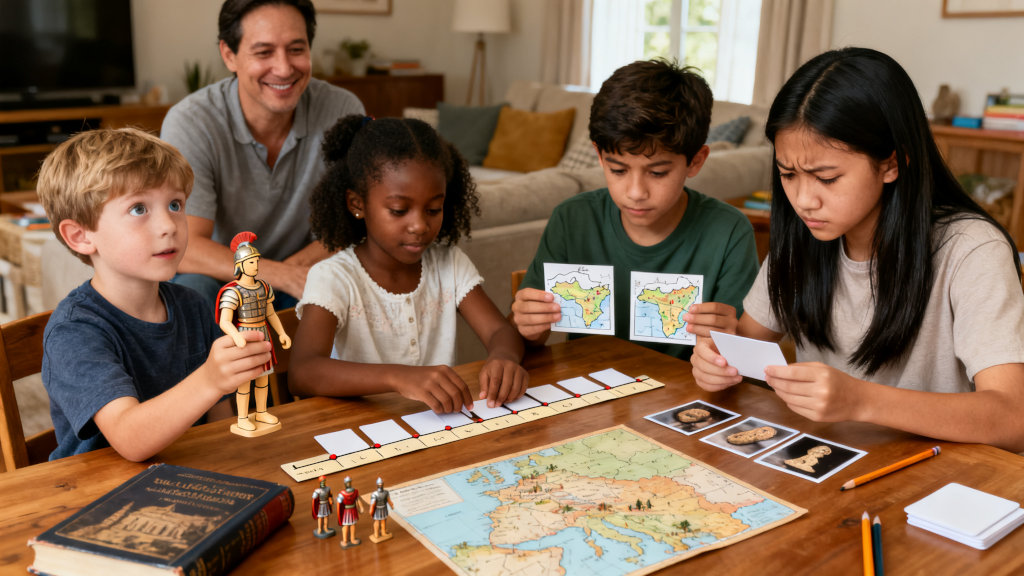
You spend several weeks studying ancient Rome with a six-year-old. The child enjoys the stories, talks about gladiators, remembers Julius Caesar, and asks to hear more about Roman soldiers.
A month later, you ask:
“When did Rome exist?”
The child cannot answer.
“Which came first, the Roman Republic or the Roman Empire?”
The child guesses.
“What caused the Republic to collapse?”
The child looks confused.
It is easy to conclude that the history lessons did not work.
But the child may not have failed to learn.
The parent may be asking for a kind of historical understanding that has not developed yet.
A six-year-old, a ten-year-old, and a thirteen-year-old can all be learning history successfully while showing that learning in very different ways. Young children often remember people, stories, images, and emotions before they can organize events chronologically. Older children gradually become better at explaining causes, comparing societies, evaluating evidence, and recognizing historical patterns.
This article examines one specific part of the larger retention question:
What does successful history learning look like at different ages?
The goal is not to impose rigid age limits. Children develop at different rates, and experience matters. The goal is to help parents distinguish between a true learning concern and a normal developmental limitation.
Why Adult Expectations Create Confusion
Adults rarely experience history as children do.
When you hear the phrase “ancient Rome,” you may immediately place it within a large mental framework.
You may know that Rome followed ancient Greece, that the Republic preceded the Empire, that Roman rule overlapped with the life of Jesus, and that the Western Empire collapsed centuries before the Renaissance.
A child may not possess any of that structure.
For a young learner, Rome may initially be:
- a story about twins raised by a wolf
- a place with soldiers and shields
- a city with aqueducts
- a world where people watched gladiators
- a civilization ruled by emperors
- something that happened “a long time ago”
That knowledge may seem incomplete because it is incomplete.
But incomplete does not mean meaningless.
Children build historical understanding gradually. They begin with vivid people, objects, and stories. Over time, those pieces are organized into chronology, causation, comparison, context, and interpretation.
Parents can create unnecessary anxiety when they evaluate an early stage by the standards of a later one.
A young child who cannot explain the constitutional weaknesses of the Roman Republic may still be developing an important foundation through story, vocabulary, and cultural familiarity.
A ten-year-old who produces an oversimplified causal explanation may be beginning to recognize that events happen for reasons.
A thirteen-year-old who compares two civilizations imperfectly may be developing the ability to think across periods.
The question is not only:
“Is this answer complete?”
It is also:
“Is this answer developmentally meaningful?”
Development Is Not a Straight Line
Age ranges are useful, but they are not precise formulas.
Children vary in:
- language development
- working memory
- background knowledge
- reading ability
- attention
- interest
- experience with history
- confidence in speaking or writing
- familiarity with timelines and maps
A seven-year-old who has heard historical stories for several years may show stronger chronological awareness than an older child encountering history systematically for the first time.
A child may reason well orally but struggle to show the same understanding in writing.
Another may remember dates easily but have difficulty explaining motives.
Development can also be uneven. A child may show sophisticated empathy while retaining weak chronology, or strong factual memory while producing simple causal explanations.
The age ranges that follow should therefore be treated as guides.
They describe common patterns, not fixed ceilings.
Ages 5–7: Story Before Timeline
Young children often enter history through narrative.
They remember:
- memorable characters
- dramatic events
- unusual customs
- animals
- clothing
- buildings
- danger
- courage
- betrayal
- surprising outcomes
They may become fascinated by pyramids, Roman soldiers, castles, explorers, queens, or ancient inventions.
This fascination is meaningful.
At this age, historical learning often appears through emotional engagement, story recall, imaginative reconstruction, and growing vocabulary.
A child might say:
“Caesar was powerful, and some people were scared he wanted to be king.”
That statement may contain little chronology or political complexity, but it shows memory of a central conflict.
What retention may look like at ages 5–7
A child may:
- remember the main person in a story
- retell one or two major events
- recall a vivid object or setting
- use a few historical words
- express admiration, fear, sympathy, or curiosity
- ask repeated questions about a person or culture
- recognize a topic when it returns
- connect a new story with an earlier one
- distinguish broadly between “long ago” and the present
These are legitimate signs of learning.
What may still be difficult
Young children may struggle with:
- exact dates
- long chronological sequences
- understanding centuries
- distinguishing events separated by large spans of time
- explaining multiple causes
- recognizing complex political systems
- comparing distant periods accurately
- separating legend from evidence
- understanding large historical scale
A child may believe ancient Egypt, Rome, medieval knights, and early American settlers all existed at roughly the same time.
That does not necessarily indicate failed instruction.
It reflects the difficulty of building a mental timeline from limited experience.
Appropriate questions for ages 5–7
Ask:
- What happened in the story?
- Who do you remember?
- What happened next?
- What surprised you?
- What was this person trying to do?
- Which part did you like or dislike?
- What was different from life today?
- Can you draw the place and tell me about it?
Avoid making dates and formal definitions the primary evidence of retention.
At this stage, a child who remembers the human story may be learning exactly what the child is developmentally prepared to learn.
Ages 8–10: Building Historical Structure
Between roughly ages eight and ten, many children begin organizing history more clearly.
They may become better able to:
- sequence events
- use timelines
- recognize before and after
- explain simple causes
- understand that events have consequences
- compare two societies
- retain more factual detail
- connect geography with events
- recognize that people in the past lived differently
The child’s understanding is still likely to be simplified, but the pieces begin forming a structure.
A nine-year-old might explain:
“Britain taxed the colonies because it needed money, but the colonists were angry because they did not have representatives.”
That explanation shows cause, perspective, and political vocabulary.
It may omit important complexity, but it goes beyond story recall.
What retention may look like at ages 8–10
A child may:
- retell a longer sequence of events
- place major events in approximate order
- explain a straightforward cause and result
- compare two rulers or civilizations
- remember recurring vocabulary
- connect historical topics with geography
- notice patterns such as invasion, trade, or rebellion
- ask why people made certain choices
- use timelines with increasing independence
- recognize when a new topic resembles an earlier one
The child may also begin transferring learning.
For example:
“This empire had trouble because it got too big, like Rome.”
That comparison is an important sign of historical development, even if it needs refinement.
What may still be difficult
Children in this range may struggle with:
- several interacting causes
- abstract political ideas
- conflicting historical interpretations
- evaluating source reliability
- understanding why reasonable people disagreed
- keeping many dates and names active at once
- recognizing differences within a civilization
- avoiding simple hero-and-villain narratives
Their explanations may be confident but incomplete.
A child might say:
“The Revolution happened because taxes were unfair.”
That is not entirely wrong. It is a starting framework that can later be expanded to include representation, imperial policy, political ideology, economic interests, violence, and competing loyalties.
Appropriate questions for ages 8–10
Ask:
- Why did that happen?
- What happened because of it?
- Which event came first?
- How were these two civilizations similar?
- What was different?
- Why did this person make that choice?
- How did geography affect what happened?
- Does this remind you of anything else we studied?
At this age, parents can gradually shift from “what happened?” toward “why did it happen?”
Ages 11–13: Connecting and Comparing
In early adolescence, many learners become increasingly capable of organizing historical knowledge across topics.
They may begin to:
- recognize recurring patterns
- compare institutions
- explain multiple causes
- distinguish long-term pressures from immediate triggers
- consider different perspectives
- identify unintended consequences
- connect political, economic, social, and cultural factors
- question simple historical narratives
- support interpretations with evidence
A twelve-year-old might explain:
“The assassination of Caesar did not restore the Republic because the institutions were already weakened and military leaders still controlled armies.”
That response shows a more developed causal structure.
The child is no longer treating one dramatic event as the entire explanation.
What retention may look like at ages 11–13
A child may:
- compare events across periods
- identify similarities without assuming they are identical
- explain several causes of an event
- recognize that historical people had limited choices
- notice missing perspectives
- question who created a source
- revise an interpretation after discussion
- connect earlier learning with current events or literature
- produce more organized narrations
- use historical vocabulary with greater precision
- distinguish between fact, opinion, and interpretation
The child may also begin noticing that history is contested.
Two sources may describe the same person differently.
A ruler may be remembered as a hero by one group and an oppressor by another.
An event may produce benefits for some people and suffering for others.
These tensions are important signs of growing historical maturity.
What may still be difficult
Learners at this stage may still:
- overgeneralize
- apply present-day standards without enough context
- rely too heavily on one source
- mistake confidence for evidence
- struggle with very abstract systems
- produce comparisons that ignore important differences
- find long-term chronology difficult
- become emotionally certain before investigating fully
Early adolescence often brings stronger opinions before equally strong analytical restraint.
That is normal.
The parent’s role is to encourage evidence, qualification, and reconsideration.
Appropriate questions for ages 11–13
Ask:
- Were there several causes?
- Which cause mattered most, and why?
- How did different groups experience this event?
- What evidence supports that interpretation?
- What might this source leave out?
- How is this event similar to another one we studied?
- Where does the comparison stop working?
- What changed, and what remained the same?
- Did the outcome match what the people involved intended?
These questions invite historical analysis without demanding adult-level sophistication.
Ages 14 and Older: Historical Thinking Expands
Teenagers can increasingly engage with the methods historians use to investigate and interpret the past.
They may become capable of:
- evaluating sources
- contextualizing evidence
- comparing interpretations
- constructing arguments
- explaining complex causation
- recognizing contingency
- distinguishing correlation from cause
- considering change and continuity
- identifying historical significance
- examining how narratives are constructed
A teenager studying imperialism might compare economic motives, political competition, racial ideology, military power, and local resistance.
The student may also recognize that imperial rule operated differently across regions and that no single explanation accounts for every case.
This does not mean teenagers automatically think historically.
These abilities require knowledge, practice, feedback, and repeated exposure.
Age creates increasing capacity. It does not replace instruction.
What retention may look like at age 14 and beyond
A student may:
- retrieve relevant evidence for an argument
- compare primary and secondary sources
- identify bias or limitation
- place claims within historical context
- distinguish immediate and structural causes
- evaluate competing explanations
- connect events across centuries
- recognize uncertainty in the evidence
- revise conclusions
- communicate a defensible interpretation
At this stage, retention is increasingly visible through use.
The important question becomes less:
“Can the student remember the fact?”
and more:
“Can the student use the fact responsibly within historical reasoning?”
What may still be difficult
Teenagers may still struggle with:
- insufficient background knowledge
- weak chronological frameworks
- confusing interpretation with personal opinion
- selecting evidence
- recognizing the limits of analogy
- reading complex primary sources
- understanding unfamiliar values
- resisting oversimplified narratives
- maintaining nuance in emotionally charged topics
Sophisticated historical thinking develops gradually even during adolescence and adulthood.
Parents should expect progress, not instant mastery.
Appropriate questions for teenagers
Ask:
- How do historians know this?
- Which sources are most reliable for this question?
- What context changes how we interpret the source?
- Which explanation best fits the evidence?
- What evidence would challenge your conclusion?
- How did this event affect different groups?
- Was this outcome inevitable?
- What changed over time?
- Which comparison is useful, and where does it become misleading?
These questions move historical learning toward evidence-based interpretation.
Working Memory Changes What Children Can Show
Working memory is the limited mental space used to hold and manipulate information during a task.
A child may understand each part of a historical explanation but struggle when expected to manage all of them at once.
For example, a question about the causes of the French Revolution may require the child to hold in mind:
- government debt
- taxation
- social inequality
- food prices
- political ideas
- royal decision-making
- public anger
- institutional weakness
A younger child may remember two of these elements and lose the rest while speaking.
An older child may organize several into a coherent explanation.
The younger child’s shorter answer does not necessarily show that the missing ideas were never encountered or understood.
The task may exceed the child’s current capacity to retrieve, organize, and express everything simultaneously.
This is why prompts should be developmentally manageable.
Instead of asking a young child:
“Explain the political, social, and economic causes of the Revolution,”
a parent might begin with:
“Why were people angry?”
Then:
“What money problems did the government have?”
Later, the child can begin connecting the pieces.
Breaking a task into parts is not lowering the historical standard.
It is supporting the child’s path toward meeting it.
Chronology Develops Slowly
Time is abstract.
Children can understand that one event happened before another long before they develop a stable sense of centuries, duration, and historical scale.
A young child may know that ancient Egypt came before Rome while still having little sense of how much time separated them.
The child may place dinosaurs, pyramids, and medieval castles inside one broad category called “the past.”
Timelines help, but repeated exposure matters more than one lesson.
Chronological understanding grows as children encounter more historical periods and repeatedly place them within a larger structure.
Parents can support this development by using:
- simple visual timelines
- recurring chronological language
- family comparisons
- “before, during, and after” questions
- familiar anchor events
- approximate rather than excessive dating
For younger children, broad sequence may matter more than exact dates.
For older children, dates become increasingly useful for understanding overlap, duration, cause, and change.
The goal is not to eliminate chronological knowledge.
It is to introduce it at a level the child can organize meaningfully.
Story Understanding Usually Comes First
Children often understand history first as a narrative.
A person faces a problem.
A group makes a decision.
A journey begins.
A conflict develops.
A ruler gains or loses power.
A society changes.
Narrative gives children sequence, cause, motivation, and consequence in a form they can follow.
Later, they can analyze the political structure, economic conditions, sources, and historiography around the story.
This progression is not academically weak.
It reflects the way knowledge is often built.
The story provides the first framework.
Analysis refines it.
Parents should therefore take story recall seriously.
A child who remembers that Caesar gained power, frightened the Senate, and was assassinated has a foundation.
Later learning can add:
- military patronage
- constitutional breakdown
- elite competition
- civil war
- republican ideology
- the unintended consequences of assassination
The child does not need the final framework before the first one has formed.
Historical-Learning Application
Consider how children at different ages might respond to the same unit on ancient Rome.
A six-year-old
The child remembers that Julius Caesar was powerful and that senators killed him because they were afraid.
This shows narrative memory, emotional engagement, and a basic understanding of motive.
A nine-year-old
The child explains that Caesar gained power through the army and that some Romans feared he would become king.
This adds causation and political vocabulary.
A twelve-year-old
The child explains that Caesar’s rise occurred during a period of political conflict and that his assassination failed to restore the Republic.
This adds context and unintended consequences.
A sixteen-year-old
The student compares several interpretations of the Republic’s collapse, evaluates the roles of institutional weakness, elite competition, military loyalty, and economic pressure, and supports a conclusion with evidence.
This adds sourcing, argumentation, and complex causation.
All four learners may be succeeding.
They are not expected to produce the same evidence.
The six-year-old’s story is not a failed version of the teenager’s argument.
It is an earlier developmental form of historical understanding.
What Parents Should Watch for at Every Age
Although the form changes, several broad indicators matter throughout childhood.
Curiosity
Does the child ask questions or seek more information?
Curiosity shows that the topic has become mentally active.
Narration
Can the child reconstruct something from memory at an age-appropriate level?
A young child may provide three sentences. A teenager may produce a structured explanation.
Connections
Does the child connect new learning with something previously studied?
The sophistication of the connection should grow over time.
Historical vocabulary
Does the child increasingly use terms such as empire, revolution, alliance, citizen, evidence, reform, or succession meaningfully?
Cause and consequence
Can the child explain why something happened and what changed afterward?
Simple explanations should gradually become more complex.
Perspective
Can the child recognize that people in different positions may experience the same event differently?
Evidence awareness
Does the child begin asking how we know?
This may emerge slowly and become much more important in adolescence.
Transfer
Can the child use earlier historical learning in a new context?
Transfer is one of the clearest signs that knowledge has become useful.
Growth over time
Are explanations becoming more organized, nuanced, and independent?
Development is often most visible through comparison with the child’s earlier work, not with another child or an adult.
When Parents Should Look More Closely
Developmental variation is normal, but not every difficulty should be dismissed as age-related.
A closer look may be warranted if a child consistently:
- cannot recall the main event immediately after a short, appropriate lesson
- shows no recognition when a topic returns
- cannot retell even a simple narrative
- appears persistently confused by material matched to the child’s level
- is unable to explain ideas in any form
- avoids history because of repeated frustration
- shows no growth across a long period
- struggles similarly across many subjects
- cannot retain information despite repeated, spaced retrieval
These patterns do not automatically indicate a serious problem.
They may reflect:
- excessive lesson length
- difficult vocabulary
- weak background knowledge
- attention difficulties
- language demands
- poor instructional fit
- anxiety
- working-memory strain
- a mismatch between what the child knows and how the child is asked to show it
The developmental lens should improve investigation, not prevent it.
Parents can ask:
“Is my expectation appropriate?”
“What can my child show in another format?”
“Is the issue memory, language, writing, attention, or understanding?”
That leads to more accurate support.
Practical Takeaways for Homeschooling Parents
Evaluate the child in front of you.
Age ranges are guides, not scripts.
For ages five to seven, prioritize:
- stories
- people
- emotional engagement
- simple retelling
- vocabulary
- curiosity
For ages eight to ten, add:
- sequencing
- timelines
- simple causation
- comparison
- geography
- recurring patterns
For ages eleven to thirteen, expect growing ability in:
- multiple causes
- cross-period comparison
- perspective
- evidence questions
- unintended consequences
- historical patterns
For ages fourteen and older, increasingly emphasize:
- source evaluation
- contextualization
- argumentation
- complex causation
- interpretation
- change and continuity
Ask developmentally appropriate questions.
Match the question to the capacity you are trying to observe.
Separate memory from expression.
A child who struggles to write may explain well orally.
Track growth across years.
Historical development is cumulative.
Value partial understanding.
An incomplete framework can become the foundation for a stronger one.
Use story before abstraction.
Narrative often provides the structure that later analysis requires.
Build chronology gradually.
Repeated placement on timelines is more useful than demanding premature mastery of dates.
Do not confuse simplicity with absence.
A young child’s explanation may be simple because the child is young, not because the lesson failed.
Increase complexity slowly.
Move from what happened, to why, to how we know.
Compare the child with the child’s earlier work.
That is usually more informative than comparison with siblings, peers, curriculum standards, or adult knowledge.
Most importantly, redefine success by stage.
Ask:
“What form of historical understanding is developing now?”
Conclusion
History retention does not look the same at every age.
Young children often remember stories, people, images, and emotions before they understand chronology.
Older children begin organizing events into sequence, cause, and comparison.
Early adolescents increasingly recognize patterns, perspectives, and multiple causes.
Teenagers can gradually evaluate evidence, contextualize sources, and construct historical interpretations.
Each stage builds on the one before it.
A six-year-old who remembers why a historical person was afraid may be learning successfully.
A ten-year-old who explains one cause of a revolution may be learning successfully.
A thirteen-year-old who compares two empires imperfectly may be learning successfully.
A teenager who revises an argument after examining evidence may be learning successfully.
The evidence changes because the learner changes.
This developmental perspective does not completely answer the larger question of historical retention. Parents still need to consider retrieval, forgetting, conversation, portfolios, emotional engagement, and long-term transfer.
But it provides the calibration those methods require.
Before concluding that history is not sticking, ask whether the child is being measured against an appropriate developmental standard.
The issue may not be retention.
It may be expectation.
Turn Age-Appropriate History Skills Into Monthly Practice
Spot the Anachronism lets your child show historical understanding at the level they are ready for – spotting what seems out of place, describing the clues, and gradually explaining the evidence behind their answer. Each monthly visual challenge provides an active, repeatable way to strengthen observation, narration, comparison, and historical reasoning without making history feel like another test.
This Article Is Part Of A Larger Series
Question: How do I know if my child is actually retaining what they’ve learned in history?
Series Position: Article 9 of 11
This article explores one evidence-supported aspect of the larger question. Readers interested in the full answer should explore the complete series.
Related Facebook Discussions
- See how one Roman image can lead from spotting an unusual detail to explaining the material evidence that makes it historically credible.
- A familiar detail such as hairstyle shows how children can begin with what they notice and gradually learn to interpret its historical meaning.
- Roman public architecture provides a concrete example of moving from naming what a child sees to asking why a space was designed to shape crowds, movement, and power.