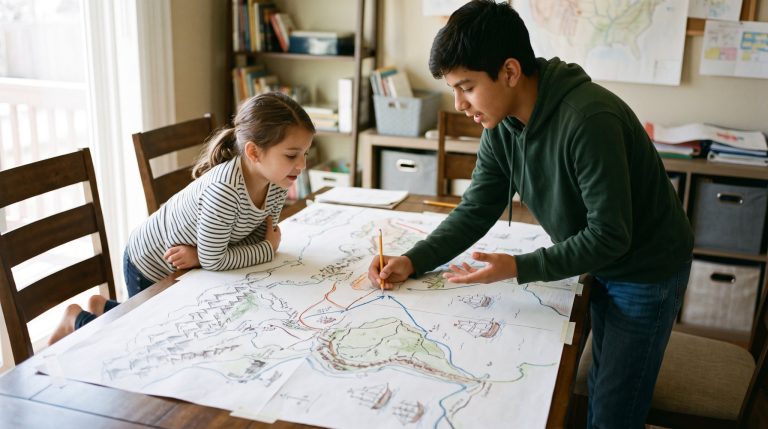
Your Child Hasn’t Forgotten – You’re Just Asking the Wrong Questions
This article explores the foundation of the larger retention question: what should count as evidence that a child has learned history? Before parents can judge whether history is sticking, they need a broader and more accurate definition of what historical learning looks like.
Why Most Parents Measure History the Wrong Way
Most adults were taught to associate learning with recall.
In school, history assessments often required students to supply names, dates, vocabulary words, and short factual answers. A student who could identify the year the Civil War began or name the major leaders of the Roman Republic appeared to know the material. A student who could not retrieve those facts appeared not to know it.
That experience creates a simple equation:
Retention = Fact Recall
It is an understandable equation, but it is incomplete.
Remembering facts is one part of learning history. Dates help establish sequence. Names help us discuss particular people. Vocabulary gives us language for describing institutions, events, and ideas.
The problem arises when factual recall becomes the only evidence parents look for.
A child might forget the exact date of an event while remembering why it happened. Another might struggle to name a historical figure but still understand the conflict that person faced. A child might be unable to recite the formal definition of an empire yet recognize how empires expand, govern distant territories, and become vulnerable to instability.
Those children have not retained every piece of information. But neither have they retained nothing.
When parents use isolated recall questions as their primary measure, they may mistake difficulty retrieving a fact for the disappearance of an entire body of understanding.
That can create unnecessary anxiety for both parent and child.
The parent sees a failed assessment. The child may feel that everything understood during the lesson somehow does not count because the exact answer cannot be produced on demand.
What It Means to Understand History
Historians certainly use facts. Historical thinking cannot occur without knowledge of events, people, places, and chronology.
But historians do not stop at remembering information. They use information to investigate larger questions.
They ask:
- What caused this event?
- What conditions made it possible?
- Why did people act as they did?
- What evidence supports this interpretation?
- How did different people experience the same event?
- What changed afterward?
- What remained the same?
- How does this period compare with another?
These questions involve causation, context, evidence, interpretation, and comparison. They require a person to organize facts into a meaningful structure.
That is the difference between merely remembering history and thinking historically.
A child who knows that the Western Roman Empire ended in 476 may possess a useful fact. A child who understands that Rome’s decline involved political instability, military pressure, economic strain, and difficulty governing an enormous territory possesses a framework.
The date can be looked up easily. The framework allows the child to reason.
That framework may remain even when some of its individual details become difficult to retrieve.
Children often preserve the shape of what they learned: the central conflict, the sequence of events, the motivations of the people involved, or the relationship between a decision and its consequences. They may not reproduce the original lesson word for word, but they retain an organized understanding that can support later learning.
This is one reason apparent forgetting can be misleading. Specific information may fade while the larger structure remains.
Remembering Facts and Understanding History Are Not the Same
Consider two hypothetical students.
The first student is an excellent memorizer. She can name several Roman emperors, identify major dates, and define terms accurately. When questioned, she gives quick and correct answers.
But when asked why Rome experienced repeated political crises, she has little to say. She knows the names of emperors but has not connected their reigns to struggles over succession, military loyalty, taxation, or the size of the empire.
The second student forgets several names and confuses two dates. Yet when asked why Rome became unstable, he explains that emperors depended on the army, powerful groups competed for control, borders were difficult to defend, and governing such a large territory created problems.
Which child has learned more history?
The first child has retained more isolated information. The second has retained more historical understanding.
Ideally, students develop both. Factual knowledge supplies the material from which deeper understanding is built. But factual recall alone does not tell parents whether a child can explain, compare, interpret, or apply what was learned.
A child who understands the forces behind an event can often reconstruct forgotten details through review. A child who remembers details without understanding their relationship may produce correct answers while possessing a fragile grasp of the subject.
The goal is not to dismiss facts. It is to stop treating them as the entire measure of learning.
Better Questions Reveal Better Learning
The questions parents ask shape the kind of knowledge children are able to demonstrate.
A question such as “What year did Rome fall?” has one narrowly defined answer. The child either retrieves it or does not.
A question such as “Why do you think Rome became difficult to govern?” opens a wider window. The answer may reveal whether the child understands geography, political instability, military pressures, communication problems, or economic strain.
Instead of asking only:
“What was the Boston Tea Party?”
You might ask:
“Why were the colonists willing to destroy property over a tax?”
Instead of asking:
“Who was Julius Caesar?”
You might ask:
“Why did some Romans support Caesar while others thought he was dangerous?”
Instead of asking:
“What year did the Civil War begin?”
You might ask:
“What conflicts had become so serious that compromise was no longer working?”
These questions do not eliminate factual knowledge. A child will still draw on remembered information. But the questions allow that information to be used rather than merely recited.
Other useful prompts include:
- What caused this?
- What changed because of it?
- What choices did this person have?
- Why might different groups have viewed the event differently?
- What does this remind you of?
- How was this society similar to or different from another one we studied?
- What evidence would you want before deciding which explanation is stronger?
- What do you think would have happened if one important decision had been different?
A child’s answer does not need to sound like a textbook. The purpose is to observe how the child organizes ideas, identifies relationships, and reasons from what was learned.
You may discover that a child who appears unable to “tell you what happened” can still discuss why it mattered.
Signs Your Child Knows More Than You Think
Historical learning often appears outside formal assessment.
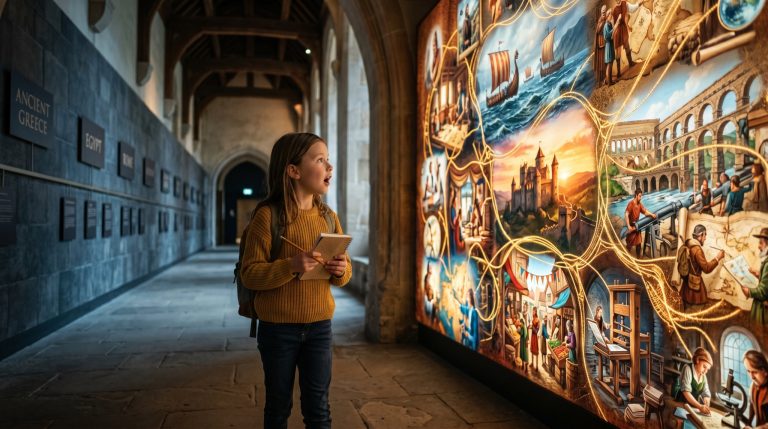
A child may reveal understanding while watching a film, reading a story, discussing a current event, visiting a museum, or asking an unexpected question during an unrelated conversation.
Several signs can indicate that historical learning is still present.
Your child explains causes and consequences
The child may say that a war happened because several conflicts had been building, or that a ruler’s decision created problems later.
The explanation may be incomplete, but recognizing that events have multiple causes is evidence of historical reasoning.
Your child compares different societies or periods
A child might notice that two empires faced similar governing problems, that two revolutions began for different reasons, or that people in different periods used power in comparable ways.
Comparison shows that knowledge is becoming organized rather than remaining tied to a single lesson.
Your child uses historical vocabulary meaningfully
Terms such as empire, citizen, alliance, trade, revolution, succession, or reform may appear in conversation.
Perfect definitions are less important than whether the child uses the ideas appropriately.
Your child recognizes human motivations
Historical empathy does not mean approving of everything people did. It means recognizing that people acted within particular circumstances, beliefs, pressures, and limitations.
A child who asks why ordinary people supported a ruler, joined a movement, resisted an authority, or accepted a social system is moving beyond simple judgment toward interpretation.
Your child transfers an idea into a new context
A child might connect a modern political conflict to an earlier struggle over power, compare modern propaganda with historical messaging, or notice that a fictional society resembles a civilization previously studied.
This kind of transfer is especially significant because the child is using historical knowledge in a situation where the answer was not directly taught.
Your child asks increasingly thoughtful questions
Curiosity itself can reveal retained understanding.
Questions such as “Why didn’t they just choose a new leader?” or “How do we know that account is true?” show that the child is noticing problems of government, evidence, perspective, or causation.
The child may not remember every fact, but the subject has provided material for continued thought.
Historical-Learning Application
Imagine that your family studied the Roman Republic several months ago.
Your child may no longer remember the names of both consuls, the exact function of every assembly, or the date Julius Caesar crossed the Rubicon. A fact-based review might therefore look disappointing.
But during a later conversation about government, your child says:
“The Romans were afraid of one person having too much power, but their system also had trouble making decisions when there was a crisis.”
That statement reveals substantial learning.
The child remembers a central tension within the Roman political system. The answer includes ideas about power, institutional design, fear of tyranny, and the difficulty of responding to emergencies. It may not contain a date or a formal definition, but it shows that the child has retained a meaningful historical framework.
The same pattern can appear across historical topics.
A child studying industrialization might notice that new technology can improve production while creating difficult working conditions.
A child studying colonization might recognize that the same event can look very different from the perspectives of settlers, Indigenous peoples, political leaders, or merchants.
A child studying war might distinguish between the event that triggered the conflict and the deeper causes that made conflict likely.
These are not substitutes for historical knowledge. They are historical knowledge being used.
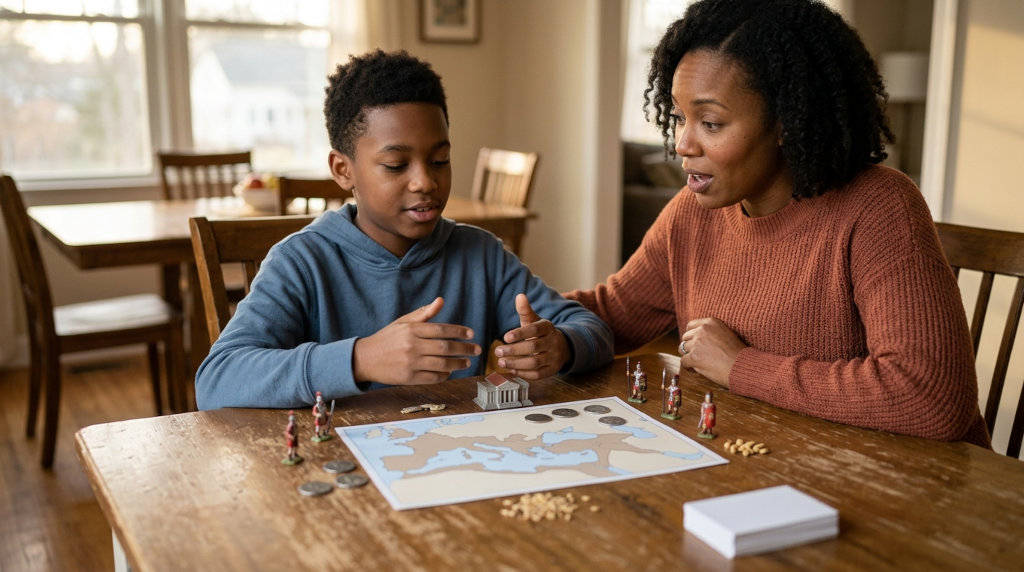
Discussion, narration, comparison, observation, and interpretation allow parents to see that use more clearly than a rapid series of recall questions often does.
Practical Takeaways for Homeschooling Parents
You do not need to abandon factual questions. Names, dates, and definitions still matter. They help children establish chronology and communicate clearly about the past.
But fact questions should be one part of a broader assessment approach.
Begin by changing the balance of your questions.
After asking what happened, ask why it happened. After asking who was involved, ask what each person or group wanted. After reviewing a date, ask what changed before and after it.
Give your child time to think. Retrieval pressure can make a child appear less knowledgeable, especially when the interaction feels like a test. A conversation conducted during a walk, meal, car ride, or hands-on activity may reveal more than a direct interrogation at the school table.
Pay attention to spontaneous evidence. Keep a brief notebook or digital record of historical connections your child makes, questions that arise, vocabulary used naturally, and comparisons made across lessons. These observations can provide a more representative picture of learning than one difficult afternoon of review.
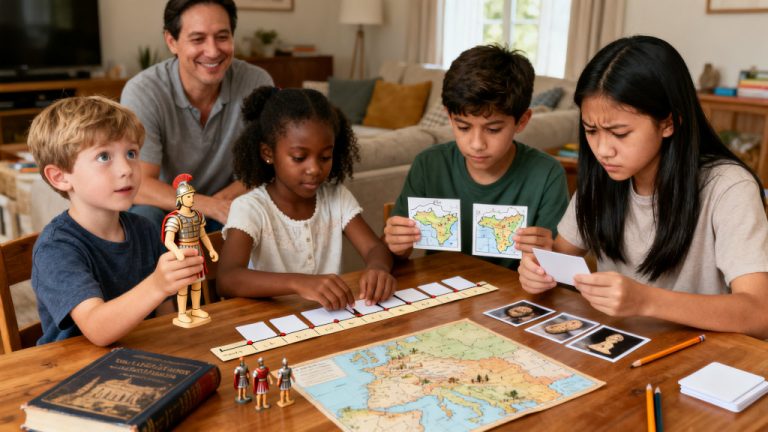
You can also invite your child to demonstrate understanding through activities such as:
- narrating an event in their own words
- comparing two leaders or civilizations
- explaining the causes of a conflict
- arranging events into a story or timeline
- debating the choices available to a historical person
- identifying what evidence would help answer a historical question
- discussing how an event might have unfolded differently
The goal is not to make every conversation into an assessment. It is to recognize that evidence of learning appears in many forms.
Most importantly, resist drawing a sweeping conclusion from one unanswered question.
“I don’t remember” may mean that a specific fact is temporarily inaccessible. It may mean the question is too broad. It may mean the child feels pressured. It may mean the information needs review.
It does not automatically mean that nothing was learned.
Conclusion
When homeschooling parents ask whether their children are retaining history, they often begin by checking what facts can be recalled on demand.
That approach provides some useful information, but it captures only one dimension of learning.
Historical understanding also appears through explanation, comparison, interpretation, curiosity, perspective-taking, and the ability to connect ideas across contexts. A child may forget a date while retaining the causes of an event. A name may fade while the person’s choices and consequences remain. Specific details may weaken while the larger historical framework survives.
The question, therefore, is not only:
“What does my child remember?”
It is also:
“How does my child think about the past?”
That broader question will not completely resolve every concern about history retention. It does, however, provide the foundation for evaluating learning more accurately. Once parents understand what evidence they are looking for, conversations, narration, observation, portfolios, and other forms of assessment begin to make much more sense.
The problem may not be that your child has forgotten everything.
The problem may be that the questions you are asking do not give your child the opportunity to show what remains.
Turn Better Questions Into a Monthly History Habit
If your child understands more history than ordinary recall questions reveal, Spot the Anachronism gives you a practical way to see that understanding in action. Each monthly visual challenge invites your child to investigate a historical scene, identify what does not belong, explain why, compare evidence, and reason about how the past actually worked. You get ready-to-use history practice without having to invent the right questions yourself – and your child builds the active, repeatable thinking habits that make historical learning visible.
This Article Is Part Of A Larger Series
Question: How do I know if my child is actually retaining what they’ve learned in history?
Series Position: Article 1 of 11 (Foundation Article)
This article explores one evidence-supported aspect of the larger question. Readers interested in the full answer should explore the complete series.
Related Facebook Discussions
- See how one simple shift—from asking whether an object looks Roman to asking what it is doing—turns recognition into historical reasoning.
- This discussion shows how asking what a surface is telling us helps children treat architecture as evidence rather than backdrop.
- A hairstyle comparison demonstrates how children can use small visual clues to reason about identity, status, daily routines, and cultural context.