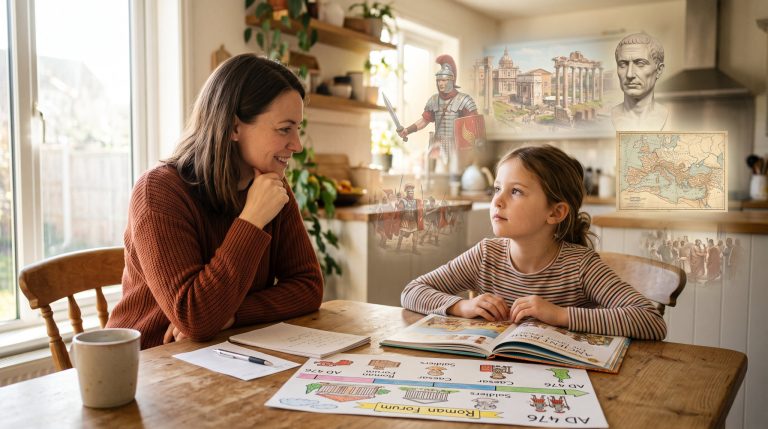
What Does It Actually Look Like When a Child Understands History?
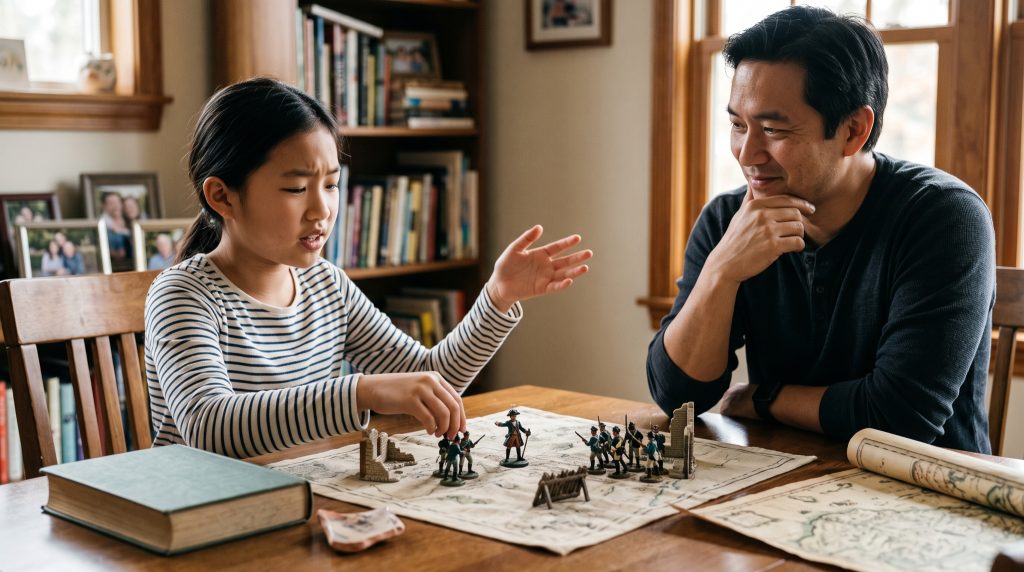
Many homeschooling parents ask some version of the same question: Are we doing too much memorization of dates and names instead of actual understanding?
It is an honest question, and often a frustrated one. Parents may have watched a child memorize a timeline, pass a quiz, and then forget most of it two weeks later. Or they may have seen a child who cannot remember a date but can give a surprisingly thoughtful explanation of why an event happened. That creates a real dilemma: if memorization is not the whole goal, then what should parents be looking for instead?
This article focuses on one specific part of that larger question: what historical understanding actually looks like when it appears in a child’s learning.
It is easy to say, “We want understanding, not just memorization.” It is harder to define what understanding means in practical terms. If a parent cannot recognize understanding, then quizzes and recall checks can start to feel like the only reliable evidence of learning.
But understanding is visible. It shows up in how a child explains, connects, questions, compares, and reasons about the past.
The Invisible Goal Problem
One reason parents fall back on memorization is that memorization is easy to measure.
A child either remembers that the American Revolution began in 1775, or does not. A child either remembers the name of Julius Caesar, or does not. A child either recalls that the Magna Carta was signed in 1215, or does not.
Those answers are tidy. They are also limited.
Historical understanding is less tidy, but it is not invisible. The problem is that many parents have never been given a clear picture of what they are trying to observe.
If the only question is, “Can my child remember this fact?” then every forgotten fact feels like failure. But if the question becomes, “Can my child make sense of this event?” then a wider range of learning becomes visible.
A child may forget the exact date of an event but still understand that economic pressure, religious conflict, political rivalry, and leadership decisions all helped produce it. That child is not merely storing information. That child is beginning to think historically.
This does not mean facts are unimportant. It means facts should serve understanding. Dates, names, places, and vocabulary are the raw materials. Understanding is what the child can do with them.
What Historians Mean by Understanding
Historians do not simply collect facts about the past. They ask questions about evidence, cause, consequence, perspective, change, continuity, and significance.
That distinction matters for homeschool history.
A child who is learning history well gradually moves beyond “what happened?” into deeper questions:
Why did it happen?
Why did people make those choices?
What changed afterward?
What stayed the same?
Whose perspective are we hearing?
What evidence supports this claim?
Why does this event matter?
These are not just “extra” questions for advanced students. They are the shape of historical understanding itself.
When children begin to ask and answer those kinds of questions, they are showing that history is becoming more than a list. They are beginning to treat the past as something that can be investigated.
That is a major shift.
A memorization-centered approach often treats history as information to be received. A historical-thinking approach treats history as an inquiry into human choices, consequences, evidence, and meaning.
For homeschooling parents, this provides a better target. The goal is not to eliminate factual knowledge. The goal is to help children use factual knowledge to reason about the past.
Four Levels of Historical Understanding
One useful way to recognize progress is to think in four broad levels: recall, description, explanation, and interpretation.
These are not rigid grade levels. Children may move back and forth among them depending on the topic, their age, and how familiar the material is. But the progression helps parents see what growth can look like.
Level 1: Recall
Recall is the ability to remember a fact.
A child might say:
“Columbus sailed in 1492.”
“The Civil War began in 1861.”
“Julius Caesar was assassinated.”
Recall matters because children need some factual material in memory. Without names, places, dates, and basic events, there is nothing to think with.
But recall by itself is not yet understanding. A child can repeat a sentence without knowing why it matters.
The problem is not that recall exists. The problem is when recall is treated as the final destination.
Level 2: Description
Description adds detail.
A child might say:
“Julius Caesar became very powerful, and some Roman senators were afraid he would become a king.”
Or:
“The Boston Tea Party was a protest where colonists dumped tea into the harbor because they were angry about British taxes.”
This is stronger than isolated recall. The child is beginning to tell what happened in a fuller way. Description often includes sequence, setting, people, and basic motives.
At this stage, a parent may notice that narration becomes more useful than a quiz. When a child retells an event in their own words, the parent can hear whether the child has a meaningful mental picture of what happened.
Level 3: Explanation
Explanation is where understanding becomes much clearer.
A child might say:
“The Roman senators did not kill Caesar just because they disliked him. They were afraid his power would destroy the Republic.”
Or:
“The colonists were angry about taxes, but the bigger issue was that they believed Parliament was making decisions without their consent.”
Now the child is identifying causes, motives, tensions, and consequences. This is more than remembering. It is reasoning.
Explanation answers “why” and “how” questions. It shows that the child can connect facts into a meaningful pattern.
For many homeschool families, this is the most important shift. A child who can explain why something happened is usually showing deeper understanding than a child who can only recite when it happened.
Level 4: Interpretation
Interpretation goes further. It involves evaluating perspectives, weighing evidence, comparing explanations, and recognizing that history often includes complexity.
A child might say:
“Some colonists saw themselves as defending liberty, but enslaved people and Native nations would not have experienced the Revolution the same way.”
Or:
“Caesar’s assassination was meant to save the Republic, but it actually helped lead to more civil war.”
At this level, children begin to understand that historical events can look different depending on perspective. They can hold more than one idea in mind. They can see unintended consequences. They can ask whether a source is trustworthy. They can compare one situation to another.
This kind of thinking develops gradually. A young child will not usually interpret history the way a teenager can. But even younger children can begin with simple forms of perspective-taking and cause-and-effect reasoning.
The parent’s job is not to force advanced analysis too early. The job is to notice the direction of growth.
Observable Signs Your Child Is Understanding History
Historical understanding often appears in conversation before it appears in formal assignments.
A child may show understanding when they ask, “Why did they do that?” That question matters. It means the child is no longer treating history as a list of things that happened. They are looking for human reasons.
A child may show understanding when they connect one event to another: “That sounds like what happened earlier when the nobles were afraid of losing power.” Connections show that the child is building a usable mental framework.
A child may show understanding when they notice patterns: “It seems like a lot of wars start when rulers want more land or money.” The pattern may be oversimplified at first, but the attempt matters. The child is beginning to think across events rather than only within one lesson.
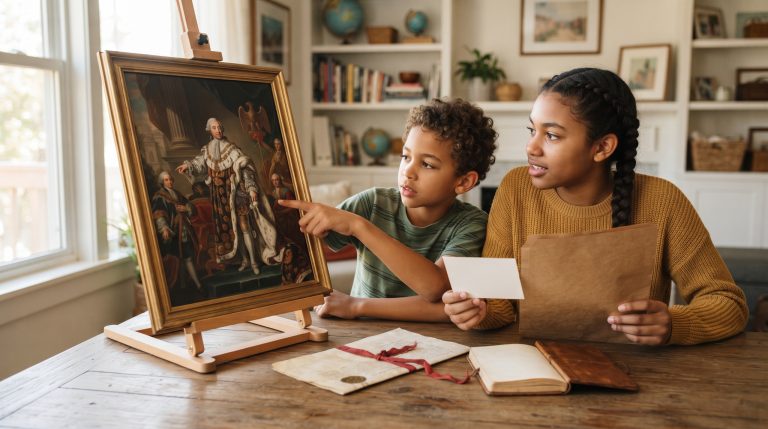
A child may show understanding when they question a source: “How do we know that?” or “Was this written by someone on one side?” That is an early sign of historical literacy.
A child may show understanding when they compare perspectives: “The king probably thought he was keeping order, but the people probably thought he was being unfair.”
A child may show understanding when they explain consequences: “That decision solved one problem but created another one.”
These signs are easy to miss if the parent is only listening for correct recall. A child might not remember every name in a chapter but still be developing the habits of historical thought.
Age-Appropriate Expectations
Historical understanding looks different at different ages.
For younger children, understanding may look like vivid narration, simple cause-and-effect statements, and basic human motives. A younger child might say, “They were scared,” “They wanted food,” or “The king made a rule people thought was unfair.” That is not shallow. It is the beginning of historical reasoning.
For middle-grade students, understanding often becomes more connected. They can compare events, explain multiple causes, and notice that people in the past had different beliefs and constraints. They may begin to see that one event can have several causes at once.
For teens, historical understanding can become more interpretive. Older students can weigh evidence, recognize bias, compare historical arguments, and discuss moral complexity with greater nuance. They can begin to see why historians disagree and why simple explanations often fail.
This developmental progression matters because parents can become discouraged when a child does not sound like an adult historian. That is the wrong standard. The better question is whether the child is moving from recall toward description, from description toward explanation, and from explanation toward interpretation.
Historical-Learning Application
In homeschool history, understanding can be observed during ordinary learning moments.
During reading, a parent can pause and ask, “What problem were these people trying to solve?” This shifts attention from isolated events to human decisions.
During narration, a parent can listen for whether the child merely repeats details or begins to organize them: “First this happened, then that caused this other thing.”
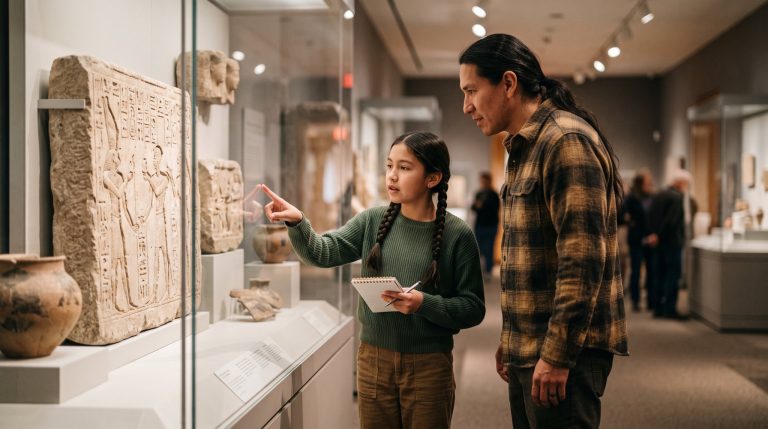
During discussion, a parent can ask, “Why do you think they made that choice?” or “Who might have seen this differently?” These questions reveal whether the child is thinking about motive, perspective, and consequence.
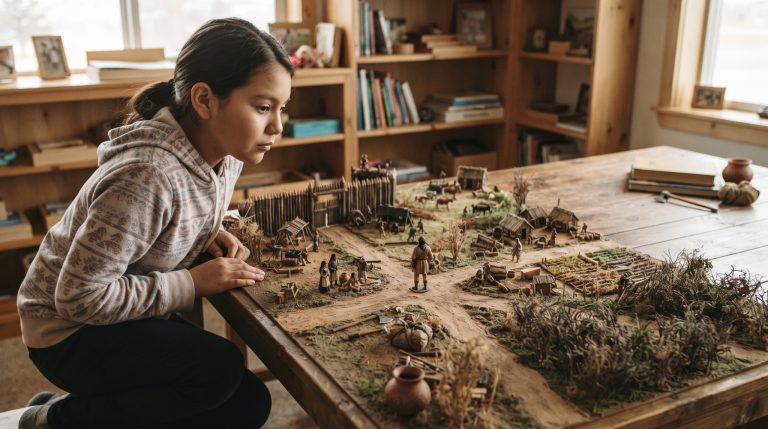
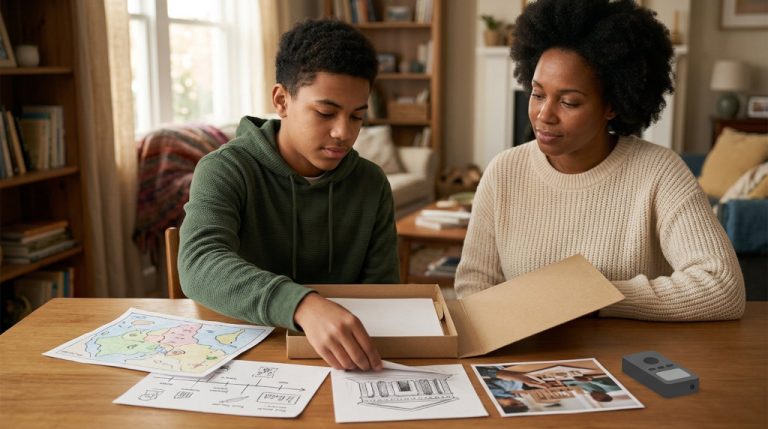
During projects, a parent can observe what the child chooses to include. A timeline that only lists dates shows one kind of learning. A cause-and-effect map, comparison chart, annotated drawing, or source discussion may reveal different kinds of understanding.
Even everyday comments can matter. If a child says, “That reminds me of what happened in ancient Rome,” the parent is seeing transfer. The child is using one historical situation to think about another.
That is a strong sign of learning.
History is not only remembered when a child can reproduce a date on command. History is also remembered when a child uses the past as a framework for making sense of people, choices, conflict, power, belief, and change.
Practical Takeaways for Homeschooling Parents
Parents do not need to abandon factual knowledge. But they can change what they treat as evidence of success.
Instead of only asking, “What year did this happen?” ask, “Why did this matter?”
Instead of only asking, “Who was this person?” ask, “What choice did this person make, and what happened because of it?”
Instead of only asking, “Can you define this term?” ask, “How did this idea affect people’s lives?”
Instead of only asking, “Can you remember the chapter?” ask, “Can you explain the problem people were facing?”
Parents can also watch for spontaneous signs of understanding: questions, connections, comparisons, disagreements, and attempts to explain.
A child who says, “I don’t think that was the only reason,” is doing something important. A child who says, “That source might be biased,” is doing something important. A child who says, “This is like the other empire we studied,” is doing something important.
Those moments may not fit neatly into a quiz score, but they are real evidence.
A practical homeschool approach might include some memory work, some narration, some discussion, some timelines, some source questions, and some comparison activities. The balance will vary by child and age. The key is to make sure memory serves meaning.
Facts should not be treated as the finish line. They should become tools for explanation.
Conclusion
The question “Are we doing too much memorization of dates and names instead of actual understanding?” cannot be answered only by saying, “Memorization is bad,” or “Facts are good.”
The better answer begins by defining what understanding looks like.
Historical understanding is visible when a child can explain, connect, question, interpret, and reason about the past. It appears when children move from isolated recall toward meaningful explanation. It appears when they begin asking why people acted, how events connected, what changed, what continued, and why different people saw the same event differently.
This article does not answer the whole memorization-versus-understanding question. It offers one necessary piece of the larger answer: parents need to know what they are looking for.
Once they do, they may discover that their child’s understanding has been more visible than they realized.
A Practice That Makes Historical Understanding Visible
Spot the Anachronism gives children a concrete way to show what they can do with historical knowledge. Finding the misplaced detail begins with observation, but explaining why it does not belong requires comparison, evidence, context, and reasoning. As children defend their conclusions, question other possibilities, and reconsider the scene, parents can hear the movement from simple recall toward explanation and interpretation.
This Article Is Part Of A Larger Series
Question: Are we doing too much memorization of dates and names instead of actual understanding?
Series Position: Article 3 of 11 (Understanding Articles)
This article explores one evidence-supported aspect of the larger question. Future articles examine additional research-supported approaches to increasing engagement with history.
Related Facebook Discussions
- Historical understanding grows when children ask whether every part of a Roman scene belongs to the same connected world.
- Reading fatigue, posture, and effort in a historical figure shows how observation can become reasoning about lived experience.
- Asking whether a marketplace feels physically contested helps children move from recognizing details to interpreting how the whole environment functioned.