The Date Problem Isn’t Dates – It’s What We Do With Them
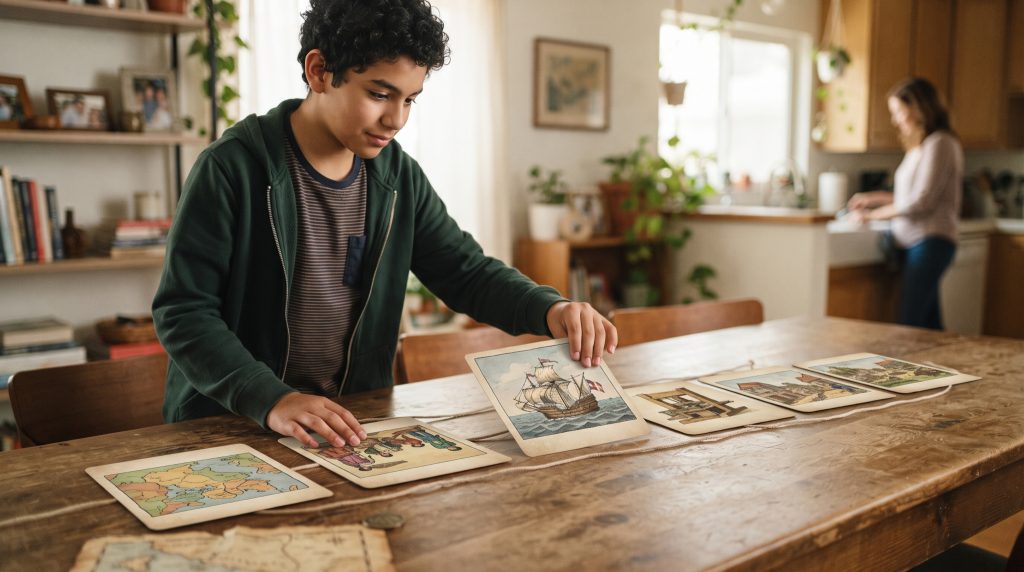
Many homeschooling parents eventually ask some version of this question:
Are we doing too much memorization of dates and names instead of actual understanding?
It is a fair question. History can easily become a long list of names, battles, kings, wars, inventions, and dates. A child may be able to recite that Rome fell in 476, that Columbus sailed in 1492, or that the Declaration of Independence was signed in 1776, yet still be unable to explain why those events mattered, what changed afterward, or how one event connects to another.
That gap is what worries parents.
They are not usually objecting to knowledge itself. They are objecting to a kind of history learning that feels thin: memorize the date, answer the quiz question, move on, forget most of it later. Parents sense that history should do more than fill a child’s head with disconnected facts.
But there is a danger in the way this concern is sometimes framed. Once parents notice the limits of memorization, it is tempting to conclude that dates and names are the problem.
They are not.
The deeper problem is not that children learn dates. The problem is what those dates are being asked to do.
This article explores one important part of the larger question: What role should factual knowledge play in historical understanding?
The False Choice: Facts or Understanding
Many families feel pushed into a false choice.
On one side is the traditional model: learn the dates, memorize the names, know the sequence. This can feel rigorous and orderly, but it often leaves children bored or confused about why the information matters.
On the other side is the reaction against memorization: focus on big ideas, discussion, projects, empathy, and critical thinking. This can feel more meaningful, but it may leave parents wondering whether their children are missing essential knowledge.
The real answer is not found by choosing one side.
History education does not work well when facts replace understanding. But understanding also cannot grow in a vacuum. A child cannot think deeply about the American Revolution, the Roman Empire, the Civil War, ancient Egypt, or World War II without knowing something about the people, places, events, and sequence involved.
The better question is not:
Should my child learn dates?
The better question is:
What understanding does this date help my child build?
That shift changes everything.
Why Parents Are Right to Be Concerned
Parents are right to worry when history becomes disconnected memorization.
A child might memorize that the Battle of Hastings happened in 1066 without understanding why it mattered. Another child might learn the names of several Roman emperors without understanding how imperial power worked. A third might memorize that the Magna Carta was signed in 1215 without grasping why later generations cared about it.
In each case, the child may “know” the fact in a narrow sense. But the fact is inert. It sits alone. It does not help the child explain anything.
That kind of learning is fragile. Isolated facts are easy to forget because they are not attached to a meaningful structure. They are like loose puzzle pieces without the picture on the box.
This is why so many children say history is boring. They are not always bored by the past itself. They are bored by information that has no visible purpose.
Dates and names become frustrating when they are treated as the finish line:
- What year did this happen?
- Who was the king?
- What was the name of the battle?
- What treaty ended the war?
Those questions are not useless. But if they are the whole lesson, the child may never reach the more important historical questions:
- Why did this happen?
- Why did it matter?
- What changed afterward?
- Who benefited?
- Who suffered?
- What did people at the time believe they were doing?
- How do we know?
A history education built only around recall may produce short-term performance without long-term understanding.
So the parent’s concern is valid. Memorization alone is not enough.
Why Facts Still Matter
The mistake would be to swing too far in the opposite direction and decide that facts do not matter.
They do.
A child cannot reason historically without background knowledge. To understand an event, the child needs some sense of chronology, geography, people, institutions, conflicts, beliefs, and prior events. Otherwise, discussion becomes vague.
For example, suppose a child is asked, “Was Julius Caesar a hero or a threat to the Roman Republic?”
That is a rich historical question. But the child cannot answer it meaningfully without knowing some facts:
- Rome had a Republic before it had emperors.
- Caesar was a military commander and political figure.
- The Senate feared his power.
- Civil war preceded his dictatorship.
- His assassination did not restore stable republican government.
- Augustus eventually became Rome’s first emperor.
Those facts do not automatically produce understanding. But without them, the child has nothing solid to think with.
This is where background knowledge matters. Facts give the mind material to organize. They allow children to notice patterns, compare situations, follow cause and effect, and understand why people acted as they did.
A child who knows nothing about monarchy, taxation, colonial government, Enlightenment ideas, or British imperial policy will struggle to understand the American Revolution as anything more than “the colonists wanted freedom.” A child who knows nothing about geography, trade routes, flooding cycles, pharaohs, temples, and agriculture will struggle to understand ancient Egypt beyond pyramids and mummies.
Facts provide the raw material. Understanding comes from organizing and using that material.
Useful Facts Versus Inert Facts
The key distinction is between useful facts and inert facts.
An inert fact is learned for recall only.
A useful fact helps explain something.
Consider the date 476, often given as the year the Western Roman Empire fell. If a child memorizes “Rome fell in 476” only because it will appear on a quiz, the date may not do much. It may be remembered briefly, then forgotten.
But the same date can become useful when it helps a child think.
A parent might ask:
- What does it mean to say Rome “fell”?
- Did everything Roman disappear in 476?
- What had been weakening the western empire before that date?
- Why did the eastern empire continue?
- Why do historians use dates to mark changes that were actually gradual?
Now the date is not the point by itself. It is a doorway into historical thinking.
The same applies to names.
Memorizing “George Washington” is not enough. But knowing who Washington was helps a child explore leadership, military difficulty, republican ideals, political restraint, and the symbolic power of voluntarily leaving office.
Memorizing “Cleopatra” is not enough. But knowing who Cleopatra was can open discussion about Egypt, Rome, empire, gender, diplomacy, propaganda, and how later cultures reshape historical memory.
Memorizing “Martin Luther” is not enough. But knowing who Luther was helps a child understand religious authority, printing, reform, conflict, and the reshaping of Europe.
The fact becomes useful when it supports a larger question.
What Historians Do With Facts
Historians know many facts, but they do not treat facts as the final destination.
They use facts to build arguments, test interpretations, compare evidence, explain causation, and judge significance.
A historian does not ask only, “When did this happen?”
A historian asks:
- Why did this happen when it did?
- What earlier events made it possible?
- What changed because of it?
- How did different people experience it?
- Which sources support this interpretation?
- Why do historians disagree about it?
This matters for homeschool history because children do not need to become professional historians in order to benefit from historical thinking. They simply need to learn that facts are tools.
A date helps place events in sequence.
A name helps identify an actor.
A place helps locate the event in a real setting.
A document helps reveal what someone claimed, believed, feared, or wanted.
An artifact helps us observe how people lived.
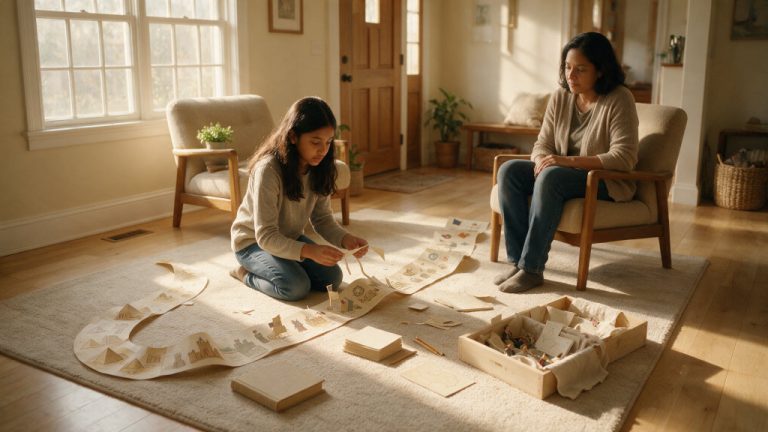
A timeline helps us see development and change.
The goal is not to eliminate facts. The goal is to put facts to work.
Reframing History at Home
For homeschooling parents, this shift can be very practical.
You do not need to throw away timelines, memory work, maps, names, or dates. Instead, you can change the questions surrounding them.
When a curriculum asks your child to remember a date, add:
What was happening before this?
When a lesson names an important person, ask:
What problem was this person trying to solve?
When a chapter describes a war, ask:
What caused the conflict, and what changed afterward?
When your child learns about an invention, ask:
How did this change daily life?
When a book introduces an empire, ask:
How did this empire hold power together?
The date or name remains. But now it serves understanding.
For example, instead of simply asking, “When did the American Revolution begin?” you might ask:
- What made the colonists angry before the war began?
- Why did some colonists remain loyal to Britain?
- How did the war change ideas about government?
- What problems remained unresolved after independence?
The date gives structure. The questions create meaning.
The same principle works for younger children. A child studying ancient Rome does not need a graduate-level discussion of imperial administration. But the child can still begin to connect facts:
- Rome had roads.
- Roads helped soldiers move.
- Roads helped trade.
- Roads helped the empire stay connected.
- Roads also helped Roman culture spread.
That is historical understanding beginning to form.
Historical-Learning Application: Dates as Thinking Tools
In history learning, dates serve several important purposes.
First, dates help children understand sequence. Children need to know whether an event happened before or after another event. Without sequence, cause and effect become scrambled.
Second, dates help children understand context. Knowing that an event happened during a war, after a famine, before an empire collapsed, or during a period of religious conflict changes how we interpret it.
Third, dates help children understand change over time. History is not just a list of isolated events. It is movement: growth, decline, reform, conflict, migration, invention, adaptation, and consequence.
Fourth, dates help children discuss significance. Some dates are remembered because people later decided they marked an important turning point. That itself is worth discussing. Why do we remember this date and not another? Who chose it as important? What does the date simplify?
This means a child does not need to memorize every date in a chapter. But the child does need enough chronological structure to think historically.
A date should help the child say:
- This came before that.
- This helped cause that.
- This changed what came next.
- This event mattered because…
That is very different from memorizing a date as trivia.
Practical Takeaways for Homeschooling Parents
The practical goal is not fewer facts. It is better-used facts.
A helpful rule is this:
Do not teach a fact without giving it a job.
A date might help explain sequence.
A name might help explain agency.
A battle might help explain a turning point.
A law might help explain power.
A map might help explain conflict, trade, migration, or expansion.
A primary source might help explain perspective.
When planning or evaluating a history lesson, ask:
What is this fact helping my child understand?
That one question can clarify whether the lesson is building historical understanding or merely accumulating information.
Here are several principles that can guide homeschool practice:
- Keep important dates, but connect them to questions.
A date becomes more memorable when it helps answer why something happened or what changed afterward. - Use timelines for relationships, not decoration.
A timeline should help children see sequence, overlap, cause, and consequence. - Ask “why did this matter?” often.
This moves history from recall into significance. - Let children use facts in discussion.
A child who uses a date, person, or event naturally while explaining an idea is showing deeper understanding than a child who only recalls it on command. - Revisit facts in new contexts.
A fact becomes stronger when it appears in multiple meaningful conversations, not just one quiz. - Watch for connections.
When a child says, “That reminds me of…” or “Was this like when…?” they are beginning to organize knowledge.
These are signs that facts are becoming part of a usable mental framework.
Conclusion: The Date Problem Is Really a Purpose Problem
So, are homeschoolers doing too much memorization of dates and names instead of actual understanding?
Sometimes, yes.
But the solution is not to remove dates and names from history education. The solution is to stop treating them as the final goal.
Facts matter because children need knowledge to think with. But facts become powerful only when they are connected to causation, significance, context, evidence, and change over time.
A child does not understand history merely because he can recite a date. But he also cannot understand history well if every event floats free of sequence, people, place, and context.
The real goal is not facts versus understanding.
The goal is facts for understanding.
This article contributes one piece to the larger answer: memorization is not the enemy, but memorization without purpose is too small a goal. History becomes more meaningful when dates and names are treated as tools that help children explain the human past.
Give Every Fact a Job
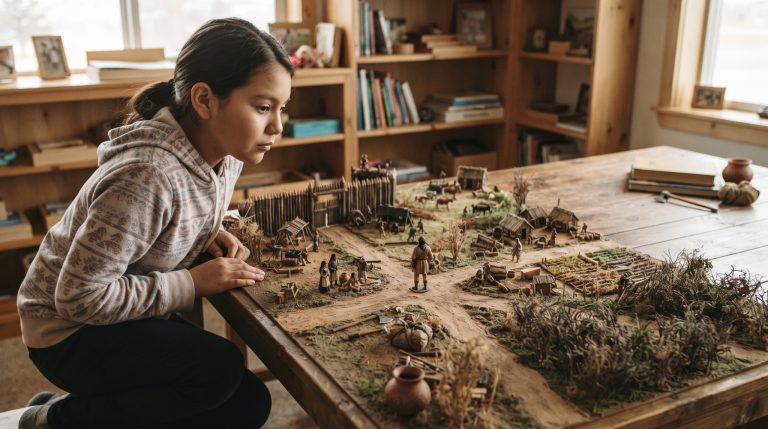
Spot the Anachronism turns historical knowledge into something children can use. As they examine a scene, decide what belongs, and explain why, facts about chronology, material culture, and daily life become tools for evidence-based historical thinking rather than isolated information to memorize.
This Article Is Part Of A Larger Series
Question: Are we doing too much memorization of dates and names instead of actual understanding?
Series Position: Article 2 of 11 (Foundation Article)
This article explores one evidence-supported aspect of the larger question. Future articles examine additional research-supported approaches to increasing engagement with history.
Related Facebook Discussions
- See how small material details can teach children to use historical facts as evidence rather than merely recall them.
- Explore how architecture, objects, lighting, and human behavior must work together to create a coherent historical world.
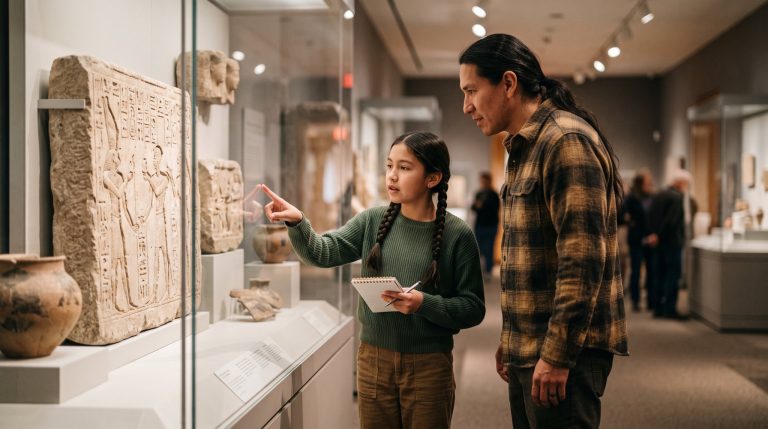
- Consider how asking what a historical object was meant to do can turn factual knowledge into deeper understanding.