What Historians Actually Do – And Why Your Child’s Curriculum Misses the Point

Many homeschooling parents eventually ask some version of this question:
Are we doing too much memorization of dates and names instead of actual understanding?
It is an understandable concern. History often arrives in homeschool materials as a long sequence of events, rulers, wars, inventions, dates, and vocabulary words. A child may be able to recite that something happened in 1776, or name the emperor, explorer, general, or reformer involved, yet still have very little sense of why the event mattered, how people understood it at the time, or how we know what happened in the first place.
Parents notice this. They see children filling in blanks, matching names to dates, and passing quizzes without becoming noticeably better at thinking about the past. Some parents remember disliking history for the same reason when they were students. Others worry that if they move away from memorization, they may be neglecting something important.
This article explores the foundation question beneath the larger concern:
If history is not mainly about memorizing dates and names, what is it actually about?
The answer begins with a simple but powerful distinction: historians do not merely remember the past. They investigate it.
Historians Do More Than Store Facts
It is easy to assume that historians are experts because they know more historical information than everyone else. They often do know a great deal. But that is not the main difference between a historian and a beginner.
A historian does not look at a historical document and simply ask, “What facts can I pull out of this?” A historian asks questions such as:
Who created this source?
Why was it created?
Who was the intended audience?
What was happening at the time?
What does this source reveal?
What might it hide?
How does it compare with other evidence?
What interpretation does the evidence support?
Those questions are not extra decoration added after the “real” history has been learned. They are the work of history.
This matters because many children are taught to approach historical material in almost the opposite way. They read a passage, extract the correct facts, memorize the highlighted terms, and answer comprehension questions. That may produce short-term recall, but it does not necessarily teach them how historical knowledge is built.
A child can know that an event happened without understanding why historians believe it happened, why people at the time acted as they did, or why later generations disagree about its meaning.
The Difference Between Reading for Facts and Reading Like a Historian
Imagine giving a child a short primary source: a letter written by a political leader during a crisis.
A fact-based assignment might ask:
What year was the letter written?
Who wrote it?
What event does it describe?
What decision did the leader make?
Those are not bad questions. They establish basic orientation. But by themselves, they train the child to treat the document as a container of answers.
A historical-thinking approach asks different kinds of questions:
What was the writer trying to accomplish?
Was this letter private or public?
What might the writer have wanted the reader to believe?
What pressures shaped the writer’s choices?
What other sources would help us check this account?
What would an opponent have said about the same event?
Now the document is no longer just a reading assignment. It becomes evidence.
That shift is central. In history, sources are not simply “information.” They are traces left by people with motives, limits, perspectives, loyalties, fears, and assumptions. Learning history means learning how to reason from those traces.
Why Traditional History Often Misses the Point
Traditional history instruction often emphasizes coverage. A curriculum may try to move from ancient civilizations to the modern world, or from one national period to another, while ensuring that students encounter the major names, events, dates, and movements.
Coverage feels responsible. Parents can see progress. Chapters get completed. Timelines fill up. Quiz scores provide evidence that something has been learned.
But coverage can create a misleading sense of success. A child may “cover” the Roman Republic, the American Revolution, or the Industrial Revolution without learning how to ask historical questions. The curriculum may present conclusions without showing how those conclusions were reached.
This is why memorization can feel so unsatisfying. The child is being asked to remember the results of historical inquiry without being invited into the inquiry itself.
That does not mean facts are unimportant. Facts matter. Dates, names, places, documents, and events give historical thinking something to work with. A child cannot reason well about the American Revolution, ancient Egypt, or medieval Europe with no factual knowledge at all.
The problem arises when facts become the endpoint.
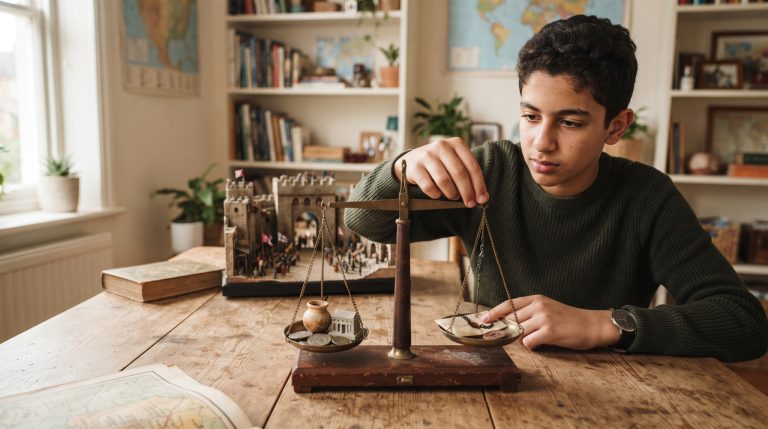
Facts should function more like tools than trophies. They help children build explanations, evaluate claims, understand change over time, and compare perspectives. A date is useful because it helps place an event in sequence. A name is useful because it identifies an actor in a larger situation. A document is useful because it gives evidence of how someone saw, justified, resisted, or experienced an event.
The goal is not to stop teaching facts. The goal is to teach children what facts are for.
What Historians Actually Do
Historians work with several habits of mind that children can begin practicing at an age-appropriate level.
One habit is sourcing. This means asking who created a source, when, why, and for whom. A diary, government decree, newspaper article, speech, painting, law code, and archaeological artifact all need to be approached differently.
Another habit is contextualization. This means placing a source or event within its historical setting. A statement that sounds strange, cruel, noble, or confusing to us may have made sense within a different social, religious, political, or economic world. Context does not excuse everything people did, but it helps us understand what choices seemed possible to them.
Another habit is corroboration. Historians compare sources. They do not usually trust one account by itself, especially when the stakes are high. They ask whether different pieces of evidence agree, conflict, or reveal different parts of the situation.
Another habit is causal reasoning. Historians ask why things happened, but rarely accept one simple cause. Wars, revolutions, migrations, reforms, collapses, inventions, and cultural changes usually involve multiple causes interacting over time.
Another habit is interpretation. Historians construct arguments about the past based on evidence. They may disagree because they weigh evidence differently, ask different questions, or focus on different dimensions of an event.
These habits are not reserved for graduate school. A homeschool parent can introduce them gently through ordinary lessons.
Instead of asking only, “What happened?” the parent can ask, “How do we know?”
Instead of asking only, “Who was right?” the parent can ask, “What evidence would help us decide?”
Instead of asking only, “What did this person do?” the parent can ask, “What pressures might have shaped that decision?”
Those questions move history from recitation toward investigation.
What This Looks Like in a Homeschool
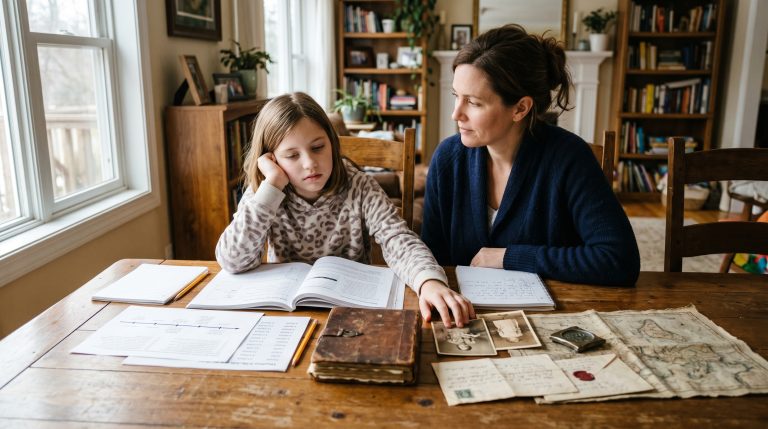
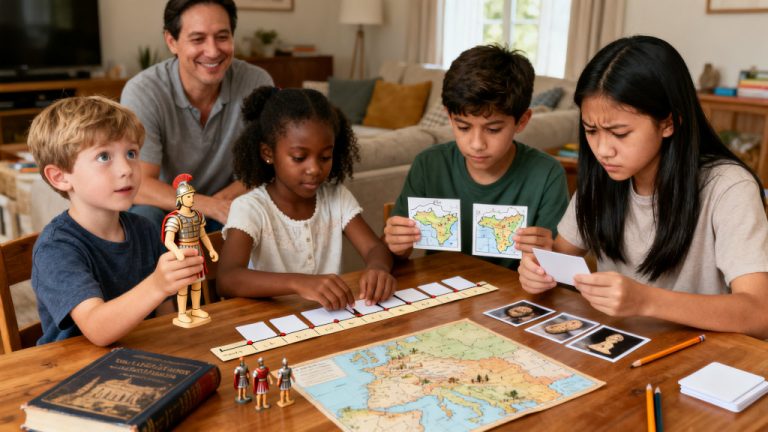
A homeschooling parent does not need to discard a curriculum in order to teach historical thinking. Often, the first step is simply changing the questions asked around the material.
Suppose a textbook describes a battle. A recall-centered lesson might focus on the date, location, commanders, and outcome. Those details may be worth knowing, but the lesson can go further.
The parent might ask:
Why did each side think this battle mattered?
What advantages did each side have?
What mistakes did people make?
How might a soldier, a civilian, a political leader, and a later historian describe the same battle differently?
What evidence would help us understand what actually happened?
Or suppose a child reads about an ancient law code. A memorization-centered lesson might ask who created it and when. A historical-thinking lesson might also ask:
What problems was this law code trying to solve?
Who had power in this society?
Who was protected?
Who was not protected?
What does this tell us about what the society valued?
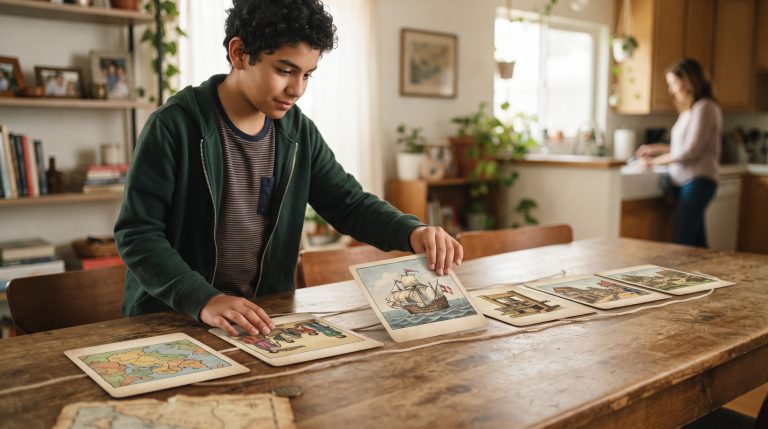
Or suppose the lesson includes a historical image. Instead of treating the image as decoration, the parent might ask:
What do you notice first?
Who seems important in this scene?
How can you tell?
What objects, clothing, buildings, or gestures give us clues?
What might the artist be trying to communicate?
What questions would we need answered before trusting this image as evidence?
In each case, the child is still learning historical content. But the content is now being used for reasoning.
Historical-Learning Application: Turning a Source Into an Investigation
Historical understanding grows when children learn to treat the past as something to investigate rather than merely absorb.
Take a simple example: two short accounts of the same event. One might come from a government official. Another might come from an ordinary witness. A parent can place them side by side and ask:
Where do these accounts agree?
Where do they differ?
Which details does one include that the other leaves out?
What might explain the difference?
Does either source have a reason to exaggerate, defend, accuse, or minimize?
What can we say with confidence?
What remains uncertain?
This kind of activity teaches several important lessons at once.
First, it teaches observation. Children learn to notice wording, emphasis, omission, and point of view.
Second, it teaches caution. Children learn that a source can be useful without being completely neutral.
Third, it teaches memory in a deeper way. Events are easier to remember when they are connected to questions, conflicts, motives, and evidence.
Fourth, it teaches discussion. Instead of giving one-word answers, children begin explaining their reasoning.
Finally, it teaches humility. History is not a magic window into the past. It is a disciplined attempt to understand the past through surviving evidence.
That is a very different kind of learning from memorizing a list.
Practical Takeaways for Homeschooling Parents
The first practical implication is that parents should not treat memorization and understanding as enemies. Children do need historical knowledge. But memorized information should serve larger thinking.
A useful test is this: after your child learns a fact, can they do anything with it?
Can they use it to explain why something happened?
Can they connect it to another event?
Can they compare two people’s perspectives?
Can they evaluate whether a source is trustworthy?
Can they ask a better question because they know it?
If the answer is yes, the fact is becoming part of understanding.
The second implication is that parents can improve history lessons by changing the question pattern. Many lessons rely heavily on “who,” “what,” and “when.” Those questions are necessary, but incomplete. Add more “how do we know,” “why did this matter,” “what else was happening,” and “who saw this differently” questions.
The third implication is that primary sources are valuable even in small amounts. A child does not need to read a full archive of documents. One short speech, law, letter, diary entry, map, painting, inscription, or artifact image can open the door to historical thinking.
The fourth implication is that disagreement is not a failure of history education. When historians disagree responsibly, they are not proving that history is just opinion. They are showing that evidence must be interpreted. Children should learn that good historical arguments are supported by evidence, not merely asserted.
The fifth implication is that homeschool discussion matters. A conversation around the kitchen table can sometimes do what a worksheet cannot: reveal how a child is thinking. When a child says, “I think this source might be biased because…” or “That decision makes more sense if…” the parent is hearing historical understanding develop.
Conclusion
The concern behind the question is valid. History can become too focused on memorizing dates and names when facts are treated as the final goal of learning.
But the solution is not to abandon factual knowledge. The solution is to restore its purpose.
Historians use facts to investigate evidence, analyze causes, compare perspectives, understand context, and build interpretations. Children can begin learning those same habits in simple, age-appropriate ways.
This article contributes one foundational piece to the larger answer: history education should not be measured only by how much information a child can recall. It should also be measured by whether the child is learning what historians actually do with information.
A child who remembers dates but never learns to question sources is not yet thinking historically. A child who knows fewer dates but can ask, “How do we know?” is beginning to enter the real work of history.
Turn Historical Images Into Evidence
Spot the Anachronism invites children to do what historians actually do: observe closely, question what they see, compare evidence, and explain which details belong in a historical setting. Instead of memorizing another finished answer, they investigate the scene and build an interpretation of their own.
This Article Is Part Of A Larger Series
Question: Are we doing too much memorization of dates and names instead of actual understanding?
Series Position: Article 1 of 11 (Foundation Article)
This article explores one evidence-supported aspect of the larger question. Future articles examine additional research-supported approaches to increasing engagement with history.
Related Facebook Discussions
- See how architecture, materials, lighting, movement, and human behavior must be evaluated together as evidence from one connected historical world.
- Explore how belts, fasteners, textile edges, and other small details can teach children to examine historical images with greater care.
- This discussion shows how brick, plaster, pigment, wear, and repair can turn Roman architecture from background scenery into historical evidence.