Why Your Child Forgets History: A Complete Retention Framework for Homeschool Parents
If you have spent any time teaching history at home, you have probably experienced a frustrating contradiction.
Your child enjoyed the lesson.
They listened attentively.
They participated in the discussion.
They answered questions correctly.
Everything seemed successful.
Then, a few weeks later, much of it is gone.
The Roman Republic has become fuzzy.
The causes of a revolution have disappeared.
Names and events have drifted out of reach.
For many parents, this experience creates two separate concerns.
The first is engagement.
How do I make history interesting enough that my child cares?
The second is retention.
How do I help history stick?
These concerns often feel connected because they usually appear together.
When children forget what they learn, history begins to feel pointless.
When history feels pointless, engagement suffers.
But engagement and retention are not exactly the same thing.
A child can enjoy a history lesson and still forget most of it.
A child can also remember historical ideas for years when the conditions for memory are present.
Throughout this series, we have explored different pieces of that puzzle.
Now it is time to put those pieces together.
Because retention is not mysterious.
It is a system.
And once parents understand that system, history begins to make much more sense.
The Four-Part Memory System
Many parents think of learning as a single event.
The lesson happens.
The child understands it.
Learning is complete.
Memory science suggests something different.
Durable learning depends on four separate processes working together:
- Encoding
- Retrieval
- Consolidation
- Revisitation
Each stage serves a different purpose.
When one stage is weak or missing, retention suffers.
When all four stages are present, historical knowledge accumulates over time.
Think of these stages as a cycle rather than a checklist.
Information enters the system.
The system strengthens it.
The system revisits it.
The cycle repeats.
Over time, memory becomes increasingly durable.
Understanding this cycle helps explain why some lessons disappear quickly while others remain available for years.
Why Most History Lessons Stop After Step One
Many history programs emphasize exposure.
Students read the chapter.
Listen to the lecture.
Watch the documentary.
Complete the worksheet.
Then the class moves on.
From the curriculum’s perspective, the topic has been covered.
From memory’s perspective, the process has barely begun.
Exposure creates opportunity.
It does not guarantee retention.
A child may encounter information without ever building a durable memory of it.
This is one reason so many parents feel confused.
The lesson seemed successful.
The material was covered.
Yet the information disappeared.
What often happened is that the lesson completed the first stage of learning but neglected the remaining stages.
The child encountered history.
The memory cycle never fully developed.
Better Encoding: Where Memory Begins
The first stage is encoding.
Encoding occurs when the brain begins transforming experience into memory.
Not all encoding is equal.
Some information receives shallow processing.
Other information receives deep processing.
Deep processing creates stronger memories.
Several factors improve encoding.
Narrative
Stories provide structure.
Human beings naturally remember events more effectively when they are organized around people, conflicts, goals, and consequences.
This is why children often remember a gladiator’s final battle while forgetting a list of political reforms.
The story gives the information meaning.
Emotion
Emotion acts as a signal of importance.
When children care about a historical figure, identify with a person’s struggles, or become invested in a difficult decision, the brain pays closer attention.
Emotion strengthens encoding.
Reduced Cognitive Load
Children cannot process unlimited amounts of new information simultaneously.
When a lesson introduces too many unfamiliar names, places, concepts, and relationships at once, understanding breaks down.
Encoding weakens.
History becomes easier to remember when complexity is introduced gradually and organized clearly.
Relevance
Children remember information more effectively when they understand why it matters.
Questions, comparisons, and connections help create that sense of relevance.
Encoding is where memory begins.
But encoding alone is not enough.
Better Retrieval: Where Memory Grows Stronger
Many parents view retrieval as assessment.
The child answers questions.
The parent discovers what was learned.
But retrieval does more than measure memory.
Retrieval strengthens memory.
Every time children reconstruct information from memory, the memory becomes easier to access in the future.
This is why narration is so powerful.
When a child retells a historical story in their own words, they are not merely demonstrating learning.
They are helping create it.
Discussion works the same way.
So do oral explanations.
So do questions that require thinking rather than recognition.
The important distinction is that retrieval requires the child to bring information back without simply seeing it again.
Recognition feels easy.
Retrieval requires effort.
That effort strengthens learning.
Better Consolidation: Where Memory Becomes Durable
The third stage is often invisible.
Consolidation occurs after instruction.
This is where sleep becomes important.
Many parents assume learning ends when the lesson ends.
In reality, the brain continues processing information afterward.
During consolidation, new memories become more organized.
Connections develop between new knowledge and existing knowledge.
Fragile memories become more stable.
This is one reason immediate performance can be misleading.
A child may seem to know something today but possess only a fragile memory of it.
The information has been encoded.
It has not yet become durable.
Sleep supports this process.
Reflection supports this process.
Time supports this process.
Consolidation does not replace good instruction.
But it helps determine whether learning survives.
Better Revisitation: Where Memory Endures
The final stage is revisitation.
Many lessons fail here.
A topic is studied once and then abandoned.
Unfortunately, memory fades when it is not revisited.
This is where spaced review becomes so valuable.
The brain remembers information more effectively when it returns after some forgetting has occurred.
Not constant repetition.
Strategic revisitation.
The goal is not endless review.
The goal is helping important information remain active.
A brief discussion weeks later.
A comparison to a new topic.
A timeline reconstruction.
A question during dinner.
A visual reminder on the wall.
These moments reactivate memory.
Every revisitation strengthens the network.
And stronger networks last longer.
How Visual Learning Fits the System
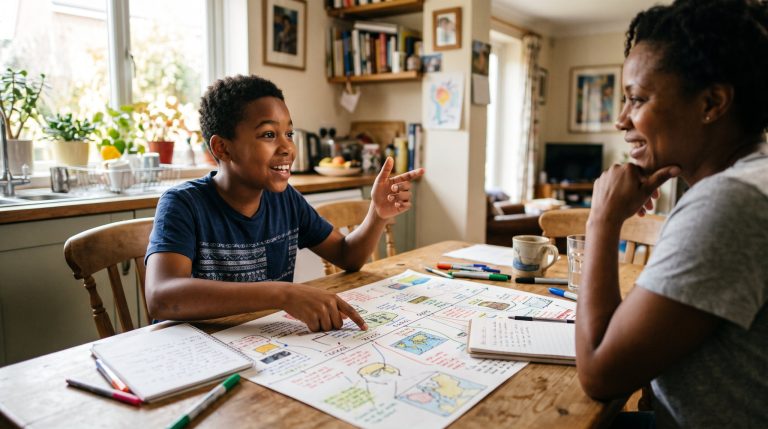
One of the most practical strategies we discussed earlier was visual encoding.
Drawing.
Mapping.
Sketching.
Timeline creation.
At first glance, these activities may seem unrelated to retention.
In reality, they strengthen multiple stages simultaneously.
Visual representations improve encoding because they require active processing.
They support retrieval because images provide additional memory cues.
They aid revisitation because maps, sketches, and timelines can be revisited later.
Visual learning does not replace other memory strategies.
It strengthens them.
This is why a simple sketch can sometimes become more memorable than an entire worksheet.
Building Historical Knowledge Over Years
Many parents evaluate history one lesson at a time.
Did my child learn this chapter?
Did they remember this unit?
Did they pass this review?
The memory framework encourages a different perspective.
Think in years rather than days.
Historical knowledge develops gradually.
One story connects to another.
One civilization connects to another.
One idea reinforces another.
Over time, children begin building a mental framework of the past.
New information attaches to previous understanding.
Connections multiply.
Historical thinking becomes easier because the knowledge remains accessible.
The goal is not perfect recall of every detail.
The goal is cumulative understanding.
History becomes part of how the child thinks.
That process requires repeated cycles of encoding, retrieval, consolidation, and revisitation.
What This Means for Homeschool Parents
The most encouraging aspect of memory science is that forgetting is not evidence of failure.
Forgetting is normal.
Expected.
Universal.
The important question is not:
“Why did my child forget?”
The more useful question is:
“Which part of the memory cycle needs support?”
Was the encoding too weak?
Was retrieval absent?
Was consolidation interrupted?
Was revisitation missing?
These questions shift attention away from blame and toward understanding.
Parents stop searching for isolated tricks.
They begin strengthening the system itself.
History Doesn’t Disappear. It Accumulates.
One of the most common frustrations in homeschooling is the feeling that history lessons vanish as quickly as they arrive.
A chapter is completed.
A test is passed.
A month later, little seems to remain.
The retention framework offers a different vision.
History does not have to be a series of disconnected experiences.
It can become a growing body of knowledge.
A developing framework.
A collection of stories, people, ideas, and relationships that accumulate over time.
When the memory cycle is supported, historical knowledge becomes more durable.
Children remember more.
Understand more.
Discuss more.
Question more.
And enjoy more.
Not because they are naturally gifted historians.
Not because the curriculum is perfect.
But because the conditions that support memory are present.
The lesson begins with exposure.
But it does not end there.
Encoding starts the process.
Retrieval strengthens it.
Consolidation stabilizes it.
Revisitation preserves it.
Together, these four stages explain why some history disappears and some history lasts.
And once parents understand that system, retention stops feeling mysterious.
It becomes something they can intentionally build.
One Practice That Touches Every Stage
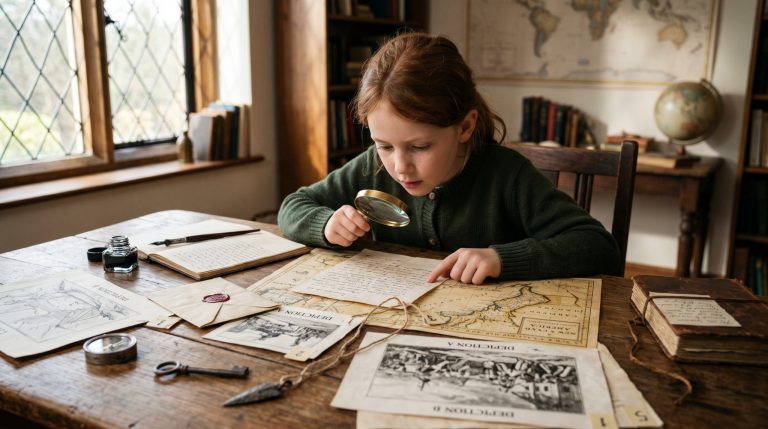
This article brings the whole series together: durable history depends on encoding, retrieval, consolidation, and revisitation working as a cycle. Spot the Anachronism is useful precisely because it touches all four. Studying a Roman scene together encodes detail through active thinking. Asking your child what’s wrong and why pulls knowledge back through retrieval. Returning to the scene days later gives consolidation and revisitation their turn. Because it’s a practice you can repeat with new images over months, it becomes one of those recurring cycles this article describes — the kind that lets historical understanding accumulate rather than vanish. Make it a habit rather than a one-time activity, and each scene adds to a framework your child keeps building.
This Article Is Part Of A Larger Series
Question: Why doesn’t the information stick? My child forgets everything right after a lesson.
Current article: Article 11 of 11 — Capstone
This article explores one evidence-supported aspect of the larger question. Future articles examine additional research-supported approaches to increasing engagement with history.
Related Facebook Discussions
- Durable history works as a connected system, the way this exercise asks whether every part of a Roman scene belongs to one coherent world.
- History encodes more deeply when it feels human, like noticing how fatigue and effort mark a person’s body.
- A question you can return to across many scenes, like whether a marketplace feels physically contested, is how understanding accumulates instead of fading.