Draw It, Map It, Sketch It
When most parents think about history lessons, they think about reading.
Reading a chapter.
Listening to a narration.
Watching a documentary.
Discussing an event.
Answering questions.
Drawing, on the other hand, is often viewed as something extra.
A reward.
An enrichment activity.
A creative break after the real learning is finished.
But what if that assumption is backward?
What if drawing is not a break from learning?
What if drawing can become part of the learning itself?
Many homeschooling parents have experienced a frustrating pattern.
Their child reads a history lesson.
They seem to understand it.
A few days later, much of it is gone.
The information simply does not stick.
Cognitive science suggests one reason this happens is that history is often presented almost entirely through words.
The child reads words.
Hears words.
Answers questions using words.
Everything enters memory through a single channel.
Drawing changes that.
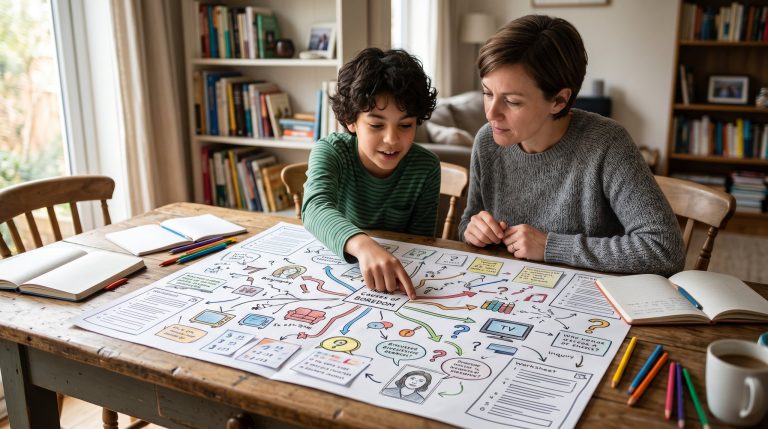
When children create visual representations of historical information, they create additional pathways for understanding and remembering what they have learned.
And that can make history both more engaging and more memorable.
Why Words Alone Often Fail
Throughout this series, we have explored several reasons historical information disappears.
Sometimes children are overloaded.
Sometimes they never retrieve the information again.
Sometimes the material lacks emotional significance.
Sometimes it simply has not had enough time to become durable.
There is another challenge as well.
Words are powerful.
But words are also temporary.
A child can read a description of a Roman forum and gain a basic understanding.
Yet the description may remain abstract.
The information enters the mind but never develops a concrete form.
The child recognizes the words without fully building a mental model of what those words represent.
History contains countless concepts that are difficult to visualize automatically.
Ancient cities.
Trade routes.
Military campaigns.
Political systems.
Social structures.
Geographic relationships.
When these ideas remain verbal, memory often struggles.
The brain has less to work with.
Less to organize.
Less to retrieve later.
That does not mean verbal learning is ineffective.
It means verbal learning sometimes benefits from support.
Visual thinking provides that support.
What Happens When a Child Draws History
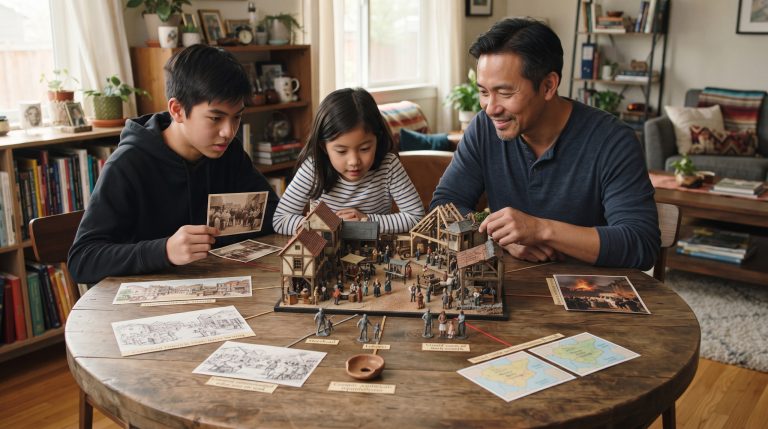
Imagine asking a child to draw a medieval village after reading about daily life in the Middle Ages.
Suddenly something changes.
The child must make decisions.
Where are the houses located?
What does the church look like?
Where are the roads?
How large is the marketplace?
What materials would people use for construction?
The drawing process requires thinking.
Not passive exposure.
Not simple repetition.
Thinking.
The child must reconstruct information from memory.
They must organize ideas.
They must determine which details matter.
They must transform words into images.
That process strengthens learning.
The educational value is not primarily in the finished drawing.
The value lies in the mental work required to create it.
A sketch becomes evidence that the child has begun building an internal model of what they learned.
And internal models are easier to remember than isolated facts.
Seeing History Through More Than One Lens
One reason visual creation helps is that it allows information to exist in more than one form.
Instead of remembering only a verbal description, the learner also remembers an image.
Instead of recalling only a sequence of words, the learner recalls relationships, positions, shapes, and spatial arrangements.
These additional memory cues make retrieval easier.
Think about directions.
Many people find it easier to remember a route when they have both verbal instructions and a map.
The map provides another way to access the same information.
History works similarly.
A student who has drawn a Roman road system may later remember details that would have been difficult to recall from text alone.
The visual representation provides another path back to the memory.
More pathways often mean stronger recall.
Maps, Timelines, and Scene Sketches
When parents hear the word drawing, they sometimes imagine elaborate artwork.
That is not what this article is advocating.
Visual learning can take many forms.
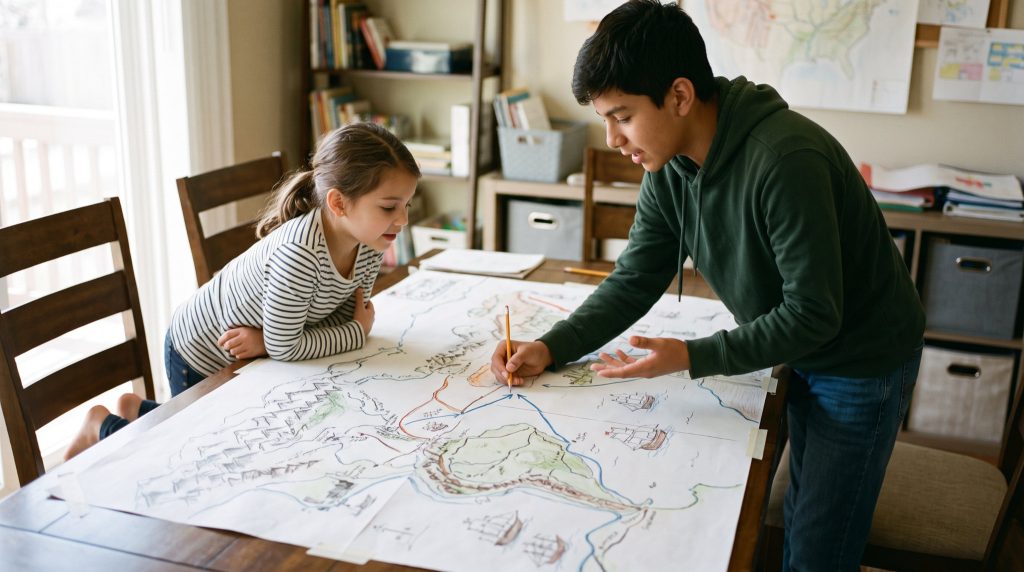
A simple battle map.
A migration route.
A timeline with small illustrations.
A sketch of a Viking longship.
A diagram of a Roman household.
A family tree.
A city layout.
A trade network.
A rough scene from a historical event.
Each of these activities requires learners to think about relationships.
Who was where?
What happened first?
How did one place connect to another?
What details mattered?
These questions strengthen understanding.
And understanding strengthens memory.
The visual representation becomes a tool for organizing knowledge.
Why Artistic Talent Doesn’t Matter
At this point, some parents immediately think:
“My child can’t draw.”
Or perhaps:
“I can’t draw.”
Fortunately, artistic ability is almost completely irrelevant.
The purpose is not producing beautiful artwork.
The purpose is producing thought.
A simple stick figure can support learning.
A rough diagram can support learning.
A crude map can support learning.
The educational benefit comes from deciding what to represent and how to represent it.
Consider a child sketching a Roman legion.
The drawing may be inaccurate in artistic terms.
That is not the point.
The child is thinking about armor.
Weapons.
Formation.
Movement.
Function.
The sketch creates opportunities for reflection that passive reading often does not.
Visual learning is about cognitive processing, not artistic performance.
Turning History into Something Visible
One reason children often find history boring is that history can feel invisible.
The people are gone.
The places are distant.
The events happened long ago.
Everything exists only in words.
Visual creation changes that experience.
History begins to take shape.
A medieval town becomes a place rather than a paragraph.
A migration route becomes a journey rather than a sentence.
A battlefield becomes a physical environment rather than a name in a textbook.
The child moves from consuming information to constructing understanding.
That shift frequently increases engagement.
Children who seem uninterested during reading sometimes become deeply invested when asked to build, sketch, map, or illustrate.
Not because they suddenly love art.
Because they are actively participating in the learning process.
Visual Creation Encourages Observation
Another benefit is that drawing teaches children to notice details.
Suppose a child sketches a Roman marketplace.
Suddenly they begin asking questions.
What kinds of clothing would people wear?
How were goods transported?
What buildings surrounded the market?
What tools might merchants have used?
These observations emerge naturally because visual representation demands attention.
Children start looking more carefully.
And careful observation is an important historical skill.
Many of the strongest history learners are excellent observers.
They notice patterns.
They notice relationships.
They notice details others overlook.
Visual activities help develop that habit.
Practical Ways to Use Visual Learning
The encouraging news is that visual encoding requires very little preparation.
After reading a lesson, ask:
“What would this have looked like?”
Instead of assigning another worksheet, invite your child to sketch the scene.
Create simple illustrated timelines.
Map historical journeys.
Draw household layouts.
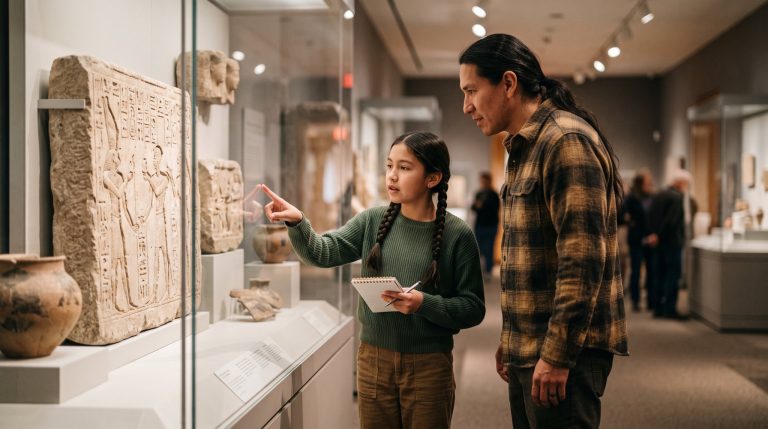
Sketch artifacts.
Build relationship diagrams.
Create labeled character sketches.
Most importantly, ask children to explain their visual work afterward.
Questions such as:
- Why did you draw that?
- Why did you place it there?
- What happened next?
- Which detail seemed most important?
These conversations combine visual learning with retrieval practice, creating even stronger memory opportunities.
Drawings Are Evidence of Thinking
Many parents underestimate visual work because it looks informal.
A completed worksheet appears academic.
A sketch appears playful.
But appearances can be misleading.
A worksheet often measures recognition.
A drawing often requires reconstruction.
A worksheet may reveal whether information was encountered.
A sketch often reveals how information was understood.
The child cannot create a meaningful representation without thinking carefully about the material.
That thinking is where much of the learning occurs.
A Simple Challenge
The next time your child finishes a history lesson, try something different.
Instead of asking for another summary, ask:
“Can you show me what happened?”
Not tell me.
Show me.
Draw it.
Map it.
Sketch it.
Diagram it.
Build it.
Represent it visually in some way.
Then talk about the result.
You may discover that your child remembers far more than you expected.
You may discover that they notice details that never emerged during discussion.
And you may discover that one of the simplest ways to make history more engaging is to make it visible.
Because drawing is not merely an art activity.
It is a form of thinking.
And when children think more deeply about history, they usually remember more of it as well.
Noticing Is a Skill You Can Build
This article makes the case that visual work sharpens observation – when a child sketches a Roman scene, they suddenly start asking what people wore, how goods moved, what surrounded the space. Spot the Anachronism builds that same observational muscle from the other direction. Instead of drawing a scene, you and your child study one closely together and ask what belongs and what doesn’t. Both activities reward the same habit: looking carefully enough to notice details, patterns, and relationships that a quick glance misses. After examining a scene together, try turning it around – ask your child to sketch how they’d fix it, or map out what a truer version would contain. Careful noticing and visual reconstruction reinforce each other, and both make history stick.
This Article Is Part Of A Larger Series
Question: Why doesn’t the information stick? My child forgets everything right after a lesson.
Current article: Article 10 of 11 — Hidden Memory Factors Cluster
This article explores one evidence-supported aspect of the larger question. Future articles examine additional research-supported approaches to increasing engagement with history.
Related Facebook Discussions
- Careful noticing awakens the same questions drawing does, like asking what goods, bodies, and clutter really filled a Roman marketplace.
- The kind of spatial detail you’d have to decide when sketching a room, like how light actually fell across it, is exactly what close observation reveals.
- Noticing how the pieces of a scene relate is the same relationship-mapping a child does when they draw or diagram what they’ve learned.